
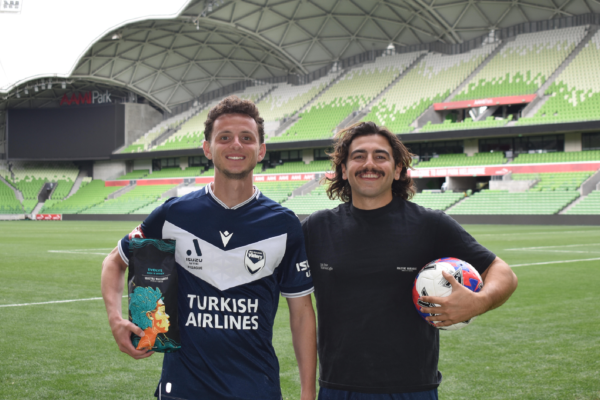

Is grassroots soccer more important than the elite level?

It’s easy to live in the present, to enjoy the moment, the times that you live in. It’s even easier to keep your concentration solely on your priorities in the present. 

But what the great businesses and organisations do differently is what sets them apart from everyone else. Their ability to adapt and look forward to the future, to those who will define their business/organisation when they’re long gone. 

In the case of soccer clubs and the FFA, to keep a sustained and vested interest in grassroots is what is going to hold them in good stead in the next 20-30 years. Planning for the long term, strategically, is critical to the success of anything. 

And it all starts at that level, grassroots. Junior soccer participation numbers are at optimum levels and soccer, as a sport, has never been more popular. The A-League, for all its divisiveness, has grown exponentially and has begun attracting attention from across the world. The NPL, the second division of Australian soccer, has grown in recent years and has risen from the ashes of the NSL. 

Combine this with the fact that the Socceroos haven’t missed a World Cup since 2006, Australian soccer is in a perfect position to capitalise on youth. To motivate them to want to play soccer in the future. To try and turn Australia into a soccer powerhouse. 

It all begins at the grassroots level. Why? First impressions. It’s always about the first impressions, especially with children. The soccer ability of children needs to be nurtured at a young age, in a way that helps develop them as a player, but more importantly as a person. If done successfully and in a way that doesn’t demotivate them, the sky is the limit. 

Take for example, Paris-Saint Germain wonderkid Kylian Mbappe. At 19 years old, he won the FIFA World Cup with France, had played Champions League football, became one of the world’s most expensive players and had comparisons to the great Thierry Henry. How many 19 year old boys can say that they had a net worth of seven plus figures at the same age?  

I certainly can’t say that. And I’m 367 days older than Kylian. But what most likely differentiates him from everyone else is that he had the talent as a junior. That talent was then nurtured correctly, allowing him to unlock his potential as a soccer player. His career would be nothing without the hard work he puts in, obviously. But at a young age, his ability was recognised and then allowed the blossom under the guidance of the right people. 

And sure, meeting Thierry Henry at a young age would’ve motived him to no end. It would motivate anyone, really. But all that motivation would culminate in him understanding how hard he needed to work to get to the top. Nothing comes without hard work, that’s a fact. But through his upbringing, coaching and talent, he has been able to do what very few can. 

On the flip side of all that, we have those who had the talent, but not the work ethic. Casual fans refer to these players as ‘flops’. It’s a very harsh word to use, but they’re on the right track. 

Take Ravel Morrison. I’m sure Manchester United fans know this name all too well. Once described by Rio Ferdinand and Sir Alex Ferguson as the next big thing, Morrison always had the talent. Plus, playing for Manchester United and under Ferguson would’ve been the dream for a young player wanting to make a name for themselves. 

But Morrison, as the soccer world has come to know, didn’t have the desire to work hard. Loaned out more times than we could count, sold off to different clubs, Morrison saw his career go from hero to zero. 

After being sent out on loan by Italian club Lazio to Mexican club Atlas, Morrison decided to permanently move closer to home, signing a contract with Swedish club Ostersunds. But to say it’s a huge fall from grace would be the understatement of the year. And it’s barely March. 

Morrison could’ve been anything. An England great, a United great, a Champions League winner. He had the soccer world at his feet. But he lacked the one thing he needed most to attain all those accolades. 

The desire to work hard. 

And here we are. He’s 26, supposed to be in the prime of his career. Yet, he couldn’t be further from it. And for how much people will say he’s the definition of a ‘flop’, it’s actually quite sad. He would’ve had dreams, wanting to be the next superstar, just like any other young star. But it hasn’t come to fruition. He still has time to turn it around, but we’ve been saying it for so long now, it’s almost like beating a dead horse. One can hope. 

But he does show one thing, if nothing else. The grassroots level is critical to the development of soccer players, mentally and physically. If a player has the talent, it needs to be nurtured. If nurtured properly, it becomes a case of wanting to do the hard yards all day, every day. Some will turn out to be Mbappes, some will turn out to be Morrisons.  

But everything has a beginning. And the beginning is the most integral part of the entire process. 

Previous ArticleNext Article

Football NNSW Releases Infrastructure Strategies as Participation Growth Outpaces Facilities

Northern NSW Football has unveiled bespoke infrastructure strategies for each of its seven member zones, providing an evidence-based roadmap for facility investment across the region as continued participation growth exposes critical gaps in the sporting infrastructure available to support it.

The Member Zone Infrastructure Strategies draw on data across participation rates, population growth and existing facility conditions to map what each zone has, what it needs and where investment will have the greatest impact. Identified gaps include drainage, lighting and inclusive changerooms – the foundational infrastructure that determines whether facilities are functional, safe and accessible year-round.

NNSWF Government Relations Manager Gary Fisher said the strategies represented a significant step toward smarter, more targeted investment across the region.

“By bringing together key data on participation, population growth and existing infrastructure, these strategies give us a stronger understanding of where the needs are greatest and where investment will have the most impact,” Fisher said. “Ultimately we want to create more inclusive and accessible environments for everyone involved in the game while building stronger, more sustainable clubs and communities for the future.”

Northern NSW Football has previously noted that participation across the region is at record levels and still rising, with women’s and girls’ football a significant driver of that growth. Infrastructure that was built for a smaller and less diverse participation base is increasingly unable to meet current demand, let alone accommodate future growth.

The strategies are also designed to strengthen NNSWF’s alignment with government funding priorities, providing the evidence base needed to support grant applications and long-term facility planning across all seven zones.

NSW Football Associations Unite Behind AED Mapping Project for Statewide Safety Network

Twelve football associations across New South Wales have joined a statewide effort to map and register Automated External Defibrillators across sporting facilities, in a project that its organisers say will significantly improve emergency response times and save lives at community sport venues.

The Heartbeat of Sport AED Mapping Project, backed by funding from the Minns Labor Government to the Heartbeat of Football Foundation, represents the first comprehensive research into AED placement across NSW sports grounds. The data collected will be provided to NSW Ambulance and its GoodSAM team to enrich the existing AED registry available to ambulance and public first responders, and will feed into NSW Health’s newly released public AED map.

The project has drawn active participation from associations spanning the breadth of the state’s football community, including Eastern Suburbs, Manly Warringah, Granville, Southern Districts, Nepean, Northern Suburbs, Football Canterbury, Bankstown, Hills, Sutherland Shire, North West Sydney Football and Football South Coast.

When seconds matter

The urgency behind the project is not theoretical. At Doyalson Wyee Football Club, a 70-year-old player survived a sudden on-field cardiac arrest because an AED was available on site. The outcome of that incident – and the many others like it that occur across community sport each year – depends entirely on whether a defibrillator is accessible, charged and registered in the systems that emergency responders rely upon.

Sudden cardiac arrest kills without warning. The survival rate drops by approximately ten percent for every minute without defibrillation. In a community sport setting, where professional medical staff are rarely present, a registered and accessible AED is the difference between a player walking off a pitch and one who does not.

The mapping project addresses a gap that has existed largely unexamined. More than 2,400 defibrillators have been deployed across NSW sports and recreation facilities through the Local Sport Defibrillator Grant Program, with grants of up to $3,000 available to eligible organisations. But a device that exists without being registered in emergency response systems provides significantly less value than one that is accurately mapped and immediately locatable by ambulance crews responding to a call.

By encouraging clubs to complete AED registration surveys, the twelve participating associations are ensuring that the equipment already on their grounds is activated within the broader emergency infrastructure – translating a physical asset into a functional one.

Regional communities and the equity of safety

The project’s expansion of the #HeartHealthMatters Program, which brings CPR and AED familiarisation training to sporting organisations with a particular focus on regional areas, addresses a dimension of safety preparedness that often receives less attention than equipment access alone.

Knowing a defibrillator exists on site is insufficient if the people present during an emergency do not know how to use it. Regional clubs, which frequently operate with smaller volunteer bases and less access to formal training programs, face a compounded risk – less equipment, less training, and longer ambulance response times due to geography. The program’s regional focus acknowledges that safety infrastructure, like sporting infrastructure more broadly, is not evenly distributed.

The data gathered through the mapping project will also guide future investment decisions, identifying facilities that still lack AEDs and providing the evidence base for targeted grant funding to address those gaps.

Football associations that have already contributed AED data have demonstrated, in the words of the project’s organisers, strong sector leadership and a shared commitment to safeguarding participants at every level of the game.

For a sport that involves hundreds of thousands of players, officials and volunteers across the state each week, the ambition of the Heartbeat of Sport project is straightforward – that no preventable death occurs on a football ground because the right equipment was not there, or could not be found.

Most Popular Topics

Editor Picks

Send this to a friend