

Football Australia unveil Domestic Match Calendar for 2022/23

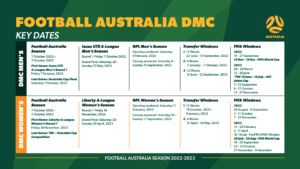
Football Australia has today released the Australian Football Domestic Match Calendar for 2022/23 (DMC 2022/23) which outlines the key dates for elite men’s and women’s football competitions, alongside transfer and registration windows, for the period from 7 October 2022 to 7 October 2023.

Designed and implemented to align the game and harmonise Australia with key international football events and activities, the DMC 2022/23 provides clear windows for matches from the Isuzu UTE A-League Men, Liberty A-League Women, Australia Cup, and National Premier Leagues (NPL) to be played, enabling administrators and teams to progress their planning for Australian football leagues and competitions accordingly.

Having extensively consulted with key stakeholders including Australian Professional Leagues (APL), Football Australia via the DMC 2022/23 has regulated that FIFA international windows for men’s and women’s football will be observed throughout 2022/23, with A-League Men’s and Women’s competitions to pause while the respective Australian senior national teams are in action.

To view the Australian Football Domestic Match Calendar for 2022/23, please click here.

This move will ensure that players selected for national team representation will not miss club matches during the periods in which they are on international duty, supporting an increase in match minutes for the individuals chosen to represent the Socceroos or Commonwealth Bank Matildas.
FA DMC

Football Australia Chief Executive Officer, James Johnson, explained that the DMC 2022/23 is a significant tool for Australian football that will help the game to capitalise on several major milestones over the coming year.

“With the Domestic Match Calendar 2022/23 now finalised, staff at Member Federations, the APL, and Football Australia, as well as clubs within the Australian football ecosystem, can more thoroughly plan their activities for the period from 7 October 2022 and 7 October 2023,” Johnson said via press release.

“There are many major milestones that the game can capitalise on over the next 12-to-18 months, with the tailwinds of Australia’s participation at this year’s FIFA World Cup™ in Qatar, and co-hosting of next year’s FIFA Women’s World Cup™, to help underpin interest in the A-Leagues, NPL competitions, and the Australia Cup.

“With clear windows for match activity now set, we can work collaboratively on maximising the opportunities that exist within player pathways, as well as think and act strategically about the promotion of the sport, ensuring that each area of the game has the best possible opportunity to engage fans, sponsors, and audiences both domestically and internationally.

“Pleasingly, we will see a significant amount of Australia Cup football prior to the commencement of the A-League Men season in early October. This could see our domestically-based Socceroos players being exposed to a good amount of competitive football prior to the FIFA World Cup™ in Qatar.”

“It has taken a collaborative, team effort to finalise the DMC 2022/23, and we acknowledge stakeholders from across the game for contributing to this important piece of work,” Johnson concluded.

Key dates/features of the DMC 2022/23 include:

  • Isuzu UTE A-League Men’s 2022/23 Regular Season to commence from Friday, 7 October 2022, with the 2023 Grand Final to be contested on the weekend of 26-27 May 2023
  • Liberty A-League Women’s 2022/23 Regular Season to commence from Friday, 18 November 2022, with the 2023 Grand Final to be contested on the weekend of 29-30 April 2023
  • Final match of the DMC 2022/23 to feature the 2023 Australia Cup Final on Saturday, 7 October 2023
  • National Premier Leagues 2023 Seasons to commence from Saturday, 4 February 2023 (men’s) and Saturday, 11 February 2023 (women’s) respectively
  • Placeholder between March 2023 and September 2023 included for establishment of new National Second Tier competition (men’s)
  • Player welfare windows included in both men’s and women’s calendars to ensure players can obtain rest/annual leave between seasons/elite football commitments

To view the Australian Football Domestic Match Calendar for 2022/23, please click here.

Previous ArticleNext Article

Socceroos Make Powerful $15K Play to Back Organ Donation Awareness

The Socceroos have reinforced football’s power beyond the pitch with a $15,000 donation to Transplant Australia Football Club (TAFC). The funding will support its 2026 Transplant World Cup campaign while raising awareness for organ and tissue donation.

The contribution, delivered through Professional Footballers Australia’s (PFA) Community Impact Fund, will assist TAFC’s preparations for the upcoming Transplant Football World Cup in Frankfurt. It is also amplifying the organisation’s broader mission to promote the life-saving impact of organ donation.

Presented during a national team training session, the donation reflects a growing commitment from Australia’s elite players to use their platform for meaningful social impact. Creating a connection between the game and causes that resonate far beyond football.

The initiative builds on an ongoing relationship between the Socceroos and TAFC, following a previous player-led contribution in 2024 that supported the team’s participation in the inaugural tournament in Italy.

More than just financial support, the partnership signals a longer-term collaboration aimed at increasing visibility for organ and tissue donation, leveraging the reach of both the national team and the PFA to drive awareness nationwide.

TAFC provides a unique pathway for transplant recipients, donors, and their families to re-engage with sport—offering not only competitive opportunities but a powerful platform to share stories of resilience, recovery, and second chances.

With the 2026 Transplant Football World Cup on the horizon, the Socceroos’ support will play a crucial role in enabling Australia’s team to compete on the global stage, while championing a message that extends far beyond results: the life-changing impact of donation.

As football continues to grow as both a cultural and social force, initiatives like this highlight the game’s unique ability to unite communities, elevate important causes, and create lasting impact where it matters most.

From Broadcast to Betting: Where Australian Football Sits in a $417 Billion Sports Economy

The global sports industry is now worth an estimated $417 billion, but the headline figure only tells part of the story. Beneath it lies a more significant shift that reveals not just how much money sport generates, but where that money is actually coming from?

Globally, the traditional foundations of football’s business model are being overtaken. Sports betting alone accounts for $133 billion, meaning nearly one in every three dollars in the industry is now driven by wagering rather than watching.

For a sport historically built on attendance, broadcast and sponsorship, this marks a profound transformation.


The Rise of Participation Over Viewership

The fastest-growing segment of the global market, which is valued at $177 billion, is now the “gaming” ecosystem: betting, fantasy sports and video games. What unites these platforms is simple: they turn fans from passive viewers into active participants.

This is the new sports economy. Engagement is no longer confined to the 90 minutes on the pitch. Instead, it is continuous, interactive and, most importantly, monetisable.

For football, the opportunity is enormous. But so too is the risk. As betting becomes the dominant financial driver, the sport must confront difficult questions around integrity, regulation and long-term dependence on gambling-linked revenue.


A Global Boom, A Local Reality

While the global industry surges ahead, Australian football presents a more complex picture.

The A-Leagues’ current broadcast deal, reportedly worth around $200 million over five years, is modest when compared to the $61 billion global media rights market. It highlights the gap between Australia and football’s major commercial powerhouses — it also underscores the importance of maximising every available revenue stream.

At the same time, there are clear signs of growth.

The rise of the Matildas has transformed the commercial landscape, with the national team now widely viewed as a central revenue driver through sponsorship, broadcast and matchday demand. Record-breaking audiences — including 2.73 million viewers nationally for key fixtures — demonstrate football’s expanding cultural footprint.

Streaming, too, is reshaping the game locally. Football viewership on Paramount+ has surged by 138%, while the sport has reached nearly 10 million Australians over a 12-month period. These figures mirror the global trend away from traditional television toward digital platforms.


The Disconnect Between Growth and Revenue

Yet, despite rising audiences and renewed interest, financial stability remains a challenge.

The A-Leagues have faced ongoing pressures — from declining distributions to structural reform — revealing a critical tension at the heart of Australian football:

Attention is growing, but revenue is not keeping pace.

This disconnect reflects a broader structural issue. While global sport is rapidly monetising digital and interactive engagement, Australian football is still heavily reliant on more traditional income streams.


Why the Global Shift Matters

The implications of the global $417 billion market are clear.

The IP monetisation pillar ($154 billion), which encompasses media rights, sponsorship, merchandise and matchday, remains vital. But it is no longer enough on its own.

Meanwhile, broadcasting and streaming ($86 billion) is fragmenting. Pay TV still dominates, but streaming is rising fast, changing not just how fans watch football, but how value is captured.

Above all, the dominance of the gaming segment signals a new reality:

The future of sport lies in participation, not just consumption.


A Defining Moment for Australian Football

For Australian football, the challenge is not simply to grow — it is to align with where the global industry is heading.

That means:

  • Building stronger digital ecosystems
  • Leveraging data and fan engagement tools
  • Exploring new commercial models beyond traditional broadcast deals

Because while the global sports market is projected to reach $602 billion by 2030, that growth will not be evenly distributed.

It will favour the sports and leagues that can successfully integrate into a landscape defined by interactivity, personalisation and constant engagement.


More Than a Game

Football in Australia is not short on momentum. Participation is rising, the Matildas have captured national attention, and audiences are increasingly engaged.

But in a $417 billion global industry, momentum alone is not enough.

The question is no longer whether football can grow.

It is whether it can evolve fast enough to capture its share of where the money is going.

Most Popular Topics

Editor Picks

Send this to a friend