Julie Bishop welcomed by Football Australia as a Legacy ’23 Ambassador

Football Australia have announced that the Hon. Julie Bishop has joined the Legacy ’23 Ambassador Program as its latest representative.

With Australia set to host the FIFA Women’s World Cup Australia & New Zealand 2023, the Legacy ’23 Ambassador Program will play a critical role in raising awareness and advocacy for achieving 50:50 gender participation in sport, as set out in Football Australia’s Legacy ’23 Plan.

During her time as Australia’s first female Minister for Foreign Affairs from 2013-2018, Julie was an advocate for gender equality in this country and throughout the world. Julie is keen to continue that advocacy and to support young women and girls in achieving their full potential.

Julie is currently the Chancellor of the Australian National University. As the first female to ever hold that and other roles, she is a trailblazer for young women and girls around the nation and throughout the Asia-Pacific region. After climbing the ladder of Australian politics, Julie is a passionate advocate for gender equality and keen to support other women in fulfilling their dreams, hopes and aspirations across all fields.

Of her new role as a Legacy ’23 Ambassador, Julie said in a statement via Football Australia:

“It is important to not let others define who you are or limit what you can achieve. It’s vital we encourage the next generation of women and girls to set their own standards and work hard to achieve those standards. Striving for success and excellence is a defining feature of female sports and that is to be encouraged.”

Football Australia CEO James Johnson added of Julie’s appointment via Football Australia:

“We are so proud to welcome the Hon Julie Bishop to our Legacy ’23 Final XI. Through her heralded career in politics, to her recent move into education, Julie embodies all the values we hope to celebrate through Legacy ’23 and is a wonderful role model to help inspire the next generation of women and girls.”

Previously announced ambassadors making up the Final XI include:

  • Julie Dolan AM, Matildas cap #1
  • Azmeena Hussain OAM, Football Victoria Director and social justice advocate
  • Narelda Jacobs, NIAG Member and Channel 10 Presenter
  • Kate Jenkins, Australia’s Sex Discrimination Commissioner
  • Awer Mabil, Socceroo
Previous ArticleNext Article

From Broadcast to Betting: Where Australian Football Sits in a $417 Billion Sports Economy

The global sports industry is now worth an estimated $417 billion, but the headline figure only tells part of the story. Beneath it lies a more significant shift that reveals not just how much money sport generates, but where that money is actually coming from?

Globally, the traditional foundations of football’s business model are being overtaken. Sports betting alone accounts for $133 billion, meaning nearly one in every three dollars in the industry is now driven by wagering rather than watching.

For a sport historically built on attendance, broadcast and sponsorship, this marks a profound transformation.


The Rise of Participation Over Viewership

The fastest-growing segment of the global market, which is valued at $177 billion, is now the “gaming” ecosystem: betting, fantasy sports and video games. What unites these platforms is simple: they turn fans from passive viewers into active participants.

This is the new sports economy. Engagement is no longer confined to the 90 minutes on the pitch. Instead, it is continuous, interactive and, most importantly, monetisable.

For football, the opportunity is enormous. But so too is the risk. As betting becomes the dominant financial driver, the sport must confront difficult questions around integrity, regulation and long-term dependence on gambling-linked revenue.


A Global Boom, A Local Reality

While the global industry surges ahead, Australian football presents a more complex picture.

The A-Leagues’ current broadcast deal, reportedly worth around $200 million over five years, is modest when compared to the $61 billion global media rights market. It highlights the gap between Australia and football’s major commercial powerhouses — it also underscores the importance of maximising every available revenue stream.

At the same time, there are clear signs of growth.

The rise of the Matildas has transformed the commercial landscape, with the national team now widely viewed as a central revenue driver through sponsorship, broadcast and matchday demand. Record-breaking audiences — including 2.73 million viewers nationally for key fixtures — demonstrate football’s expanding cultural footprint.

Streaming, too, is reshaping the game locally. Football viewership on Paramount+ has surged by 138%, while the sport has reached nearly 10 million Australians over a 12-month period. These figures mirror the global trend away from traditional television toward digital platforms.


The Disconnect Between Growth and Revenue

Yet, despite rising audiences and renewed interest, financial stability remains a challenge.

The A-Leagues have faced ongoing pressures — from declining distributions to structural reform — revealing a critical tension at the heart of Australian football:

Attention is growing, but revenue is not keeping pace.

This disconnect reflects a broader structural issue. While global sport is rapidly monetising digital and interactive engagement, Australian football is still heavily reliant on more traditional income streams.


Why the Global Shift Matters

The implications of the global $417 billion market are clear.

The IP monetisation pillar ($154 billion), which encompasses media rights, sponsorship, merchandise and matchday, remains vital. But it is no longer enough on its own.

Meanwhile, broadcasting and streaming ($86 billion) is fragmenting. Pay TV still dominates, but streaming is rising fast, changing not just how fans watch football, but how value is captured.

Above all, the dominance of the gaming segment signals a new reality:

The future of sport lies in participation, not just consumption.


A Defining Moment for Australian Football

For Australian football, the challenge is not simply to grow — it is to align with where the global industry is heading.

That means:

  • Building stronger digital ecosystems
  • Leveraging data and fan engagement tools
  • Exploring new commercial models beyond traditional broadcast deals

Because while the global sports market is projected to reach $602 billion by 2030, that growth will not be evenly distributed.

It will favour the sports and leagues that can successfully integrate into a landscape defined by interactivity, personalisation and constant engagement.


More Than a Game

Football in Australia is not short on momentum. Participation is rising, the Matildas have captured national attention, and audiences are increasingly engaged.

But in a $417 billion global industry, momentum alone is not enough.

The question is no longer whether football can grow.

It is whether it can evolve fast enough to capture its share of where the money is going.

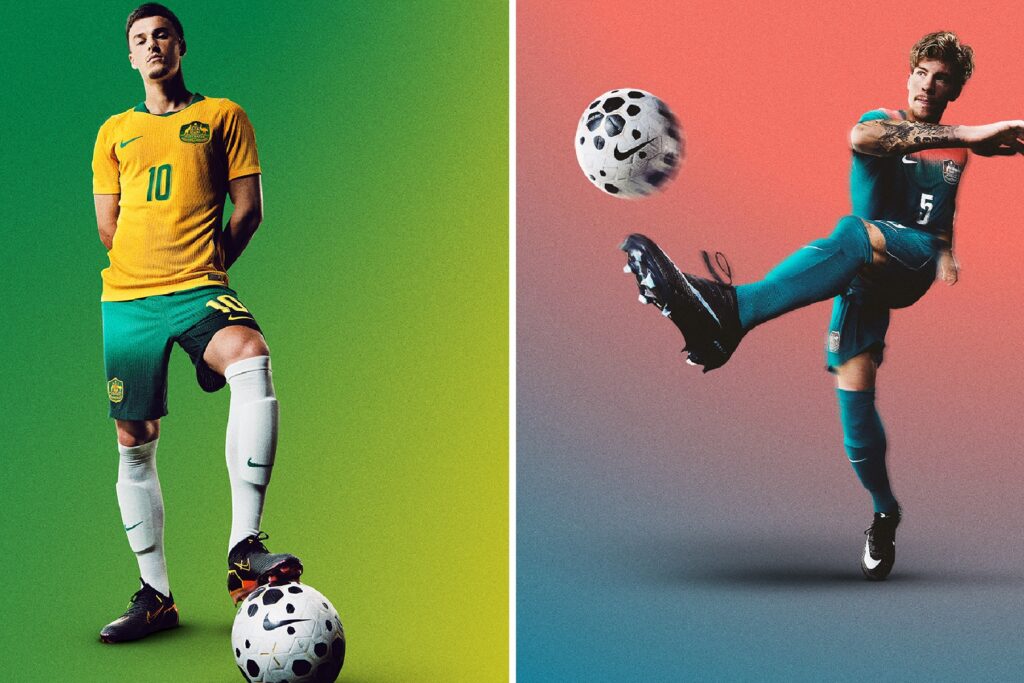
Nike and FA reveal Socceroos kit ahead of 2026 FIFA World Cup

As the lastest collaboration between Football Australia and Nike, the 2026 National Team collection is testament to a partnership spanning over two decades.


New threads, old partners

Built on the balanced principles of heritage, culture and progression, Nike have designed two kits which reflect the very DNA within Australia’s men’s national team.

“The CommBank Socceroos are set to perform on the world stage with a clear intent to compete and succeed against the world’s best, and this new kit reflects that ambition,” said Football Australia CEO, Martin Kugeler, via official press release.

“Socceroo kits become part of Australian football history, forever tied to defining moments and performances and we look forward to seeing the Socceroos represent the country with pride in this jersey on the global stage.”

Honouring the twenty-year partnership with Nike, this year’s kit draws inspiration from the iconic 2006 jersey. The hope, therefore, is that performances on the pitch will mirror this sense of pride, passion and ambition.

Innovation on the biggest stage

Furthermore, football kits represent innovation and ambition. Materials, fit and finer details must all come together in a perfect combination to allow for optimal performance.

The Socceroos collection features Nike’s Aero-FIT performance cooling technology, thus increasing airflow and ensuring players stay cool while playing in high temperatures.

But beyond the inner workings and technology of the kits, a sense of authenticity and intention continue to shine through.

“I really love the new home kit, it has a great traditional feel with the colours and the style and it feels unmistakably Australian,” outlined Nike athlete and Socceroos star, Jordan Bos.

Although kits appear as little more than a squad number and a badge, the international stage demands a jersey which represents something far greater. The World Cup is about national pride, passion and ambition, and Australia’s 2026 kit collection unites all of them.

Most Popular Topics

Editor Picks

Send this to a friend