Inclusion in sports – Why it matters more than anything

In today’s society, flexibility is key.

As a journalist, it’s about being able to fulfill multiple roles such as commentary, writing, reporting, interviewing and so on.

As a soccer player, it’s about being able to play multiple positions when called upon, even if it’s a position you’re not comfortable with.

As an event manager, you need to ensure your patrons have access to your events, even if they are impaired in some way.

Take for example, the Australian Open. A worldwide event that attracts fans from all across the globe. Different types of fans flock to Melbourne Park every year to watch the best players in the world.

However, for some, getting to Melbourne Park and then watching stars like Roger Federer, Rafael Nadal, Novak Djokovic, Serena Williams and many more isn’t as seamless as it may seem.

Physical impairments, in the past, have restricted some fans’ ability to watch world class tennis live. To say it’s a shame puts it lightly, it’s downright unfair. Fans should be able to watch tennis live and enjoy it just like everyone else.

That’s why Tennis Australia acted, as well as Wheelchair Tennis champion and Australian Dylan Alcott. Alcott is the men’s wheelchair first seed and is a modern-day Australian tennis icon.

He is the co-founder of a company called Get Skilled Access which, in accordance with Tennis Australia, has made access to all grounds at Melbourne Park 10 times easier.

All stadiums have lifts that can easily take people up to their seats. All showcourts now have certain entrances that have ramps instead of stairs and designated seats for those with disabilities.

Even getting around Melbourne Park has been made easier with more signs directing those in need to where they specifically need to go.

Now, those with physical impairments can enjoy the tennis just as much as everyone else, which is fantastic and a great reward for effort by TA and especially Alcott.

In saying that, sometimes it’s not a physical impairment that limits the enjoyment of sporting fans.

Deafness and blindness affect millions of people worldwide and as unfair as physical impairments are, being able to listen and/or see is just as unjust.

The ability to hear and to ability to see are things in life we often take for granted. For some, they dream of the ability to one day, be able to see or hear. But now, measures are being taken to ensure that they can still enjoy sport, like everyone else.

As another example, there have been videos making the rounds recently of groups of two people at soccer venues with someone who is unable to see. Between these two people is a mini soccer pitch, most likely made from cardboard. Using the blind person’s hands, they place them at points on the mini soccer pitch and tell them who has the ball and what’s happening.

Combined with the atmosphere of the stadium and its fans, it allows for the blind men and women to still enjoy the game and the memorable moments to its fullest extent. It’s a beautiful thing to see, especially when these videos are taken during important moments of important matches (e.g. Champions League).

It’s more than just great to see these people being able to enjoy sport, but it’s just plain awesome to see people committing themselves to helping those in need. It’s not just a credit to them, it’s life affirming for anyone else.

In conclusion, anyone who is anyone should be able to enjoy sporting events the way anyone else could. Inclusion is the most important thing about sports. Ensuring that everyone is involved, and everyone is treated equally in this respect is critical. It’s all a part of why sport is so loved worldwide. It brings people together but most importantly, it brings the best out of people, on and off the field.

Previous ArticleNext Article

Football SA Commits $100,000 to Referee Fuel Subsidy as Cost-of-Living pressure Mounts

Football South Australia has announced a fuel subsidy scheme for match officials across its semi-professional competitions, allocating up to $100,000 for the remainder of the 2026 season in response to rising fuel costs that the governing body says are threatening the delivery of fixtures across the state.

The subsidy, effective immediately, covers referees officiating across the RAA National Premier League, Apex Steel Women’s National Premier League, Apex Steel Women’s State League, HPG Homes State League 1 and State League 2. The subsidy spans senior, reserves and under-18 competitions across both men’s and women’s football.

Under the metro scheme, reimbursements will be tiered against the average Adelaide unleaded petrol price recorded each Friday, applying to all matches played in the following seven-day period. Officials will receive $30 per match day when the average price sits at $3.25 or above, $25 between $2.75 and $3.24, and $20 between $2.35 and $2.74. No subsidy applies below $2.34. For regional matches, referees travelling to Port Pirie, Barossa and Whyalla will see their per-kilometre reimbursement rise from 88 cents to $1.26 when petrol prices exceed $2.35.

All subsidy payments will be funded directly by Football SA, with no cost passed to competing clubs.

The Economics behind the Whistle

Fuel prices in South Australia, as across much of Australia, have been running at elevated levels against the backdrop of an ongoing imperialist war on Iran that has sent shockwaves through global oil markets. Iran’s targeting of the Strait of Hormuz, through which a significant proportion of the world’s oil supply passes, has disrupted shipping and contributed to price surges that are being felt at service stations in Adelaide as acutely as anywhere.

For match officials, who are overwhelmingly volunteers or low-paid part-time workers travelling to multiple venues across a season, those price surges are not an abstraction. They are a direct financial disincentive to take on appointments, particularly in outer metropolitan and regional areas where travel distances are significant and the cost of attending a game can approach, or exceed the payment for officiating it.

The consequences are cancelled fixtures, forfeited points, disrupted seasons and players who stop turning up to clubs that cannot guarantee them a game.

“This initiative recognises the critical role match officials play in delivering competitions,” CEO Michael Carter said in the announcement, “and aims to reduce the impact of travel costs across the 2026 season.”

A Structural Problem, a Seasonal Solution

The subsidy applies only to the 2026 season. Football SA has been careful to frame it as a response to current conditions rather than a permanent structural change. The $100,000 allocation is described as subject to fuel prices remaining at current levels, with the final amount invested likely to vary as the weekly threshold calculations play out across the season.

That framing is honest about what the scheme is and isn’t. It does not resolve the underlying question of whether referee payments in community and semi-professional football are adequate relative to the demands placed on officials. It remains a question that transcends the current fuel price environment and will outlast it. What it does is buy time and goodwill in a moment when both are in short supply.

Sport, and football in particular, depends on a volunteer and semi-volunteer workforce that is increasingly being squeezed by the same cost-of-living pressures affecting every other part of Australian life. When the price of petrol rises, the people who feel it first are not the players or the clubs, it’s the officials, the committee members and the volunteers who make the infrastructure of community sport function.

Football SA’s decision to absorb that cost rather than pass it to clubs is a recognition that the referee pipeline is fragile in ways that are not always visible until it breaks. The SAPA review into South Australian football, released earlier this month, identified referee development and retention as one of the most pressing structural challenges facing the game in the state, recommending greater investment in recruitment and suggesting affiliation fee subsidies for clubs that bring new officials into the system.

Friday’s announcement does not go that far. But in a season already defined by uncertain economic and geopolitical circumstance, the levy sends a clear enough signal about where Football SA’s priorities lie.

The fuel levy will be calculated each Friday using average Adelaide prices listed on Fuel Price Australia, with payments made to officials on the regular weekly schedule.

AFC Women’s Asian Cup: How do we sustain growth and success?

This year’s AFC Women’s Asian Cup 2026 was not just another tournament. It was a momentum shift for women’s football in Australia. Match quality, crowd numbers and national pride have never been higher – but how do we ensure this success continues after the final whistle?

Financial input and output

Ahead of the tournament, the Australian Government demonstrated their support and commitment through a $15 million investment.

With such significant financial backing behind the Matildas’ pursuit of victory on home soil, the tournament seemed poised to be hugely successful – and it didn’t disappoint.

Projections point towards an overall revenue of over $250 million, with over 24,000 international visitors and 1000 jobs created. It proves that when money is invested into the women’s game, the rewards on and off the pitch are undeniable.

Federal Minister for Sport, Anika Wells, was present at the official announcement of the Australian Government’s funding boost.

“The Tillies and the 2023 Women’s World Cup redefined Australian sport and now the Albanese Government is backing the Matildas again with a $15 million investment for the Women’s Asian Cup,” said Wells.

“Women’s sport is not nice to have or a phase, it is brilliant, nation-stopping, and here to stay.”

With huge revenue numbers and contributions to local economies, this year’s AFC Women’s Asian Cup has demonstrated the financial power and potential of the Matildas, and ultimately of women’s football across Australia.

Attendance numbers skyrocket

Beyond finances, however, the standout factor throughout the tournament was the record-breaking crowd sizes.

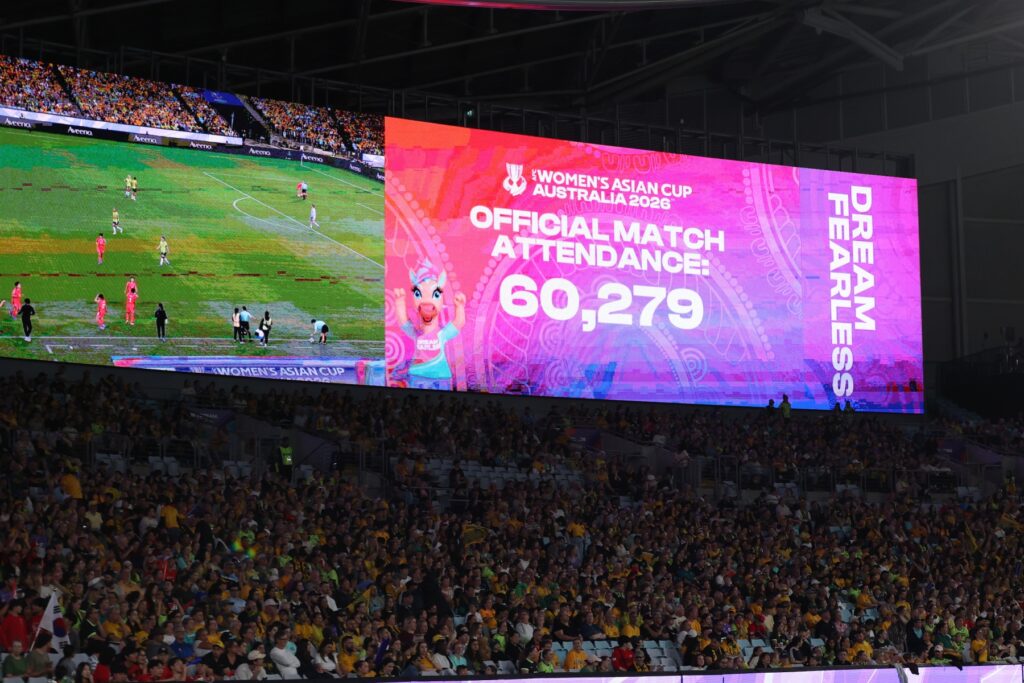
60,279 fans packed into Stadium Australia in Sydney to witness an entertaining 3-3 draw between the Matildas and South Korea, a huge number which was later smashed by Saturday’s final attendance of 74,397.

However, support wasn’t exclusive to the Matildas. At Japan’s semi-final demolition of South Korea, a 17,367 crowd set a record for the highest attendance at a Women’s Asian Cup match between two visiting teams.

Although skeptics will highlight that many games failed to sell out, the crowds attracted during this year’s tournament highlight two decades of immense growth. In 2006, the final brought in little more than 5000 people.

In fact, with 250,000 attendees over three weeks, and ticket sales increasing five-fold from the previous record, the proof of a nationwide buzz is there for all to see.

But creating a buzz is not enough. We must act on it, and sustain it, if we want to see true, long-term development.


Avoiding past mistakes

Following the excitement of the 2023 FIFA Women’s World Cup, women’s football in Australia looked set to launch into a new era of development and expansion.

Although female participation increased in New South Wales by 31% between 2022 and 2025, attendance numbers at ALW matches fell by 26% between the 2023-24 and 2024-25 seasons. The ‘buzz’ – without genuine commitment or backing to sustain it – wore off far too quickly.

This year’s AFC Women’s Asian Cup was a second chance for Australia’s football industry to correct its past mistakes, and ensure that state federations, governments and teams align in their commitment to growing the ALW and women’s football as a whole.

Furthermore, given the on-pitch prowess and off-pitch success over the past few weeks, the Asian Cup could play a major role going forward. It may yet be the catalyst, the long-awaited springboard that can propel women’s football to new heights in years to come, both on the international stage and within Australia.


How do we prolong the buzz?

So, while the success of the Asian Cup can encourage important discussions, the key is to inspire stakeholders and decision makers into taking real action.

On Saturday, Football Australia expressed their commitment to progressing the women’s game in NSW after the tournament ends. Joined by Football NSW and Northern NSW Football, they called upon the NSW government to address facility imbalances over the next decade.

“The growth of women’s football in New South Wales is not a short-term trend – it represents a fundamental shift in participation and expectation across our communities. To sustain this momentum, we must invest in infrastructure that is inclusive, accessible and fit for purpose, ensuring everyone has the opportunity to play, develop and thrive in the game,” said Football NSW CEO, John Tsatsimas.

“We call on the government to invest in the largest participation sport in NSW to bridge the growing facilities gap in NSW which will deliver economic and social long-term benefits through connected communities.”

To this end, a proposed NSW AFC Women’s Asian Cup Australia 2026 Legacy Fund – worth $343 million over a ten-year period – would address several issues at grassroots level. These include:

  • Delivering upgraded community facilities to accommodate growing participation numbers among women and girls
  • Improving accessibility, safety and playing capacity across metro, regional and remote communities
  • Supporting multi-use and multi-sport facilities
  • Strengthening pathways for women and girls across all age groups
  • Continuing the legacy of the AFC Women’s Asian Cup 2026

Should this fund be implemented in NSW over the next ten years, fans and players within the women’s game will be at the heart of a major, long-overdue realignment.

Final thoughts

Despite the bitter disappointment of losing in the final on home soil, there is nevertheless an important reminder to take away: we can’t control results on the field, but we can control intent, attitude and commitment off it.

The AFC Women’s Asian Cup 2026 was a huge success for women’s football in Australia. Matches were of extremely high quality, crowd numbers smashed tournament records, and the nation was united in their support for one of Australia’s most popular sporting outfits.

There may not be silverware to show for it, but the past few weeks have provided something far greater: recognition, respect and a platform to continue growing long after the final whistle. The demand is undeniable, participation and interest is soaring, and the voice of the women’s game can no longer be ignored.

Most Popular Topics

Editor Picks

Send this to a friend