
How the use of statistics in modern football is changing the game

For so long, we’ve seen managers and clubs take on players with little more than a hunch. Or because they see something that the majority don’t see.

It hasn’t always been the most successful method of business for clubs across the world, but there are always some diamonds in the rough. You don’t need to look too deeply, either.

Ballon D’or winner and World Cup finalist Luka Modric is a great example. As a child, Modric grew up during the Croatian Independence War. A far cry from the high-grade youth academies we see at any number of top-flight clubs today.

After being rejected by his childhood club, Hadjuk Split, Dinamo Zagreb took a chance on the then 16-year old, signing him. He was loaned out numerous times before turning into Zagreb’s shining light.

He eventually would sign for high-profile Premier League club Tottenham. After a successful stint in North London, he made the dream transfer to Los Blancos, Real Madrid.

The rest speaks for itself.

Four Champions League trophies, a league title, three domestic cup titles, three UEFA Super Cup triumphs and three FIFA Club World Cup victories.

Luka Modric will forever live on as a footballing legend.

Mario Balotelli is another great example. A footballer who has always had an attitude, the Italian striker originally trialled at Barcelona as a junior. However, he was never signed up by the Blaugrana for that very reason. Attitude.

However, Manchester City took a chance on him, recognising his talents. They believed that if they could harness that talent and help him drop the arrogant tag, he could help them win trophies.

Now, we know they were right. Before ‘Aguerooooooooo’, there was ‘Balotelli’. His influence in that play justified the chance Roberto Mancini and City took on him, regardless of anything else.

His City career may have been short-lived, but he repaid the faith and in turn, became a Manchester City legend.

Now in saying all of this, there are some footballers who have failed to repay their managers, fans and clubs. These are the times when perhaps, those who take the chance on these players when no one else will, should’ve listened to the majority.

Ravel Morrison sticks out like a sore thumb on a list of high-potential players that never fulfilled their destiny. Once touted by Sir Alex Ferguson as ‘the best he had ever seen’, Morrison’s career went downhill quicker than you could snap your fingers.

A once promising English football talent, Morrison now plays for Swedish club Ostersunds and with full respect to the Swedish leagues, it’s a far stretch from where he could’ve been.

Juan Manuel Iturbe, once dubbed ‘the next Messi’, was another immensely talented youngster who had the world at his feet at a club like AS Roma back in 2014.

But a slow start in the nation’s capital saw him out of favour and soon, out of the club. After several loan spells at AFC Bournemouth, Torino and Club Tijuana, Iturbe now represents UNAM in the Mexican league.

25 years old and no longer playing in Europe, it appears he may never get another chance.

All this can confirm one thing.

We never know just how high a player’s ceiling is. We can listen to all the talk, read all the hype. But at the end of the day, we never truly know until they get out on the park and on the big stage.

Which is why the use of statistics in player recruitment has become such a worldwide phenomenon amongst football clubs, especially in the age of technology.

There was always research done when clubs looked to sign players, but that’s child’s play compared to the amount that professional clubs do nowadays.

There’s no stone unturned. No book unopened. No margin for error.

Clubs get one chance to do it right and if they get it wrong, it’s disastrous. But when done correctly, it can be a masterstroke.

Davy Klaassen was signed by Everton prior to the 2017/2018 Premier League season. Despite a lot of hype behind a player supposed to be in his prime, Klaassen failed to cut it, managing less than 500 minutes in both Everton’s league and Europa League campaigns.

Klaassen, an attacking-minded midfielder, averaged at least one shot per game for Ajax in their Eredivisie and Champions League matches across five seasons. He was involved in 21 goals from 30 appearances during the 2015/16 league season. Then, the season before he joined the Toffees, he was involved in 23 goals from 33 appearances.

He was named the Dutch footballer of the year in 2016.

But when he joined Everton, he averaged a mere 0.3 shots on goal during his time in Merseyside with no goals or assists to his name, either. That’s for the Premier League and Europa League.

So why didn’t he work at Everton?

We may never know, but we can only assume that his playstyle wasn’t suited to that of the Premier League. He may not have been a physically or mentally prepared as he should’ve been.

Now at Werder Bremen in the German Bundesliga, he has a second chance to show that he can cut it in Europe. But it seems to be a long road back.

It is possible, as players such as Mohamed Salah and Kevin De Bruyne have proven. Once cast aside by Premier League clubs, they worked hard and earned another shot in England.

Now, they are two of the best players in world football.

As an example of a player who has been able to prove his worth in what is regarded as ‘the toughest league in the world’, let’s take a quick look at Gabonese striker Pierre-Emerick Aubameyang.

The Arsenal talisman was a proven goal-scorer at Borussia Dortmund, scoring nearly 100 goals during his 150 appearances at Die Borussen. He was also prolific during his tenure at Saint-Etienne, prior to Dortmund.

He averaged one scoring involvement per game in his last full season for Dortmund and was on track to repeat those efforts the following season. Before Arsenal snapped him up in the winter transfer period.

Also bear in mind that Aubameyang had also performed strongly in the Champions League prior to his move to North London, scoring 15 goals from 25 appearances.

He has repaid Arsene Wenger’s faith and also that of new coach Unai Emery at the Emirates, scoring 32 goals from 50 games. A remarkable record for someone so new to the Premier League.

Aubameyang is clearly a player who is well suited to the physical and fast-paced nature of the Premier League, something Davy Klaassen was perhaps not.

In conclusion, the use of statistics can go a long way to helping clubs sign up players who will become icons. But in some instances, it’s that something special that someone sees that determines a player’s success.

But one thing’s for certain.

The age of technology and the use of statistics has changed the way we and football clubs see professional footballers.

Previous ArticleNext Article

Football SA Commits $100,000 to Referee Fuel Subsidy as Cost-of-Living pressure Mounts

Football South Australia has announced a fuel subsidy scheme for match officials across its semi-professional competitions, allocating up to $100,000 for the remainder of the 2026 season in response to rising fuel costs that the governing body says are threatening the delivery of fixtures across the state.

The subsidy, effective immediately, covers referees officiating across the RAA National Premier League, Apex Steel Women’s National Premier League, Apex Steel Women’s State League, HPG Homes State League 1 and State League 2. The subsidy spans senior, reserves and under-18 competitions across both men’s and women’s football.

Under the metro scheme, reimbursements will be tiered against the average Adelaide unleaded petrol price recorded each Friday, applying to all matches played in the following seven-day period. Officials will receive $30 per match day when the average price sits at $3.25 or above, $25 between $2.75 and $3.24, and $20 between $2.35 and $2.74. No subsidy applies below $2.34. For regional matches, referees travelling to Port Pirie, Barossa and Whyalla will see their per-kilometre reimbursement rise from 88 cents to $1.26 when petrol prices exceed $2.35.

All subsidy payments will be funded directly by Football SA, with no cost passed to competing clubs.

The Economics behind the Whistle

Fuel prices in South Australia, as across much of Australia, have been running at elevated levels against the backdrop of an ongoing imperialist war on Iran that has sent shockwaves through global oil markets. Iran’s targeting of the Strait of Hormuz, through which a significant proportion of the world’s oil supply passes, has disrupted shipping and contributed to price surges that are being felt at service stations in Adelaide as acutely as anywhere.

For match officials, who are overwhelmingly volunteers or low-paid part-time workers travelling to multiple venues across a season, those price surges are not an abstraction. They are a direct financial disincentive to take on appointments, particularly in outer metropolitan and regional areas where travel distances are significant and the cost of attending a game can approach, or exceed the payment for officiating it.

The consequences are cancelled fixtures, forfeited points, disrupted seasons and players who stop turning up to clubs that cannot guarantee them a game.

“This initiative recognises the critical role match officials play in delivering competitions,” CEO Michael Carter said in the announcement, “and aims to reduce the impact of travel costs across the 2026 season.”

A Structural Problem, a Seasonal Solution

The subsidy applies only to the 2026 season. Football SA has been careful to frame it as a response to current conditions rather than a permanent structural change. The $100,000 allocation is described as subject to fuel prices remaining at current levels, with the final amount invested likely to vary as the weekly threshold calculations play out across the season.

That framing is honest about what the scheme is and isn’t. It does not resolve the underlying question of whether referee payments in community and semi-professional football are adequate relative to the demands placed on officials. It remains a question that transcends the current fuel price environment and will outlast it. What it does is buy time and goodwill in a moment when both are in short supply.

Sport, and football in particular, depends on a volunteer and semi-volunteer workforce that is increasingly being squeezed by the same cost-of-living pressures affecting every other part of Australian life. When the price of petrol rises, the people who feel it first are not the players or the clubs, it’s the officials, the committee members and the volunteers who make the infrastructure of community sport function.

Football SA’s decision to absorb that cost rather than pass it to clubs is a recognition that the referee pipeline is fragile in ways that are not always visible until it breaks. The SAPA review into South Australian football, released earlier this month, identified referee development and retention as one of the most pressing structural challenges facing the game in the state, recommending greater investment in recruitment and suggesting affiliation fee subsidies for clubs that bring new officials into the system.

Friday’s announcement does not go that far. But in a season already defined by uncertain economic and geopolitical circumstance, the levy sends a clear enough signal about where Football SA’s priorities lie.

The fuel levy will be calculated each Friday using average Adelaide prices listed on Fuel Price Australia, with payments made to officials on the regular weekly schedule.

AFC Women’s Asian Cup: How do we sustain growth and success?

This year’s AFC Women’s Asian Cup 2026 was not just another tournament. It was a momentum shift for women’s football in Australia. Match quality, crowd numbers and national pride have never been higher – but how do we ensure this success continues after the final whistle?

Financial input and output

Ahead of the tournament, the Australian Government demonstrated their support and commitment through a $15 million investment.

With such significant financial backing behind the Matildas’ pursuit of victory on home soil, the tournament seemed poised to be hugely successful – and it didn’t disappoint.

Projections point towards an overall revenue of over $250 million, with over 24,000 international visitors and 1000 jobs created. It proves that when money is invested into the women’s game, the rewards on and off the pitch are undeniable.

Federal Minister for Sport, Anika Wells, was present at the official announcement of the Australian Government’s funding boost.

“The Tillies and the 2023 Women’s World Cup redefined Australian sport and now the Albanese Government is backing the Matildas again with a $15 million investment for the Women’s Asian Cup,” said Wells.

“Women’s sport is not nice to have or a phase, it is brilliant, nation-stopping, and here to stay.”

With huge revenue numbers and contributions to local economies, this year’s AFC Women’s Asian Cup has demonstrated the financial power and potential of the Matildas, and ultimately of women’s football across Australia.

Attendance numbers skyrocket

Beyond finances, however, the standout factor throughout the tournament was the record-breaking crowd sizes.

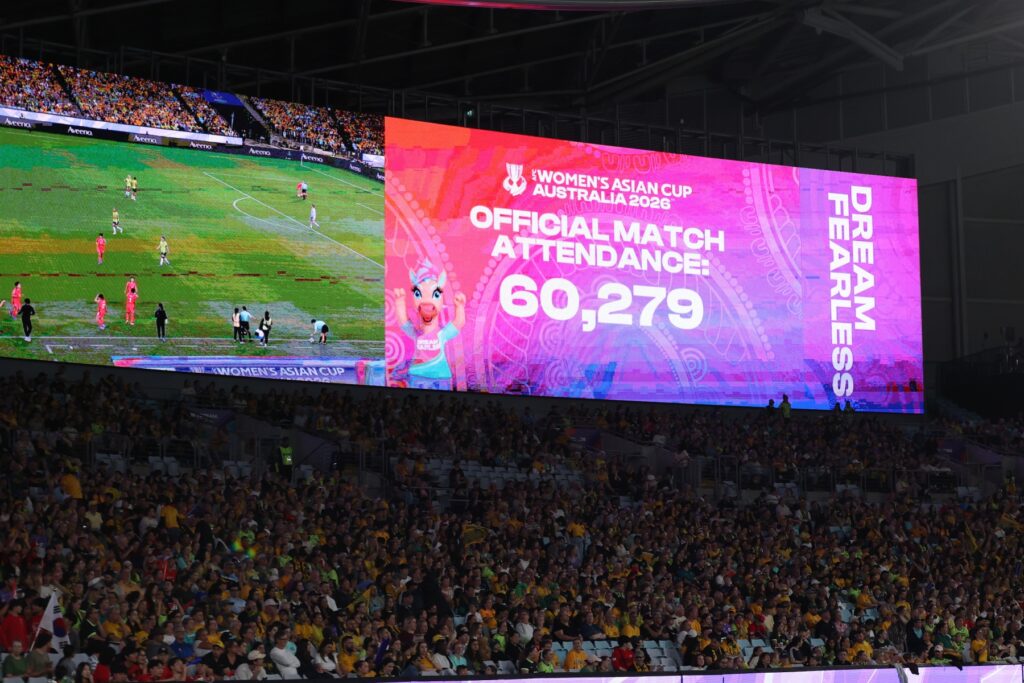
60,279 fans packed into Stadium Australia in Sydney to witness an entertaining 3-3 draw between the Matildas and South Korea, a huge number which was later smashed by Saturday’s final attendance of 74,397.

However, support wasn’t exclusive to the Matildas. At Japan’s semi-final demolition of South Korea, a 17,367 crowd set a record for the highest attendance at a Women’s Asian Cup match between two visiting teams.

Although skeptics will highlight that many games failed to sell out, the crowds attracted during this year’s tournament highlight two decades of immense growth. In 2006, the final brought in little more than 5000 people.

In fact, with 250,000 attendees over three weeks, and ticket sales increasing five-fold from the previous record, the proof of a nationwide buzz is there for all to see.

But creating a buzz is not enough. We must act on it, and sustain it, if we want to see true, long-term development.


Avoiding past mistakes

Following the excitement of the 2023 FIFA Women’s World Cup, women’s football in Australia looked set to launch into a new era of development and expansion.

Although female participation increased in New South Wales by 31% between 2022 and 2025, attendance numbers at ALW matches fell by 26% between the 2023-24 and 2024-25 seasons. The ‘buzz’ – without genuine commitment or backing to sustain it – wore off far too quickly.

This year’s AFC Women’s Asian Cup was a second chance for Australia’s football industry to correct its past mistakes, and ensure that state federations, governments and teams align in their commitment to growing the ALW and women’s football as a whole.

Furthermore, given the on-pitch prowess and off-pitch success over the past few weeks, the Asian Cup could play a major role going forward. It may yet be the catalyst, the long-awaited springboard that can propel women’s football to new heights in years to come, both on the international stage and within Australia.


How do we prolong the buzz?

So, while the success of the Asian Cup can encourage important discussions, the key is to inspire stakeholders and decision makers into taking real action.

On Saturday, Football Australia expressed their commitment to progressing the women’s game in NSW after the tournament ends. Joined by Football NSW and Northern NSW Football, they called upon the NSW government to address facility imbalances over the next decade.

“The growth of women’s football in New South Wales is not a short-term trend – it represents a fundamental shift in participation and expectation across our communities. To sustain this momentum, we must invest in infrastructure that is inclusive, accessible and fit for purpose, ensuring everyone has the opportunity to play, develop and thrive in the game,” said Football NSW CEO, John Tsatsimas.

“We call on the government to invest in the largest participation sport in NSW to bridge the growing facilities gap in NSW which will deliver economic and social long-term benefits through connected communities.”

To this end, a proposed NSW AFC Women’s Asian Cup Australia 2026 Legacy Fund – worth $343 million over a ten-year period – would address several issues at grassroots level. These include:

  • Delivering upgraded community facilities to accommodate growing participation numbers among women and girls
  • Improving accessibility, safety and playing capacity across metro, regional and remote communities
  • Supporting multi-use and multi-sport facilities
  • Strengthening pathways for women and girls across all age groups
  • Continuing the legacy of the AFC Women’s Asian Cup 2026

Should this fund be implemented in NSW over the next ten years, fans and players within the women’s game will be at the heart of a major, long-overdue realignment.

Final thoughts

Despite the bitter disappointment of losing in the final on home soil, there is nevertheless an important reminder to take away: we can’t control results on the field, but we can control intent, attitude and commitment off it.

The AFC Women’s Asian Cup 2026 was a huge success for women’s football in Australia. Matches were of extremely high quality, crowd numbers smashed tournament records, and the nation was united in their support for one of Australia’s most popular sporting outfits.

There may not be silverware to show for it, but the past few weeks have provided something far greater: recognition, respect and a platform to continue growing long after the final whistle. The demand is undeniable, participation and interest is soaring, and the voice of the women’s game can no longer be ignored.

Most Popular Topics

Editor Picks

Send this to a friend