
Australian football has been historically divided, the moment of change is here

NSL

One of the fundamental and historical challenges faced by Australian football has been connectivity.

From as far back as 1880 when Wanderers, the first official Australian football club was birthed in Sydney, the game has struggled to form a unified face.

For near on 100 years, just like Australia’s more traditionally favoured pastimes of cricket, AFL and rugby league, the game existed as a predominately amateur endeavour. As that changed football lacked a cohesive and overarching structure that allowed the game to flourish in the way we still hope it can.

At the core of that division was race, culture and ethnicity. It would be nice to think that we have moved beyond that scenario in the 21st Century, yet the game still struggles to see itself as an all-encompassing beast, as opposed to a collection of individual components.

With post World War II immigration providing the driving force, the beautiful game exploded in Australia during the 1950’s and 60’s. Clubs built around the idea of community support networks became the norm and by the mid 70’s, the demand for a more formalised, organised and national competition had well and truly been born.

The Italian, Maltese, Greek, Yugoslav, Arabic and English communities longed for football to become a more significant part of their lives; just as it had been in their homelands.

That longing and demand was met casually on Saturday afternoons in amateur play before it finally began to take shape as a semi-professional league in the late 1970’s.

Founded in 1977, the National Soccer League gave voice and presence to the world game on Australian shores and as a five-year-old boy at the time, still remains something of a hazy and distant memory.

With a myriad of political issues existing between many of the clubs, some ethnic hostility and clear inter club tensions, division became the norm. So much so that as a little and pasty white Anglo-Saxon kid I was banned from attending NSL matches in the 1980’s.

My father felt I might get hurt and preferred to watch highlight packages of English football than risk life and limb at an NSL match. How wrong he was about so many things, including football.

We should all probably excuse him considering the negative media coverage the game received at the time; racist and inflammatory, the images and copy gave the game little chance to thrive.

Such coverage kept the game well and truly divided from the potential main stream interest of a keen and enthusiastic Australian sporting public. For nearly 30 years, football battled through re-incarnation after re-incarnation; desperately seeking acceptance that was not forthcoming thanks to internal division and external bias.

By the late 1990’s the game was hamstrung. Despite phenomenal growth in junior participation rates, division had led to stagnation. At the eleventh hour, the A-League was born. It was an attempt to bridge the divides, yet one that appears to have had little impact in drawing football together as one and may in fact have widened the chasm between the past and present.

There is no doubt that culture and community can indeed interact with professionalism, modernity and corporate football in Australia. However, the A-League has not proven to be the answer. Finding that answer is key.

Now, after 15 years of A-league play and a strengthening NPL competition that continues to highlight the lessening gap between the two, football may finally be on the cusp of morphing into one entity.

With the FFA Cup showcasing traditional and community based clubs and a newly independent A-league, the domestic game stands at the dawning of a new financial and collaborative football age.

If Perth Glory owner Tony Sage is correct and there is indeed an extra A$80 million to allocate towards the advancement of Australian football, one of the keys will be corporate connectivity. Moreover, a broad vision, driven by people with not just knowledge of football but knowledge of football in Australia and all its foibles, is paramount.

The game stands at a crucial juncture where vision and reality must combine in order to fund and develop the game at all levels. The women’s game requires investment, as do the immensely talented youth leagues from where our next generation will emerge.

Building clear connections between the traditional history of the NPL, women’s football and the now independent top tier is paramount.

The visionary decisions that need to be made require clear, corporate and unbiased minds; capable of picturing the long term future of the game, perhaps at the cost of some short term disappointment.

For decades, the game has been divided, a hodgepodge if you will. The moment has now arrived, where an independent top tier can take the lead and drive change. Change towards true promotion/relegation across the country, a transfer fee system that reflects the realities of world football and a connection to the women’s game that acknowledges the changing face of the sport.

If done well, the corporate interest in the game would increase, with the financial sector excited by a truly united and inter-connected game with immense promise and potential.

Both spiritual and financial connectivity are required. Let’s hope football has the vision to put the right people in place to achieve such a goal.


Previous ArticleNext Article

Weekly update: Latest NPL partnership announcements

Read here for the latest news and updates on NPL partnerships across each state in Australia.

NPL VIC

Preston Lions

Titan Pre-Mix Concrete – Providers of premium concrete solutions and exceptional service for residential, commercial and industrial projects.

Masalkovski Group – A family-owned business specialising in recycling, excavation and landfill services. Since 1974, the team has provided resource recovery and earthmoving.

Allcar Towing Group – A high quality and professional towing service, with a team of dedicated drivers and support staff committed to helping customers involved in accidents.

Chemist Warehouse – Australia’s largest discount pharmacy, committed to providing customers with affordable and accessible healthcare products.

The Butchers Daughter – Family-owned for over 40 years and renowned for supplying high-quality products including kebapi, gyros,cured meats and gourmet sausages.

T.S. Auto Electrics – For over 30 years, TS Auto has provided clients with repairs and an extensive range of services including EFI and CRD engine & Transmission Control Systems, Alternators, Starters and more.

La Monte Tiles – Family-operated with over 100 years of combined experience, La Monte Tiles specialise in premium Italian porcelain, ceramic and natural stone tiles.

Allied Print Australia – A leading print management company, offering an extensive variety of services including design, printing, banners, brochures and promotional products.

KBG Building and Construction – Striving to create sustainable projects across residential, commercial and industrial sites, KBG combine affordability and innovation to ensure their works are made for the long-term.

Heidelberg United 

Alpha Seafoods – Reliable and high quality food service solutions in Victoria since 1991. The team now supplies over 1,500 products to more than 200 customers across Victoria.

Dandenong Thunder

Cameron – Leaders in Melbourne’s South-East commercial and industrial property deals. The team has provided excellent customer service and guidance, backed by over 45 years of experience.

CNC Pro – Melbourne-based carpenters and cabinet specialists, offering services across design and installation for commercial and domestic clients.

NPL NSW

Wollongong Wolves

Buonissimo Cucina – Founded in 2016, Buonissimo has grown from a bakery supplying premium products to supermarkets across Australia and New Zealand, to producing over 100 products including frozen items.

MCR (Multi Civil & Rail) – A leader in rail services, MCR is the largest provider of rail safe working staff in Australia with over 450 clients. They lead the way in the industry for innovation, safety and efficiency.

SD Raiders

Crown Electrical Solutions – Offering an extensive range of services for home automation solutions, Crown Electrical Solutions can help clients achieve their project goals with innovative and dependable technology.

NPL Northern NSW

Cooks Hill United

Aspira Business and Financial Services – Aspira prides itself on building genuine relationhips with clients to ensure long-term and sustainable success for their financial goals. Based in Newcastle and Maitland, they are a business ally for many locals.

The George Darby Hotel – A popular hotel and restaurant setting in Newcastle, the George Darby Hotel offers excellent food options and entertainment nights throughout the week.

Harcourts – Operating since 1888, Harcourts offers a full range of services in the real estate industry, both locally and internationally in the USA, China, Canada and more.

Manning Valley – Since 1989, Manning Valley have only produced free range, quality eggs grown on Australian farms. The team is led by a ‘flock first’ policy and dedication to nurturing the natural environment of the farm.

NPL QLD

Wynnum Wolves

Trace Project Management – Experts in high-quality projects, as well as end-to-end management and advisory services for clients. All projects are delivered with care, precision and professionalism.

Olympic FC

Symferon Wealth – Brisbane-based financial advisory firm with deeply connected roots to Olympic FC and the local area. The team at Symferon are committed to acting always in the best interests of their clients to support financial wellbeing.

NPL WA

Armadale SC 

Aview Windows & Doors – From consultation to installation, Aview deliver premium service across windows and doors. The team is renowned for providing durable and reliable products.

Spinifex Sheds – A local independent shed dealer in Perth since 2010, Spinifex build sheds designed to endure harsh Australian conditions through premium materials and expertise.

Olympic Kingsway

PPC Supplies – An experienced team supplying plasterboard, insulation and building materials. PPC works across Western Australia and South Australia.

Western Knights

Peninsula Personal Injury Lawyers – For over 45 years, PPIL have provided clients with exceptional and transparent service when handling claims. They offer services across vehcile accidents, public liability, workers compensation and more.

Optimus Fleet – Delivering top quality steel fabrication, poly pipe solutions and workforce services for mining, construction and infrastructure projects. Their global partenrships and reputation are built on affordability, innovation and dependable solutions.

Perth Redstar 

Credentia Construction – With more than 60 years of combined experience, Credentia are committed to delivering quality construction projects backed by integrity, trust and an innovative spirit.

Stirling Macedonia

Stirling Central Shopping Centre – A go-to location in Stirling for family and friends to relax, shop and find a huge range of entertainment services.

NPL NT

Casuarina FC

AJ Couriers & Haulage – Providing reliable courier, freight and logistics services, AJ Couriers & Haulage operate with an extensive fleet across the Northern Territory.


AFC Women’s Asian Cup: How do we sustain growth and success?

This year’s AFC Women’s Asian Cup 2026 was not just another tournament. It was a momentum shift for women’s football in Australia. Match quality, crowd numbers and national pride have never been higher – but how do we ensure this success continues after the final whistle?

Financial input and output

Ahead of the tournament, the Australian Government demonstrated their support and commitment through a $15 million investment.

With such significant financial backing behind the Matildas’ pursuit of victory on home soil, the tournament seemed poised to be hugely successful – and it didn’t disappoint.

Projections point towards an overall revenue of over $250 million, with over 24,000 international visitors and 1000 jobs created. It proves that when money is invested into the women’s game, the rewards on and off the pitch are undeniable.

Federal Minister for Sport, Anika Wells, was present at the official announcement of the Australian Government’s funding boost.

“The Tillies and the 2023 Women’s World Cup redefined Australian sport and now the Albanese Government is backing the Matildas again with a $15 million investment for the Women’s Asian Cup,” said Wells.

“Women’s sport is not nice to have or a phase, it is brilliant, nation-stopping, and here to stay.”

With huge revenue numbers and contributions to local economies, this year’s AFC Women’s Asian Cup has demonstrated the financial power and potential of the Matildas, and ultimately of women’s football across Australia.

Attendance numbers skyrocket

Beyond finances, however, the standout factor throughout the tournament was the record-breaking crowd sizes.

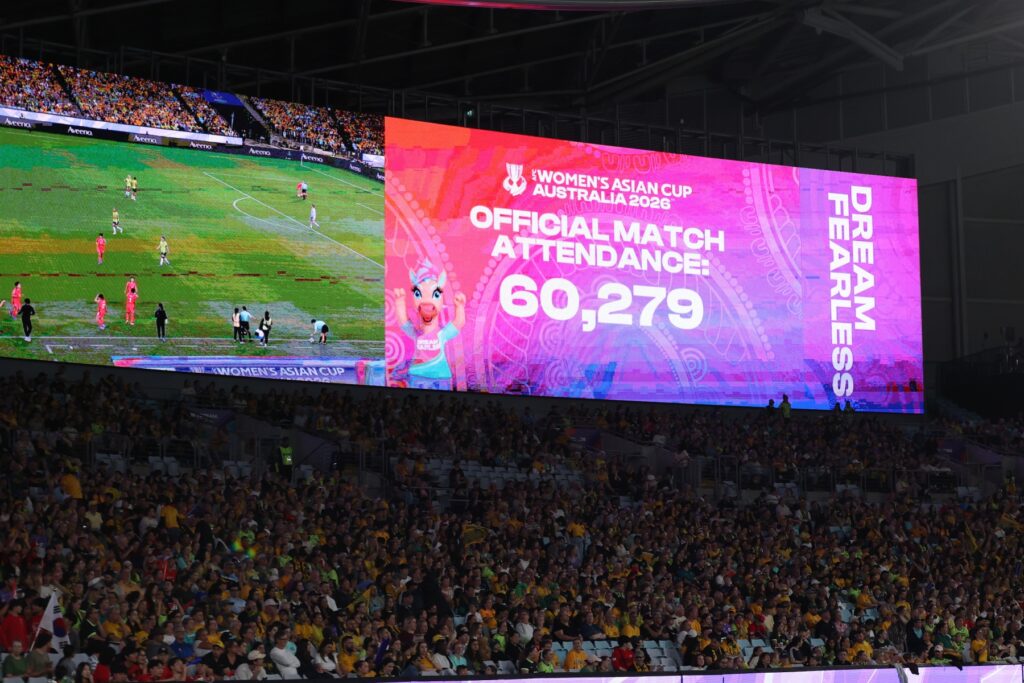
60,279 fans packed into Stadium Australia in Sydney to witness an entertaining 3-3 draw between the Matildas and South Korea, a huge number which was later smashed by Saturday’s final attendance of 74,397.

However, support wasn’t exclusive to the Matildas. At Japan’s semi-final demolition of South Korea, a 17,367 crowd set a record for the highest attendance at a Women’s Asian Cup match between two visiting teams.

Although skeptics will highlight that many games failed to sell out, the crowds attracted during this year’s tournament highlight two decades of immense growth. In 2006, the final brought in little more than 5000 people.

In fact, with 250,000 attendees over three weeks, and ticket sales increasing five-fold from the previous record, the proof of a nationwide buzz is there for all to see.

But creating a buzz is not enough. We must act on it, and sustain it, if we want to see true, long-term development.


Avoiding past mistakes

Following the excitement of the 2023 FIFA Women’s World Cup, women’s football in Australia looked set to launch into a new era of development and expansion.

Although female participation increased in New South Wales by 31% between 2022 and 2025, attendance numbers at ALW matches fell by 26% between the 2023-24 and 2024-25 seasons. The ‘buzz’ – without genuine commitment or backing to sustain it – wore off far too quickly.

This year’s AFC Women’s Asian Cup was a second chance for Australia’s football industry to correct its past mistakes, and ensure that state federations, governments and teams align in their commitment to growing the ALW and women’s football as a whole.

Furthermore, given the on-pitch prowess and off-pitch success over the past few weeks, the Asian Cup could play a major role going forward. It may yet be the catalyst, the long-awaited springboard that can propel women’s football to new heights in years to come, both on the international stage and within Australia.


How do we prolong the buzz?

So, while the success of the Asian Cup can encourage important discussions, the key is to inspire stakeholders and decision makers into taking real action.

On Saturday, Football Australia expressed their commitment to progressing the women’s game in NSW after the tournament ends. Joined by Football NSW and Northern NSW Football, they called upon the NSW government to address facility imbalances over the next decade.

“The growth of women’s football in New South Wales is not a short-term trend – it represents a fundamental shift in participation and expectation across our communities. To sustain this momentum, we must invest in infrastructure that is inclusive, accessible and fit for purpose, ensuring everyone has the opportunity to play, develop and thrive in the game,” said Football NSW CEO, John Tsatsimas.

“We call on the government to invest in the largest participation sport in NSW to bridge the growing facilities gap in NSW which will deliver economic and social long-term benefits through connected communities.”

To this end, a proposed NSW AFC Women’s Asian Cup Australia 2026 Legacy Fund – worth $343 million over a ten-year period – would address several issues at grassroots level. These include:

  • Delivering upgraded community facilities to accommodate growing participation numbers among women and girls
  • Improving accessibility, safety and playing capacity across metro, regional and remote communities
  • Supporting multi-use and multi-sport facilities
  • Strengthening pathways for women and girls across all age groups
  • Continuing the legacy of the AFC Women’s Asian Cup 2026

Should this fund be implemented in NSW over the next ten years, fans and players within the women’s game will be at the heart of a major, long-overdue realignment.

Final thoughts

Despite the bitter disappointment of losing in the final on home soil, there is nevertheless an important reminder to take away: we can’t control results on the field, but we can control intent, attitude and commitment off it.

The AFC Women’s Asian Cup 2026 was a huge success for women’s football in Australia. Matches were of extremely high quality, crowd numbers smashed tournament records, and the nation was united in their support for one of Australia’s most popular sporting outfits.

There may not be silverware to show for it, but the past few weeks have provided something far greater: recognition, respect and a platform to continue growing long after the final whistle. The demand is undeniable, participation and interest is soaring, and the voice of the women’s game can no longer be ignored.

Most Popular Topics

Editor Picks

Send this to a friend