


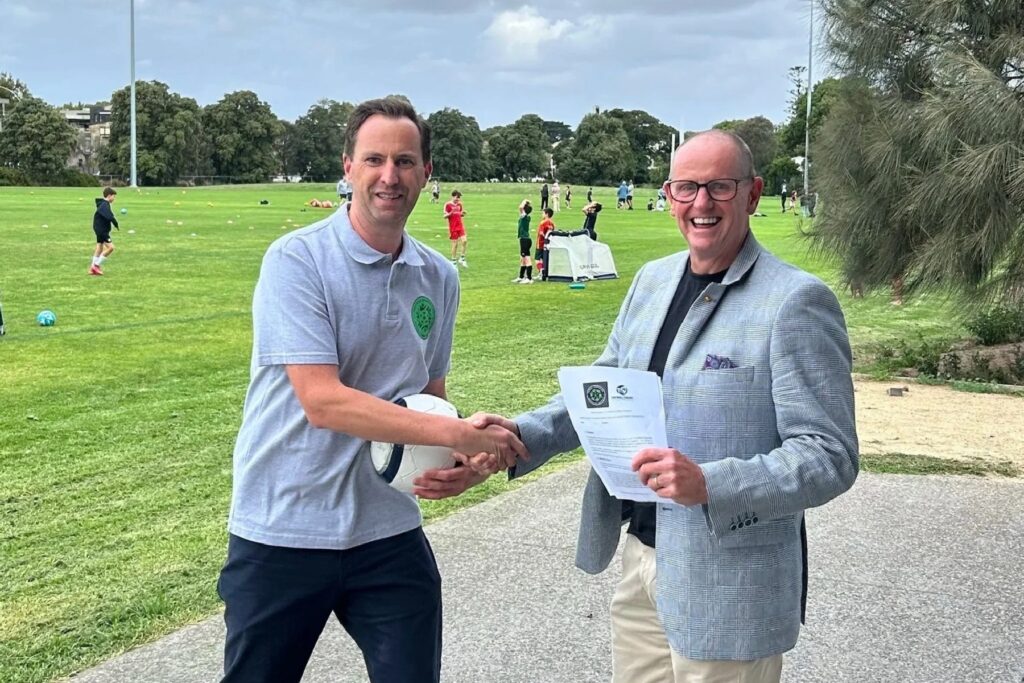
Australian coaches and supporters unite in new partnership

Football Coaches Australia (FCA) and The Football Supporters Association Australia (FSAA) announced the beginning of a new agreement which will see two essential parts of the game brought together.

Terraces and touchlines

The partnership marks an exciting progression for both organisations, and reflects the ambitions of many in Australia’s football industry to continue forming alliances which can help the game grow.

“We’re delighted to announce a formalised partnership with The Football Supporters Association Australia (FSAA) aimed at uniting two of the most vital stakeholder groups in the game: the supporters on the terraces and the coaches on the touchlines,” said FCA via official social media announcement on Wednesday.

“It is desigend to ensure open communication, mutual understanding, and active collaboration through the sharing of ideas and finding solutions to universal issues across the Australian football landscape.”

Ultimately, growth only becomes possible when all stakeholders in the industry unite in vision, commitment and understanding of what the next steps must be. Fortunately, through FCA and FSAA’s shared dedication, several key elements will be addressed, including:

  • Advocacy and voice
  • Engagement and dialogue
  • Education and cultural development
  • Research and projects


United through values and vision

Supporters are the beating heart of the world’s game – whether at grassroots level or on the international stage. Thus, FSAA’s work is a pivotal part of Australia’s football landscape.

“We want all organisations to understand the importance and needs of football supporters,” outlined FSAA Chair, Patrick Clancy, via media release.

“Football coaches around our nation clearly recognise the vital support of fans and the value they can provide to players and success of clubs. FSAA’s new partnership will be one of mutual benefit, helping to grow both organisations.”

Furthermore, the partnership highlights how two organisations – representing two distinct groups of people within the game – can still share common values and ambitions to ensure success.

“This partnership reflects our belief that meaningful progress happens when every part of the football ecosystem works together,” said FCA President, Gary Cole, via media release.

“By joining forces with FSAA, we’re strengthening the foundations of our game and ensuring that respect, connection and community remain at the heart of Australian football.”

Final thoughts

At a time when much of the Australian football landscape is divided and criticsed, partnerships such as this become more valuable than ever. Now is the time for building bridges in the industry, not burning them.

Coaches and supporters, while divided by advertising boards and match stewards, will now be more united than ever by the combined efforts of FCA and the FSAA.

Previous ArticleNext Article

Northern NSW Football opens registrations for Female Football Week 2026

Northern NSW Football has opened registrations for Female Football Week 2026, inviting clubs, players, coaches, referees and administrators across the region to take part in a national celebration of women’s football running from Friday May 8 to Sunday May 17.

Now in its latest edition, Female Football Week provides a structured opportunity for the football community to acknowledge the contributions of women and girls to the game at every level, from grassroots volunteers to elite competitors. The week sits within a broader national context of record participation growth in women’s football following the AFC Women’s Asian Cup, with northern NSW among the regions experiencing some of the most significant increases in female registrations over recent seasons.

The first 40 clubs to register will receive a club activation pack. Registered clubs will also receive promotional support through the NNSWF website and access to Female Football Week advertising collateral, with activities ranging from panel discussions and workshops to social media campaigns highlighting female participants within their communities.

Award nominations are also open across six categories, Player of the Year, Coach of the Year, Referee of the Year, Volunteer of the Year, Community Champion of the Year and Club of the Year, recognising individuals and clubs making significant contributions to women and girls’ football in northern NSW over the past twelve months.

“Female Football Week is a fantastic chance to highlight the passion and talent of female players, coaches, referees and volunteers across the northern NSW community,” said NNSWF Participation and Women’s Football Officer Serena Carter. “There’s something for everyone with activities and events catering to all levels, from grassroots through to elite competition.”

Stop Complaining, Start Building: Why Proactive Clubs Always Win

It’s a tale as old as time in grassroots sport: your club is stuck in a “time warp” facility, sharing a severely overused pitch with another code, while a club a few suburbs over just scored millions of dollars in council funding.

It is incredibly frustrating. The disparity in local government funding, the draconian facility-sharing arrangements, and the feeling that your sport is constantly fighting an uphill battle in certain heartlands can make committee members want to throw their hands in the air.

But when faced with this reality, your club has a choice. You can go on a rampage of advocacy – bitching, moaning, and focusing on everything the council or state sporting body isn’t doing – or, you can focus on what you can control.

The Post-COVID Divide

Think back to the clubs that emerged from the COVID-19 lockdowns. During that time, every club faced the exact same external restriction: nobody could play.

However, two distinct types of clubs emerged.

The first type went dark. They complained about the government, complained about the lack of support from their Peak Bodies, and disconnected from their members. They took years to recover.

The second type of club stayed connected. They acknowledged the reality but focused entirely on what they could do. They posted backyard drills on TikTok, sent training plans to parents, and kept their community engaged. As soon as restrictions lifted, they were on the front foot, miles ahead of the competition. Same environment, entirely different mindset.

The Circle of Control

In business and in sport, there is a circle of concern (things you care about but can’t change) and a much smaller circle of control (your own thoughts, behaviours, and operations).

If you have signed a 10-year lease on a substandard facility, that is your playing field. You aren’t going to change it tomorrow. So, how can you win given the rules you have?

·  Run a tight ship financially.

·  Pay your rent on time.

·  Communicate brilliantly with your members.

·  Streamline your governance.

Government likes to back a winner. If you spend your time spinning up the flywheels of good marketing, membership growth, and volunteer connection, you build a small business that clearly has its act together. When it comes time to advocate for better facilities, you aren’t just a complaining club—you are a highly successful, proactive community asset that councils will want to support.

Is your club stuck in a cycle of complaining? It’s time to take control of what you can. Contact CPR Group today to find out how our clubMENTOR program and strategic planning services can put your club on the front foot.

Most Popular Topics

Editor Picks

Send this to a friend