
FFA makes clever choice with Gustavsson appointment

Football Federation Australia announced the appointment of Tony Gustavsson on Tuesday night, as head coach of the Matildas for the next four years.

The 47-year-old Swede will take up the role from the beginning of next year, with the chance to lead Australia’s most loved sporting team to World Cup success on home soil in 2023.

Before then he will have to prepare the current crop of Matildas stars for an Olympic campaign in Tokyo next year and an Asian Cup in India in 2022.

It is of little doubt, Gustavsson’s assignment is a very difficult one.

With four major tournaments (the final one being the Paris Olympics in 2024) in four years there will be a pressure to perform, as the FFA continue to prioritise women’s football in this country, to resurrect the overall outlook of the game.

But is he the right person for the job?

Initial impressions are positive, and on paper, the FFA seems to have made an astute appointment.

Gustavsson’s CV is well rounded with a deep knowledge of the women’s game.

His greatest achievements include winning two World Cups in 2015 and 2019, as an assistant to Jill Ellis for the US Women’s National Team (USWNT).

He was lauded as the “brains” behind the success of the USWNT in the subsequent World Cup victories, as his analytical and tactical execution was instrumental to their setup.

The newly-announced head coach of the Matildas also has an Olympic Gold Medal to his name, as an assistant in a USWNT squad led by Pia Sundhage in 2012.

In club coaching, he guided Swedish club Tyresö FF to the 2014 UEFA Women’s Champions League Final where they lost to German side VFL Wolfsburg.

Gustavsson’s extensive experience and familiarity in women’s football, his proven track record of success in major tournaments, alongside his willingness to maximise the potential of the current women’s squad, ticked a lot of boxes for the FFA and the panel charged with filling the vacant Matildas role.

“Having worked closely with some of the best female footballers and coaches in the world and, through his time with the USWNT, Tony has developed an excellent understanding of what it takes to prepare for and perform in the intense, high-expectation environments of major international tournaments,” FFA CEO James Johnson said.

“We believe that in Tony, we have appointed a coach who will not only surpass the benchmarks and criteria we set as an organisation, but the standards that are expected by our players, football community and fans.

“Throughout the process it was evident that Tony is eager to buy in to what we are working to build with the Westfield Matildas – a uniquely Australian team with a strong identity that is recognised as world class.”

While his impressive CV will contribute to the Matildas’ fortunes on the field, in his opening press conference he exuded enthusiasm for the project and presented himself as a passionate, colourful manager which will likely benefit the team off the pitch.

“To balance my passion (for the game and people), I also need to work with what I call ‘love and joy’,” Gustavsson said.

“Passion, love and joy.

“Love in the sense of loving the game, love to work with people, love the people for who they are but see them for who they can become.

“I want to create a culture where we embrace differences and work together every day to get one day better as an individual and as a team. Hopefully, together with the staff – I talked to the staff this morning and said, ‘without the staff, I’m nothing. I need the staff; I need a team behind the team; we need each other’ – and if everyone can bring their piece to the puzzle and we, together, make that puzzle beautiful, I think we can create a culture where everyone feels important and included.”

The question, of course, is how far can the Swede take this team?

He has spoken about having a proactive part in the process of producing the next batch of Matildas and with a governing body eager to invest in women’s football, it is a promising development for the long-term future.

But I’m sure the FFA realises the enormity of the upcoming World Cup in Australia and New Zealand.

It very well may be Australia’s best ever chance to win football’s biggest prize and optimisation for that tournament should be the main priority.

Will Gustavsson be able to deal with the expectation of a nation on his back at the World Cup?

The man himself doesn’t believe that will be an issue.

“I’ve experienced a lot of pressure throughout my career, both on the men’s and women’s side,” he said.

“I’ve been in that pressure cooker and know what it takes to deliver, when it means the most.”

As always, the proof will be in the pudding, but for now there is cautious optimism amongst Australian football circles around the appointment, which is refreshing to say the least.

Previous ArticleNext Article

From Broadcast to Betting: Where Australian Football Sits in a $417 Billion Sports Economy

The global sports industry is now worth an estimated $417 billion, but the headline figure only tells part of the story. Beneath it lies a more significant shift that reveals not just how much money sport generates, but where that money is actually coming from?

Globally, the traditional foundations of football’s business model are being overtaken. Sports betting alone accounts for $133 billion, meaning nearly one in every three dollars in the industry is now driven by wagering rather than watching.

For a sport historically built on attendance, broadcast and sponsorship, this marks a profound transformation.


The Rise of Participation Over Viewership

The fastest-growing segment of the global market, which is valued at $177 billion, is now the “gaming” ecosystem: betting, fantasy sports and video games. What unites these platforms is simple: they turn fans from passive viewers into active participants.

This is the new sports economy. Engagement is no longer confined to the 90 minutes on the pitch. Instead, it is continuous, interactive and, most importantly, monetisable.

For football, the opportunity is enormous. But so too is the risk. As betting becomes the dominant financial driver, the sport must confront difficult questions around integrity, regulation and long-term dependence on gambling-linked revenue.


A Global Boom, A Local Reality

While the global industry surges ahead, Australian football presents a more complex picture.

The A-Leagues’ current broadcast deal, reportedly worth around $200 million over five years, is modest when compared to the $61 billion global media rights market. It highlights the gap between Australia and football’s major commercial powerhouses — it also underscores the importance of maximising every available revenue stream.

At the same time, there are clear signs of growth.

The rise of the Matildas has transformed the commercial landscape, with the national team now widely viewed as a central revenue driver through sponsorship, broadcast and matchday demand. Record-breaking audiences — including 2.73 million viewers nationally for key fixtures — demonstrate football’s expanding cultural footprint.

Streaming, too, is reshaping the game locally. Football viewership on Paramount+ has surged by 138%, while the sport has reached nearly 10 million Australians over a 12-month period. These figures mirror the global trend away from traditional television toward digital platforms.


The Disconnect Between Growth and Revenue

Yet, despite rising audiences and renewed interest, financial stability remains a challenge.

The A-Leagues have faced ongoing pressures — from declining distributions to structural reform — revealing a critical tension at the heart of Australian football:

Attention is growing, but revenue is not keeping pace.

This disconnect reflects a broader structural issue. While global sport is rapidly monetising digital and interactive engagement, Australian football is still heavily reliant on more traditional income streams.


Why the Global Shift Matters

The implications of the global $417 billion market are clear.

The IP monetisation pillar ($154 billion), which encompasses media rights, sponsorship, merchandise and matchday, remains vital. But it is no longer enough on its own.

Meanwhile, broadcasting and streaming ($86 billion) is fragmenting. Pay TV still dominates, but streaming is rising fast, changing not just how fans watch football, but how value is captured.

Above all, the dominance of the gaming segment signals a new reality:

The future of sport lies in participation, not just consumption.


A Defining Moment for Australian Football

For Australian football, the challenge is not simply to grow — it is to align with where the global industry is heading.

That means:

  • Building stronger digital ecosystems
  • Leveraging data and fan engagement tools
  • Exploring new commercial models beyond traditional broadcast deals

Because while the global sports market is projected to reach $602 billion by 2030, that growth will not be evenly distributed.

It will favour the sports and leagues that can successfully integrate into a landscape defined by interactivity, personalisation and constant engagement.


More Than a Game

Football in Australia is not short on momentum. Participation is rising, the Matildas have captured national attention, and audiences are increasingly engaged.

But in a $417 billion global industry, momentum alone is not enough.

The question is no longer whether football can grow.

It is whether it can evolve fast enough to capture its share of where the money is going.

Coles MiniRoos Program Opens Football Pathway for Children aged 4 to 11 across Australia

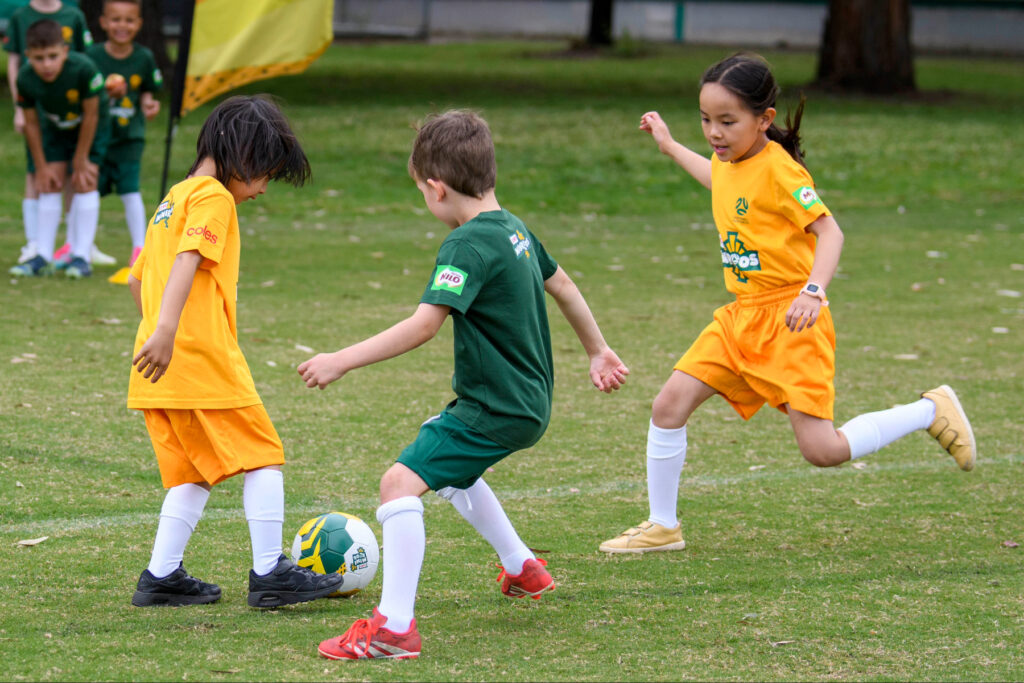
Football Australia’s Coles MiniRoos program is welcoming new participants across the country, offering children aged 4 to 11 a structured and inclusive introduction to football through local clubs and schools.

Now one of Australia’s largest grassroots sporting initiatives, MiniRoos operates across two streams designed to meet children at different stages of their footballing journey. Coles MiniRoos Kick-Off, available to children aged 4 to 11, provides a non-competitive, skills-based entry point for those new to the game, using short game-based sessions of 45 to 60 minutes to build confidence and basic technique. Coles MiniRoos Club Team, open to children aged 5 to 11, moves into small-sided club football- formats of 4v4, 7v7 and 9v9- designed to maximise touches, involvement and opportunity for developing players.

Both programs run for between four and twelve weeks and are delivered by local clubs and schools, keeping participation embedded in the communities where children already live and learn.

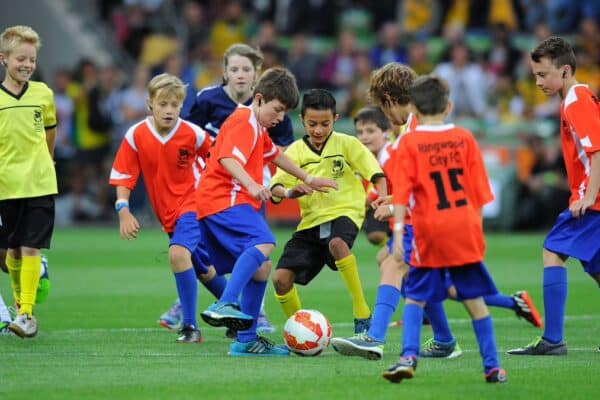
The program’s structure reflects a broader shift in how junior sport is being designed. Small-sided formats give younger players more contact with the ball and more meaningful involvement in each session, addressing one of the most common reasons children disengage from team sport early: the experience of spending more time watching than playing.

The timing carries particular significance. With the AFC Women’s Asian Cup currently underway and women’s football participation in Australia at record levels, the pipeline that will sustain that growth over the next decade is being built now, in programs like this one, in communities across the country.

Coles MiniRoos is approved by Football Australia and open to children of all abilities. Registrations are open now through local clubs and schools.

Most Popular Topics

Editor Picks

Send this to a friend