
Equal pay in football is one thing, but fair prize money is much harder to achieve

After the stunning success of the 2019 Women’s World Cup in France, continued calls for equal pay rang loudly across the globe.

The tournament took the women’s game into the stratosphere. Broadcast wise, the numbers were astonishing, stadium attendance was superb and the football played impressive. The growth in women’s football at the elite level has a momentum unparalleled by any other global sport and the process of guiding the game through that growth is an important one that must be overseen astutely.

Australia’s national women’s team, the Matildas, will play a key role in the short term future of football, as one of the top ten nations in the female game. With a significant portion of the national squad now plying their trade in the FA Women’s Super League in the UK, their personal development as footballers appears limitless.

The Super League has attracted the best of the best from around the world and appears likely to become similar to the EPL in terms of the quality of play and the financial remuneration available to players.

It is that financial remuneration that has been a hot topic in recent days, with news surfacing the England’s FA have been paying the exact same amount in match fees and bonuses to its men’s and women’s teams since January 2020. The Brazilian Football Confederation has confirmed that a similar parity has been occurring since March and the ground breaking collective bargaining agreement announced in November 2019, saw Australia’s elite female players earn true equity in pay and conditions.

That agreement saw Matilda salaries increase to around A$100,000, in line with their male counterparts, whilst also increasing their share of revenue generated from national team play.

No doubt, more and more countries around the globe will follow suit in the short to medium term and by the time the world gathers in Australia and New Zealand in 2023 for the next edition of the FIFA Women’s World Cup, it is highly likely that true pay equality will be universally in existence for all the squads competing.

Sadly for the United States Women’s National Team (USWNT) the road to financial parity has been a less than simple and uncontroversial one. A March 2019 court proceeding seeking US$100 million was tossed from the court room by a federal judge, citing the team’s original decision to reject the payment structure adopted by the men’s team and their subsequent dissatisfaction with that choice.

Taking legal action retroactively once the error of their way became clear was frowned upon by the judge, yet claims that the medical treatment and travel support offered to the squad were inadequate, will indeed see the USWNT have their day in court in the near future.

No doubt the USWNT’s situation will be resolved in due course and wages and conditions set in line with those provided for the men’s team, however the best female players in the world will still be well behind males when it comes to the potential financial windfall they can take from the game they love.

At the 2019 Women’s World Cup, the USWNT received $4 million for its victory. Each participating team was given $750,000 for playing in the group stage, with bonus funds due the further a nation progressed through the tournament. Overall, FIFA allocated $30 million to the event, a smallish figure when compared to the $400 million paid to the teams participating at the 2018 World Cup in Russia.

National federations receive the funds and dole out the money as they see fit and this is where the next discussion around the reimbursement of female players will lie. Whilst the Matildas are pleased with their negotiated 30 per cent share of prize money, such an agreement does not exist for most women’s national teams.

Some might argue that if FIFA’s total investment in the Women’s World Cup was around seven per cent of the $400 million spent on the men’s tournament, then the share of prize money allocated to female participants should be at around the same rate.

However, FIFA makes little distinction between the two tournaments, claiming revenue cannot be split among all FIFA events, as broadcast and corporate arrangements are agreed to as a complete package. Thus, a discussion around the value of the women who play the game at the highest level and the share of the purse they should earn will be the next step in the path to true pay equality.

Australia has pioneered that path and will look to lead the rest of the world when it comes to ensuring that the current and future generation of Matildas is compensated fairly; not only via salaries and match payments, but also through the allocation of prize money awarded for the entertainment they provide and any success they have on the pitch.



Previous ArticleNext Article

Football NSW Targets Female Coaching Gap with Twin Programs

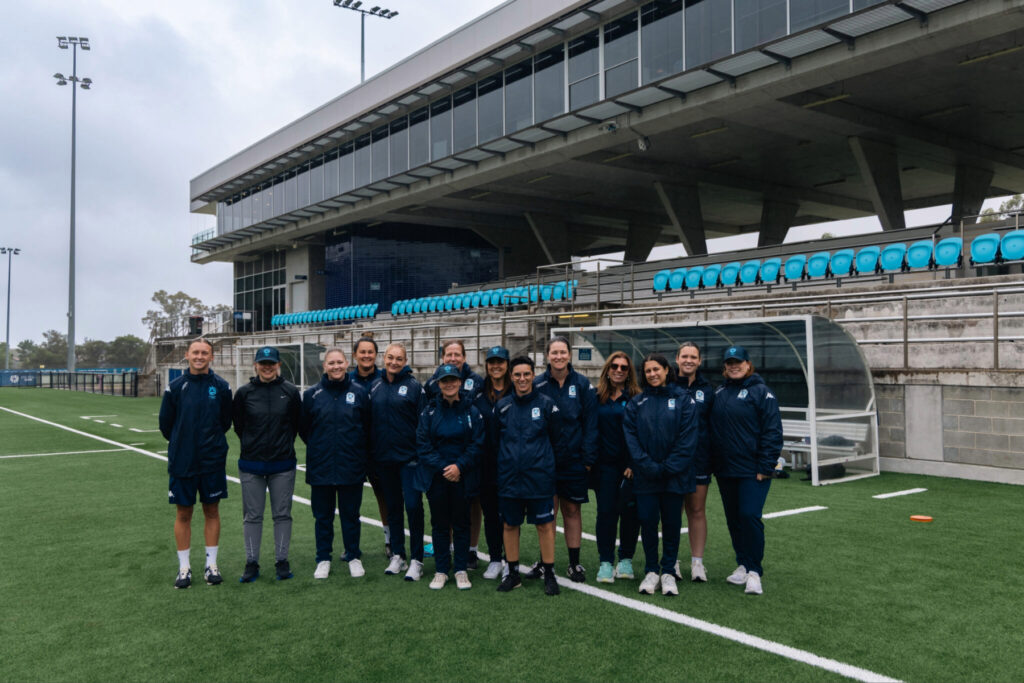
Football NSW has announced two new initiatives targeting the development of female coaches and coach education tutors, backed by federal and state government funding, as the governing body moves to address the longstanding structural absence of women across all levels of coaching in the sport.

The Future Female Coaches Mentoring Program, funded through the NSW Office of Sport’s Empower Her program, will select six female coaches holding a minimum AFC B Diploma for a structured mentoring program beginning mid-year. Participants will be paired with experienced mentors and receive three in-person visits including real-time observation and feedback, alongside regular online development sessions throughout the season.

Separately, Football NSW has opened expressions of interest for its 2026/27 Female Coach Education Tutor (CET) Program, supported by the Australian Federal Government’s Play Our Way investment, targeting C Diploma holders who want to move into coach education delivery.

Together, the programs address two distinct but connected gaps in the women’s football coaching pipeline- the progression from active coach to elite-level practitioner, and the transition from practitioner to the tutors who shape how coaching is taught.

The Pipeline Problem

The structural underrepresentation of women in football coaching isn’t a new observation. It is a documented and persistent feature of the game at every level, from community clubs to national team environments. Female coaches remain a minority in pathway competitions, and female coach education tutors are even more so.

One current tutor in the program described the environment she encountered when she came through the system. “My experience coming through as a coach, there was no females on the courses as participants and there was no females running the courses either,” she said. “That kind of inspires me to be someone that can hopefully make other females feel comfortable and confident to want to become coaches.”

“It is really important to have female role models because it shows that there is an opportunity or pathway for females,” said one program participant. “Traditionally it has been a male-dominated area and to know that yes, you can do it as a passion or a side thing, or you can actually make a career of it if you want.”

Removing barriers at the point of entry

The mentoring program’s design reflects an understanding that formal accreditation alone is insufficient to retain and develop female coaches in high-performance environments. Access to experienced mentors, observation in live coaching contexts and ongoing reflective practice address the informal development gaps that credentials cannot fill.

“Learning happens through coaching in real environments, and we recognise our role in providing both stretch and support to high-potential coaches,” said Edward Ferguson, Football NSW Head of Football Development. “This program offers tailored mentoring that complements formal coach education and enhances effectiveness in practice.”

Hayley Todd, Football NSW Head of Womens and Schools Football, framed the initiative in terms of long-term system building rather than individual development. “Creating sustainable pathways for female coaches is a key priority,” she said. “This program supports their development while also providing valuable insight into what is required to progress from state competitions into national and international environments.”

The barriers the programs are designed to remove are clear. The cost of accreditation, lack of access to mentoring networks, the absence of welcoming environments in coaching courses and the scarcity of female role models at senior levels all compound one another in ways that make progression difficult regardless of ability or commitment.

“You want to try and remove as many barriers as possible,” said one tutor involved in the program. “If you can start to remove those barriers, you actually get to engage with the females more consistently and build their confidence and competence in that space.”

A system investing in itself

The timing of both announcements sits within a broader national moment for women’s football. The AFC Women’s Asian Cup, currently underway in Australia, has delivered record crowds and sustained visibility for the female game at the elite level. The programs announced this week operate at the other end of the pipeline – building the coaching infrastructure that will determine whether the players inspired by that visibility have qualified, experienced and representative coaches to develop them.

Western Strikers Nominated FSA Club of the Month for Equity Outcomes

Western Strikers SC has been nominated for Club of the Month after a period of deliberate structural investment in its female program that is already producing measurable outcomes, and offering a model for how community clubs can drive participation growth through equity-focused planning rather than passive goodwill.

The nomination recognises a program that has moved beyond surface-level commitment to women’s football and into the kind of structural change that determines whether female players actually stay. Improved lighting across training and match pitches, equitable scheduling, extended training hours and dedicated pitch allocation have addressed the practical barriers that clubs often overlook. It’s conditions that tell players, implicitly or otherwise, whether the game was built for them.


Leadership as Infrastructure

Central to Western Strikers’ approach is a leadership structure that takes female football seriously as a technical and administrative priority. Women’s Coordinator Michelle Loprete and Technical Director Georgia Iannella, a former Matilda, provide the program with both organisational direction and the kind of visible role modelling that shapes whether younger players can picture themselves progressing through the game.

The presence of a former international player in a technical leadership role at a community level isn’t incidental. It signals to junior players that the pathway from their Friday night training session to elite football is real and navigable, and it gives the club’s coaching staff access to experience and credibility that most community programs cannot offer.

That pipeline is already functioning. Western Strikers’ Under-13 to Under-16 girls teams all qualified for finals in the Youth Premier League this season. Under-15 goalkeeper Sian Schopfer made her debut in the Women’s State League team which is a direct product of a club environment designed to move players upward.


The Friday-night model

One of the more quietly significant initiatives at Western Strikers is the scheduling of Friday night women’s matches, with junior girls training beforehand encouraged to stay and watch senior football. The structure is straightforward but its implications are meaningful. Aspiration in sport is not abstract. It’s built through proximity, through watching players a few years older doing what you want to do, in the same kit, at the same club.

The absence of that experience is one of the more consistent reasons girls disengage from football in their mid-teens. When junior female players cannot see where the game goes after their age group, the logical conclusion is that it goes nowhere. Western Strikers’ scheduling decision addresses that directly, at minimal cost, and whose effects are starting to manifest.


The Club Changer framework

The club’s participation in Football South Australia’s Club Changer Program has provided a structured framework for identifying and addressing barriers that might otherwise go unexamined. Pitch allocation, training structures and safety conditions are the kinds of issues that accumulate quietly in club environments; not because of deliberate exclusion but because the default systems were built around male participation and have never been comprehensively reviewed.

The Club Changer Program creates accountability for that review. Western Strikers’ ability to project an additional 146 female players over the next three years is a product of planning rather than optimism.


Industry implications

Western Strikers’ model matters beyond its own membership. At a time when women’s football in Australia is navigating the challenge of converting a participation surge into sustainable long-term growth, the question of what community clubs actually do with increased interest is among the most consequential in the sport.

Record crowds at the AFC Women’s Asian Cup and sustained national visibility have opened the door. Whether players walk through it and stay depends on whether the club on the other side looks anything like Western Strikers

Most Popular Topics

Editor Picks

Send this to a friend