
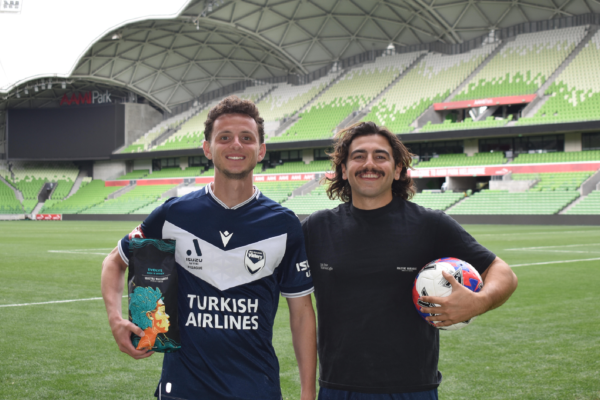


Taka Grips: The high-performance grip socks making a difference

Taka Grips is a high-performance grip socks company based in Sydney, with the overall aim of improving player performance and comfort on the field.

Liam McConaghy, the founder of the business, explained to Soccerscene that his own personal experiences of discomfort on the pitch inspired him to find a viable solution to issues affecting his game.

“It was actually November last year, so not that long ago, we started back at preseason – I play in NPL NSW and I was signed for St George at the time,” he said.

“What happened was we were training on an artificial turf on a Sunday and it was really hot (it was coming into summer) and my feet were just getting torn to shreds.

“There were just the worst blisters and I could feel the friction inside my boot – so I thought to myself I need to find a fix and investigated what all this grip sock business was about.”

He personally never had owned a pair of grip socks, but was left dismayed by the prices he saw online for the item, which prompted him to try and start his own business.

“I got online to buy some and they were $70 a pair,” McConaghy said.

“So, I guess I just had a thought to myself (about creating the business), it just sort of started off as one of those ideas.”

A PE and Design and Technology teacher by trade, McConaghy used his expertise in these areas to devise his product at a much more affordable price of $30.

“I have got a bit of experience and training with graphic design and that sort of thing, so I had a bit of a play around and contacted some suppliers and manufacturers and eventually, one thing led to another.”

The sock itself is made with durable and lightweight material, however its custom grip placement and advanced technology is specifically beneficial for players looking to improve their change of direction, speed, agility and enhance their comfort.

“The socks have got these little grip pads that are basically pressed into the socks through a high-heat glue gun,” McConaghy said.

“I’ve strategically placed them all over the bottom of the sock in places where you would have the most pressure inside your boot. So for example, around the ball of the foot and the back of the heel – I made sure mine came up the back of the foot, so you wouldn’t get that slippage in the back of your boot where a lot of the blisters happen.

“Essentially what happens is you don’t slide around in your boot, so without any friction in your boot you don’t get blisters and it’s better for your movement.”

Taka Grip Socks – White

Although only recently launching the business, the socks have gathered an immediate following and appreciation from professional football players in the A-League and around the world, in leagues such as the J-League.

“I’ve pretty much been playing NPL1 since I was 14 years old, I used to play with the likes of Massimo Luongo and Aaron Mooy,” McConaghy said.

“So, I’ve got old contacts through playing and reached out to a few people and asked if they’d like to wear them, which they were more than happy to and from there more doors have opened.”

Other professional players from different codes including NRL and AFL have also been using the product, with the socks now entering more sports department stores around Australia.

Social media, particularly the company’s Instagram page, has increased the profile of the grip socks to a wider audience, but possible future partnerships with football clubs and state federations across Australia is a logical next step, according to McConaghy.

“While I have thought about expanding into different clothing down the line, firstly it would be good to be able to get some clubs onboard with Taka Grips through a sponsorship, supplying the whole club from juniors through to first grade,” he said.

In the present however, McConaghy is proud of the work he has done so far and how quickly the product has already grown.

“I am very proud, because it sort of just started out of nowhere,” he said.

“I literally just thought let’s give it a crack, apart from some help from my girlfriend I’ve pretty much done it all myself.

“It makes me proud, especially when I look at the calibre of people who are wearing them.”

For more information on Taka Grips visit their website here: https://www.takagrips.com.au/


Previous ArticleNext Article

“20 Years Ahead”: The System Quietly Reshaping Korean Football

For all its consistency, Korean football has long carried an underlying tension.

On paper, it works. The national teams remain competitive, the player pool is technically sound, and the country continues to produce athletes capable of performing on the continental stage. But beneath that surface-level success, a more uncomfortable question has persisted about whether Korea has been simply maintaining its position while others evolve.

That question has driven the Korea Football Association (KFA) toward one of the most ambitious structural overhauls in modern football development: the Made in Korea (MIK) Project. Rather than focusing on short-term gains or isolated improvements, the initiative attempts to do something far more complex. It is rebuilding the foundations of how football is taught, understood and executed across the entire ecosystem.

Internally, the project has been described as having “brought Korean football 20 years ahead.” Whether that claim ultimately proves accurate remains to be seen, but what is already clear is the scale of the shift taking place.

From talent to system

The starting point was not talent, but structure. For years, concerns had been growing within Korean football circles about a lack of uniqueness in players, inconsistencies in long-term planning and an over-reliance on safe, risk-averse styles of play. The system, while producing disciplined and technically capable footballers, was not consistently producing players equipped to thrive in the most demanding environments. Environments such as Europe, where tempo, decision-making speed and adaptability define success.

Rather than attempting to patch these issues, the KFA chose to reimagine the system itself.

At the core of the MIK Project is the idea that high performance is not the result of individual excellence alone, but of an interconnected structure that allows that excellence to emerge consistently. Coaching, sports science, performance analysis, leadership and education are no longer treated as separate pillars, but as components of a single, integrated system designed to evolve continuously.

A new operating model

This philosophy is most clearly expressed through the project’s adoption of a cell-based operating model. In place of traditional hierarchies, the system is organised into small, cross-functional units, called “cells”. These cells are given autonomy over their work while remaining connected through shared frameworks and objectives. Each unit is responsible not only for delivery, but for learning, adapting and refining its approach on a constant cycle.

The intention is to bring decision-making closer to the pitch, allowing those working directly with players to respond faster and more effectively to the realities of the game. In an environment where marginal gains are often decisive, that speed of adaptation can be critical.

Closing the gap

Yet structure alone is not enough. The project is equally shaped by a clear-eyed assessment of where Korean football currently stands in relation to the world’s elite.

Comparative analysis has highlighted several consistent gaps: technical execution under pressure, the ability to operate at higher game speeds and effectiveness in decisive moments such as one-on-one situations. These are not deficiencies of talent, but of context. Korean players, while highly capable, have often developed within systems that prioritise control and precision over risk and spontaneity.

The consequence is a style that can become predictable under pressure.

Training for reality

To address this, the MIK Project has fundamentally shifted training methodology. Sessions are increasingly designed to replicate the intensity and unpredictability of real matches, placing players in situations where decisions must be made quickly, under pressure, and often in confined spaces. The focus is no longer on rehearsing ideal scenarios, but on preparing players for imperfect ones.

This approach reflects a broader philosophical shift that prioritises adaptability over perfection, and decision-making over repetition.

Evolving the Korean identity

Importantly, this evolution does not come at the expense of Korea’s existing strengths. Discipline, work ethic and technical proficiency remain central to the national identity. What the MIK Project seeks to do is build upon those foundations, combining them with the creativity, speed, and tactical awareness required at the highest level of the game.

It is, in many ways, an attempt to reconcile tradition with modernity.

A global ambition

The ambition underpinning the project is unmistakable. The KFA is not simply aiming to remain competitive within Asia, but to re-establish itself among the world’s leading football nations. That means producing players capable of not only reaching Europe, but succeeding there.

More than a project

What makes the MIK Project particularly compelling is that it does not present itself as a finished solution. Instead, it is designed as a system that evolves, adjusts and refines itself over time. In a sport where trends shift rapidly and competitive edges are constantly eroded, that capacity for continuous development may prove more valuable than any single innovation.

For other football nations, Korea’s approach offers an instructive case study. While many federations continue to debate philosophical direction, the KFA has committed to structural transformation, embedding its ideas not only in theory, but in practice.

Whether the project ultimately delivers on its boldest ambitions will depend on time, execution, and the unpredictable nature of the game itself. But one thing is already evident.

Korean football is no longer standing still.

WSL Football set for major technology advancement with Sportable

The Barclays Women’s Super League (WSL) will collaborate with Nike and Sportable, a data and analytics company in the sports landscape, making it the first football league in the world to use advanced tracking technology.


Where innovation meets football

Sportable’s Connected ball technology will feature in Nike’s Official WSL Matchballs, promising a new level of insight and analysis into the game.

The product is currently undergoing a trial and test process, but may launch at an even larger scale from the start of the 2026/27 season. Potentially operating at every Barclays WSL match in the very near future, Sportable’s cutting-edge technology stands as a springboard for the future intersection between data technology and the beautiful game.

Moreover, Sportable CEO, Dugald Macdonald, expressed his excitement at what the product can bring for the women’s game.

“The opportunity to create a consistent, data-rich view of performance, from training pitches to stadiums, is truly groundbreaking and we are excited to help unlock the next level of insight for teams across the league and their fans via an enhanced, data-rich, broadcast experience,” Macdonald said via official media release.

Furthermore, with analytics and data taking a leading role within clubs to maximise performance, Sportable are providing clubs in the WSL with a vital tool in an elite, highly competitive landscape.


What does the technology provide?

Certified by the FIFA Quality Programme for Electronic Performance Tracking Systems (EPTS), Sportable’s Connected ball and player tracking system presents many benefits to clubs and athletes alike.

For example, across both training and competition, aspects such as ball speed, spin, flight, high intensity plays, team shape, tactical patterns and off-the-ball actions are all measured. Therefore, Sportable’s technology will play an essential role in backing current and future athletes with the information they need to maximise their potential.

“Nike’s new partnership with us is built on innovation and putting players first,” outlined Chief Revenue Officer for WSL Football, Zarah Al-Kudcy.

“Their desire to elevate the role of the ball through Sportable’s technology will enable us to provide enhanced performance data to our clubs as well as tell richer stories to our fans. We are excited to be the first football league in the world to use this technology.”


Read here for more information about Sportable.

Most Popular Topics

Editor Picks

Send this to a friend