Rydalmere Lions FC: How diversifying income can lead to a financially sustainable club

At the grassroots level, many sporting clubs rely heavily on sponsorship dollars and player fees to drive their financial strategy. While this is a stock-standard approach, diversifying income streams can create enormous benefits for clubs and protect them from becoming overly dependent on one or two areas of business.

Based in Sydney’s inner-west, Rydalmere Lions FC is setting a new standard for economic diversification, branching out from traditional means and setting a positive example for the rest of the football industry.

After officially completing the takeover of a community bowling club, Executive Committee Member Elias El Khoury spoke exclusively to Soccerscene to discuss the club’s ambitious plans and the importance of creating a well-rounded commercial strategy.

“The COVID-19 pandemic has been disastrous, but it has also taught us a lot. Football needs to stand up on its own. Clubs can’t just rely on a sponsorship model,” El Khoury said.

“Diversifying income is critical. As a result of COVID-19 we’ve seen a number of clubs struggling and go public with requests for help, with some potentially going to hand in their NPL licenses. This is a direct result of sponsors either withdrawing their support, or being unable to support these clubs any longer,” El Khoury said.

With the takeover of the bowling club now complete after a four-year process, Rydalmere FC is in a position to use its new space to build its community presence and form a sustainable business model.

Rydalmere Bowling Club prior to being taken over.

“We don’t want to be seen as just a football club, but truly a community club. There have been some hurdles along the way, but we asked the council for a temporary license to operate the bowling club to prove ourselves. We’ve renovated the premises to make it livelier and give it a connection to younger families as well as traditional users,” El Khoury said.

“There are spaces to hire for social and corporate functions, other outdoor functions, barefoot lawn bowls and more. There are no membership fees at the moment, the local community is encouraged to use and benefit from the facilities.”

The concept of becoming a community-centric club is a deliberate strategy that the Rydalmere FC’s board is aiming to achieve. The concept creates a very beneficial two-way street where the club is supported by the people while also serving them with services that extend far beyond football.

El Khoury, a commercial lawyer who specialises in commercialisation strategy and business growth, believes many of Australia’s most successful clubs have shared this trait.

“All of the most successful current NPL and former NSL clubs have it in common – a genuine community connection embedded in passion. This is what drives football forward and keeps the likes of Marconi, Sydney United and so on going. Having that ingrained link to the club means patrons will come and support the club regardless of results on the pitch,” he said.

“The fanbase isn’t made up of the casual patron seeking entertainment but people with real ties to the club. Not that there’s anything wrong with the more casual patron, it is just a different type of model that requires a lot more from the club in terms of persuasion and selling that message of entertainment.”

It is only fitting that the biggest winners of Rydalmere Lions FC’s financially sustainable model will ultimately be the people.

El Khoury, along with the club’s other administrators have detailed their long-term plans to reinvest into the football ecosystem by tearing down barriers of entry that impact some families.

“Our vision is about creating pathways. In the end we want to create an environment where kids get to play for free, that way we are not limiting talent coming through the system. It would encourage more kids to attend and would remove finance as a restriction for some kids. Admittedly it’s a long-term goal, but with initiatives like the bowling club we can work towards creating the environment where player fees are zero, or as close to zero as possible,” El Khoury said.

Lions juniors lending a hand during renovations.

The idea of an ecosystem which provides equal opportunity for all kids is an exciting prospect, but Rydalmere Lions FC also believes by standing on its own two-feet, it will be able to allocate more resources towards player development turning football into a more realistic career path for the region’s next generation.

“Whether you’re for or against the transfer system, there is a need for pathways and funding to go back into grassroots football. It is so important for keeping clubs alive and dreams alive so unless money can flow freely, kids will hit a certain age group and disappear because football isn’t a viable career path,” El Khoury added.

“We know that as a club, in order to have a positive impact, we need to set our own standards first before leaning on FFA, Football NSW or other administrative groups. Four years ago, we built up a governance structure to create a sustainable business model so that way the club can rely less on funding from third parties to improve facilities and invest in technical resources to assist players in developing a career in the game.”

Outside of Rydalmere Lions FC’s commercial strategy and community ties, the club’s short-term goals involve improving its infrastructure and seating capacity.

These are undoubtably exciting times for the club from Sydney’s inner-west and El Khoury is optimistic that on the back of a sustainable strategy, the future looks bright.

“Everyone is surprise with what we’ve achieved, but we want more. We have a strong supporter base and we want to build a grandstand for the spectators. This will expose us to a wider range of football competitions and potentially the National Second Division when it arrives,” he said.

Previous ArticleNext Article

Seven Iranian Footballers granted asylum in Australia after Anthem Protest

Seven members of Iran’s women’s football team have been granted humanitarian visas in Australia, after a dramatic 48-hour operation that saw players slip away from government minders, protesters block team buses, and a late-night diplomatic resolution.

The saga began on March 2, when five players declined to sing the Iranian national anthem before their opening Women’s Asian Cup match against South Korea on the Gold Coast. The moment, seen by millions, prompted furious condemnation on Iranian state television, where conservative commentator Mohammad Reza Shahbazi labelled the players “wartime traitors” and called for them to be “dealt with more harshly.”

“This is no longer some symbolic protest or demonstration,” Shahbazi said on air. “In wartime conditions, going there and refusing to sing the national anthem is the height of shamelessness and betrayal.”

Under Iran’s Islamic Republic penal code, charges of corruption or treason can carry lengthy prison sentences or the death penalty.

A delicate operation

Australian officials had been preparing for what followed for some time. After Iran’s final group match- a 2-0 loss to the Philippines on Sunday night, government representatives were waiting at Robina Stadium on the Gold Coast, signalling to the players that help was available.

A police officer had been stationed inside the team’s hotel, working to create what Home Affairs Minister Tony Burke later described as “the maximum amount of opportunities” for players to make contact. Reports from inside the hotel suggested the women were not permitted to move around unaccompanied and were escorted even to meals.

By Monday morning, it had become clear that five players wanted to stay. The women slipped away from their minders, with Australian Federal Police and Queensland Police there to escort them to a secure location. Shortly after they left, BBC journalists at the hotel witnessed Iranian officials running through the building in an apparent attempt to locate them, but they were unsuccessful.

Burke met the group at approximately 9pm Monday and signed off on their applications for temporary humanitarian visas. By 1:30am Tuesday, the paperwork was complete. In a secure location in Brisbane, the five players, Fatemeh Pasandideh, Zahra Ghanbari, Zahra Sarbali, Atefeh Ramazanzadeh and Mona Hamoudi, broke into a spontaneous chant of “Aussie, Aussie, Aussie.”

Trump calls, the number grows

The story had by then attracted international attention. US President Donald Trump took to his Truth Social platform to demand action, writing that Australia should “give asylum” to the women or “the US will take them.”

Prime Minister Anthony Albanese confirmed he spoke to Trump just before 2am Tuesday. Shortly after, Trump posted again, appearing satisfied: “Five have already been taken care of, and the rest are on their way. Some, however, feel they must go back because they are worried about the safety of their families.”

The number of asylum seekers then continued to rise. As the remaining squad was transferred from the Gold Coast to Sydney Airport ahead of their departure, Burke and Border Force officials pulled each team member aside individually, without Iranian minders present, and offered them a choice. Two more players and a member of the support staff accepted. The total reached seven.

Crowds of Iranian-Australians gathered outside the airport, breaking into cheers as word spread that more players had stayed. A bus carrying the remaining squad had earlier been briefly blocked outside their Gold Coast hotel by protesters lying in the road, some holding signs, others desperately trying to persuade the players visible through the windows to disembark.

“They can’t speak freely because they are threatened,” said Naz Safavi, who had attended all three of Iran’s matches during the tournament. “We are here to show them that we are fully supporting them.”

One changes her mind

The situation shifted again on Wednesday when Burke informed parliament that one of the seven had changed her decision after speaking with departing teammates, who had encouraged her to contact the Iranian embassy.

“As a result of that, it meant the Iranian embassy now knew the location of where everybody was,” Burke said. The remaining asylum seekers were immediately moved to a new secure location.

The six remaining visa holders have been granted temporary humanitarian protection, valid for 12 months and providing a pathway to permanent residency, similar to visas previously issued to Ukrainians, Palestinians and Afghans.

Burke stressed throughout that the process had been entirely voluntary. “We never told anyone it was time to end the meeting,” he said. “If people wanted to stay and keep talking and miss that plane, they had agency to do that as well.”

Iran’s Foreign Ministry urged the players to return home, with spokesperson Esmaeil Baghaei writing on X: “To Iran’s women’s football team: don’t worry- Iran awaits you with open arms.”

The six who stayed have not responded publicly. Burke said they were grateful, and clear about one thing: “They are not political activists. They are athletes who want to be safe.”

The Participation Boom Councils Didn’t Plan For Is Hitting Football Hard

Football in Australia isn’t being held back by passion, participation, or community support. It’s being held back by local government failure. From a CEO perspective, the warning signs are no longer subtle — they’re screaming. Confidence towards councils is collapsing, clubs are done believing the rhetoric, and the people carrying the game every weekend are telling us the same thing: councils don’t understand football, don’t consult properly, and don’t plan for growth. This isn’t opinion anymore. It’s measurable. And it should embarrass every policymaker in the country.

Football in Australia isn’t struggling because of a lack of passion. It isn’t struggling because communities don’t care. And it certainly isn’t struggling because participation is declining.

Football is struggling because, at the local government level, confidence is collapsing. What is more, the people closest to the game can feel it.

Soccerscene’s latest survey on council readiness and football planning shows something deeply confronting: trust in councils is at its lowest point, and clubs no longer believe the rhetoric. Councils frequently speak about “supporting the world game” and “investing in community sport,” but the data tells a different story.

The people building the game every weekend, people such as presidents, coaches, volunteers and administrators, are telling us councils do not understand football demand, do not consult effectively, and do not plan for long-term growth. And that’s not an emotional opinion. It’s now measurable.

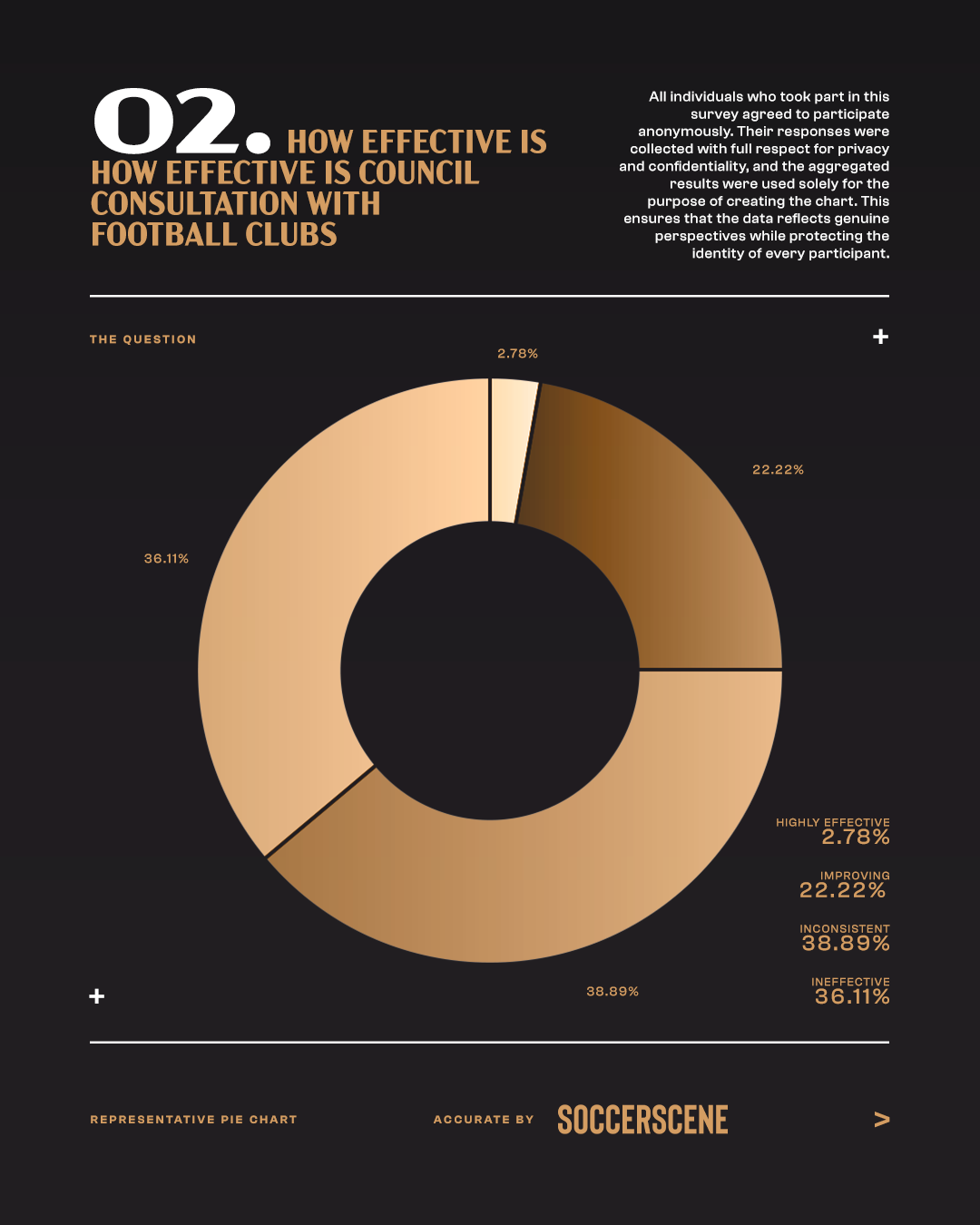
In our survey, over 61% of respondents said their council has limited or no understanding of football participation demand. Consultation outcomes were even worse: 74% said council consultation is inconsistent or ineffective. And when asked if facilities are being planned with long-term growth in mind, the answer should stop every policymaker in their tracks: more than 71% said planning is short-term or non-existent.

Results graphic from Soccerscene’s January industry survey:

This is not a small problem. This is a national warning sign.

Football is not a niche sport. It’s the world’s sport

Councils across Australia are making decisions as if football is still an emerging code, competing for scraps. That thinking is decades out of date.

Football is not only Australia’s largest participation sport in many communities – it is also part of the global economy of sport, the largest sport market on earth, and a cultural engine that connects Australia to Asia, Europe, Africa and the Americas.

When councils underinvest in football infrastructure, they’re not just failing local clubs. They’re failing an entire economic pipeline: participation growth, player development, coaching pathways, community engagement, multicultural integration, women’s sport, health outcomes, events, tourism, and commercial opportunity.

And yet, football is still treated as the code that should “make do”.

The Glenferrie Oval case: a perfect example of the imbalance.

Take the redevelopment of Glenferrie Oval and the historic Michael Tuck Stand in Hawthorn.

This is a major project with a total estimated investment of approximately $30 million, with the City of Boroondara allocating $29.47 million over four years to transform the site into a premier hub for women’s and junior AFL.

Let’s be clear: there is nothing wrong with investing in women’s sport. In fact, it’s essential.

But this investment is also a symbol of something football people have been saying quietly for years: councils understand AFL. Councils prioritise AFL. Councils know how to justify AFL.

They don’t do the same for football, despite its participation scale, multicultural reach, and global relevance.

Across the country, football clubs are being told there is “no funding,” that “planning takes time,” or that facilities “can’t be upgraded yet.” Meanwhile, we see multi-million-dollar grandstands, boutique ovals, and legacy infrastructure funded and delivered for other codes.

Football isn’t asking for special treatment.

Football is asking for fair treatment based on reality.

Councils are stuck in a domestic mindset – while football is global.

Here is the core issue: local councils are making decisions through a domestic sporting lens, while football operates in a global one.

Football isn’t just a Saturday sport. It’s a worldwide industry with elite pathways, commercial frameworks, international investment, and an ecosystem that Australia must compete within.

If councils don’t understand this, they will keep making decisions that shrink our competitiveness.

And this is where the stakes become real.

Australia is not only competing against itself. We are competing against countries like Japan and South Korea, who treat football as a national asset. They don’t leave football infrastructure to fragmented local decision-making without a clear national framework. They invest strategically, align education with delivery, and build systems that create long-term advantage.

We cannot keep pretending we are in the same conversation globally while our local facilities remain stuck in the past.

Clubs are carrying the burden – and it’s breaking the system.

The survey results point to a harsh reality: football clubs feel like they are carrying the weight of growth alone.

When asked what the biggest council-related challenge is, nearly 49% said funding is not prioritised, while others pointed to poor facility design, limited engagement, and slow planning processes.

This isn’t just an inconvenience.

It is creating volunteer burnout, club debt, stagnation in women’s participation, and barriers to junior growth. It is forcing clubs into survival mode – patching up grounds, sharing overcrowded facilities, and trying to grow in spaces that were never designed for modern football demand.

And when planning is short-term, the problem compounds. Councils aren’t just falling behind- they’re building the wrong solutions.

So what do we do? We stop reacting and start leading.

Football cannot keep waiting for councils to “get it” organically. That approach has failed.

What we need now is a national strategic response that is structured, intelligent, and relentless.

This is where football must learn from high-performing football nations  not just on the pitch, but in governance, philosophy, and decision-making.

A powerful example is Korea’s “Made in Korea” project, which was built to identify structural gaps, align stakeholders, and create a unified development philosophy. It wasn’t just a technical framework, it was a national alignment strategy.

Australia needs the off-field equivalent.

A National Football Facilities & Readiness Taskforce.

I believe the time has come to establish a National Football Facilities & Readiness Taskforce, made up of the most capable minds across the game and beyond it.

Not another committee. Not another meeting group.

A taskforce.

It should include leaders from football, infrastructure, urban planning, commercial strategy, government relations, and corporate Australia. We should be selecting the most intelligent and effective people in the country, not based on titles, but based on outcomes.

This taskforce should have one clear mission:

Educate, influence, and reshape how councils plan, consult, and invest in football infrastructure.

Alongside a taskforce, we need long-term strategic working groups embedded across the states, designed to:

educate councils on football participation demand and growth forecasting

standardise best-practice facility design and future-proofing

create consistent consultation frameworks

align football investment with economic, health and multicultural outcomes

build a national narrative that football is an asset rather than a cost

Because right now, the survey shows councils aren’t prioritising football for economic reasons. In fact, only 2.56% of respondents said councils should prioritise football due to economic benefits. This is not because it isn’t true, but because councils haven’t been educated to see football that way.

That is a failure of strategy, not a failure of the game.

This is bigger than facilities – it’s about Australia’s place in the world game.

If we want to be taken seriously as a football nation, we must build a country that treats football seriously.

Not just at elite level.

At local level – where the entire pyramid begins.

The message from the survey is blunt: football’s confidence in councils is collapsing. But within that truth is also an opportunity.

Because when trust hits its lowest point, change becomes possible.

The next step is ours.

We either continue accepting a system that doesn’t understand the world game – or we build one that does.

Most Popular Topics

Editor Picks

Send this to a friend