


Even before the FIFA Women’s World Cup was on the horizon, Optus Sport had already made its mark in Australian football.
At this point, Optus have cemented themselves as the place to watch all major events and leagues, including the men’s and women’s Premier League, Spanish LaLiga, Japan J. League and Korean K League.
Fully supporting the Matildas in the upcoming Women’s World Cup, you’ll be able to see every game of the national team live and on demand.
It’s this commitment that has seen FIFA name Optus as an Official Supporter of the Women’s World Cup, adding to the confirmation that Optus is the Official Broadcaster of the tournament.
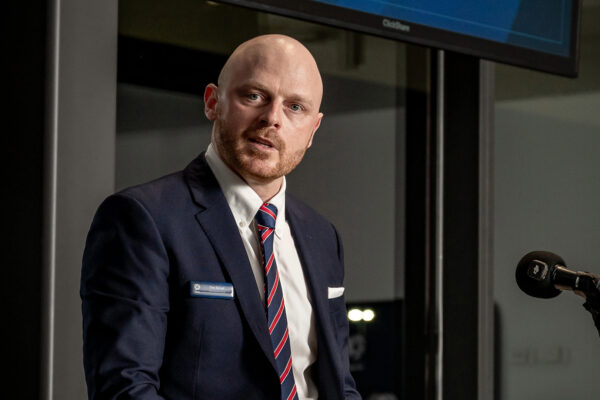
Clive Dickens, Vice President, Television, Content and Product Development of Optus, spoke with Soccerscene about Optus’ growth as an organisation, the buzz around the World Cup, how to leverage the viewing audience and plans for the future.
Tell us about your thoughts leading into the World Cup itself?
Clive Dickens: The Women’s World Cup was awarded to Australia two and a half years ago and we have a deep history at Optus Sport of broadcasting World Cup content.
We were the only place to watch all games from the 2019 Women’s World Cup in France, and we were also the partner of SBS in 2018. We’ve also broadcast the FIFA Club World Cup as well in the past. So, we bid for those rights when Australia and New Zealand were nominated as the host countries and through a very aggressive tender process.
We’ve invested enormously in the product and platform and team to become the official broadcaster. We’ll have brand new studio facilities, production facilities, hundreds of people working on that coverage, five remote teams across two countries collecting content from all the 11 cities where there are games being held, and see all 64 games live on demand with highlights, goals, mini matches etc.
As Optus itself is an official supporter, we’ll leverage all the fantastic tournament tickets, content, imagery and intellectual property across all of our 400 stores and thousands of channel experiences. A bit like some of the other official supporters and partners, this is an incremental investment in the sport.
What’s your take on how the viewing audience consumes content?
Clive Dickens: A lot of fans won’t sit down and watch the entire game or the whole second half or even a replay or long highlights.
But they will see amazing goals, athletes and content stories across social platforms. Whether it’s across TikTok, Snapchat YouTube or Facebook, or whether it’s on LinkedIn or Twitter, we’re confident that our content will reach 20 million of the 25 million Australians.
That’s really what will benefit the women’s game enormously. It wasn’t that long ago when the women’s game was a minority sport. Being a host nation and an official broadcaster and supporter of a telco and digital business, we will be able to bring this to not only our 10 million customers, but we confidently predict 20 million Australians will see at least five minutes of our coverage of the event, making it by far the biggest event in this country since the 2000 Olympics and prior to the Brisbane 2032 Olympics.
You started with Optus in May 2019, what have you observed from when you started?
Clive Dickens: Each year, there’s been 40% growth on the prior year in terms of engagement and subscribers. This is the beautiful world game, it is the fastest growing game in the world, even though it’s one of the oldest. There is no sport in the world that’s growing faster. And we’ll see that over the next five years with the 2026 Men’s World Cup in USA, Canada, and Mexico.
One of the big watershed moments was the Euro 2020 Championships. Here in Australia, that still holds the record for the largest ever live streamed event in the history of the Australian Internet, where 675,000 devices connected to our origin service to watch England lose to Italy between 4am and 7am in June 2021. No single sporting event has ever had a larger online audience than that in Australia. Not a Grand Final, not Ashes Cricket, not an Australian Open.
Part of the reason for that is because all those events I mentioned are also carried on broadcast TV, whereas the Euro 2020 tournament that was played in ’21 was exclusively online. But if you think that number of 600,000 to 700,000 concurrent devices peak, that was England versus Italy with not a single Australian playing there. And it was at 4am to 7am. Now fast forward, we’ve got the Matildas playing the Republic of Ireland and hopefully going through from the group stage or the finals. This is a prime-time event. No Matildas games are before five or six in the evening. Before we had to get up early, but we won’t need to in Australia. You’ve got this confluence of factors that have never been seen before in football.
How do you assess the international appeal of Australia?
Clive Dickens: In Sydney they’re currently building the Fox Sports America Women’s World Cup Studio, a huge construction that’s going on just under the Harbour Bridge, because NBC, Peacock, Telemundo and Fox Sports are the combined official broadcasters of the tournament in America. What this means is that the tournament is going to be a huge platform for Australian tourism across all those networks. The world champions, America, are going to obviously do very well, even if they don’t go all the way. This will create amazing platform of inspiration for our country, following on from the pandemic, where we will be able to showcase the best of Australia to a huge global audience.
I go past this studio construction every day and they are building one spectacular set right with the Harbour Bridge as the backdrop. For 10 to 12 hours a day, Sydney and the whole of Australia and New Zealand is going to feature as a backdrop to British, European and American broadcasting. This is an incredible moment for the country’s tourism industry as well off the back of the pandemic.
What is Optus Sport doing to help promote the tournament?
Clive Dickens: We’ve got hundreds of licensed venues where you can watch all 64 football games, including clubs, pubs and casinos where you can watch it with other fans in the warmth of the indoors, because it is winter in Australia and a little bit cooler. A lot of this shared experience is going to be in venues. We’ve also got dozens of FIFA fan zones – public parks where councils are applying for free licenses to stage fan zones. For example, in one Sydney council area alone – the Inner West Council – there will be infrastructure set up in six parks to watch games. That’s six in just one Local Government Area. There will be other councils in other cities doing the same. It’s a daytime event, the first game kicks off at 11am, and the last game whistle blows at 11pm. What could be better? No staying up late at night, no setting your alarm early.
One of the big differences you would notice as a football fan is the profile difference in the type of supporters. Women’s football has a much, much younger supporter base than men’s because men’s football is steeped in history. In the UK, it’s like 180 years. The average club in Premier League is 100 years old. To get even football in the major leagues, it’s quite expensive. You’ve got to be a member and got to buy a season ticket. That tends to favour people who have handed down their team from granddad to dad, to son or to family. And it’s expensive to go and watch big flight teams across Europe. It’s less expensive with the A-League, but it’s pricey. Whereas women’s football is typically much younger audience and is much less male. For example, over 80% of our subscribers are male, but we’re predicting 55 % of our FIFA Women’s World Cup audience to be female. So, you’ve got a younger, more female fan base.
Whether that’s in the stadium or elsewhere, the atmosphere is completely different. The chants are different. The songs are different. Because you put 60 % women in one place versus 80 % men, it feels very different. Like going to a concert is different. You’ve got a rock act or you’ve got a pop act. Therefore, not only is a game a little bit different on the pitch, but the audience is very different. So that’s one of the reasons why it’s going to be so enormous. For example, my 21-year-old daughter and her friends are not really interested in men’s football at all, but they’re all on my case about getting tickets for the FIFA Women’s World Cup because they see themselves on the pitch. They see this as a leveling up and a real difference around how the women’s game is played.
How do you think the Matildas will fare and thoughts on the tournament overall?
Clive Dickens: We have one of the best players in the world, if not the best, in Sam Kerr. When you couple that with the team on form and home ground advantage, this is the moment.
Just imagine if Matildas can make it to the final. I don’t want to tempt fate, but I think they can even get through to the quarter finals, which will feel like a final for Australia. A quarter final World Cup, something that no Women’s or Men’s team have ever achieved – anything after that is a bonus.
The thing about this event is that when we’re watching these incredible athletes, whether they’re American or from the Philippines or from New Zealand or Australia, it’s going to inspire millions of people, particularly young Australians.
That’s what sporting tournaments and amazing athletes do. They inspire people to go off and do amazing things, beyond just going outside to kick the ball around. As a high participation sport, football is the beautiful world game that’s growing faster than any other in the world.