



Is the FW Regional Girls Training Camp bridging the access gap for talent?

In Western Australia, the tyranny of distance has historically functioned as the primary barrier to talent identification.

For regional footballers, the logistical and financial burden of accessing elite pathways often renders the concept of “equal opportunity” a theoretical ideal rather than an operational reality. However, the recent Regional Girls Training Camp, hosted at the Sam Kerr Football Centre, suggests that Football West is moving to operationalise the structural changes announced in its 2026 academy overhaul.

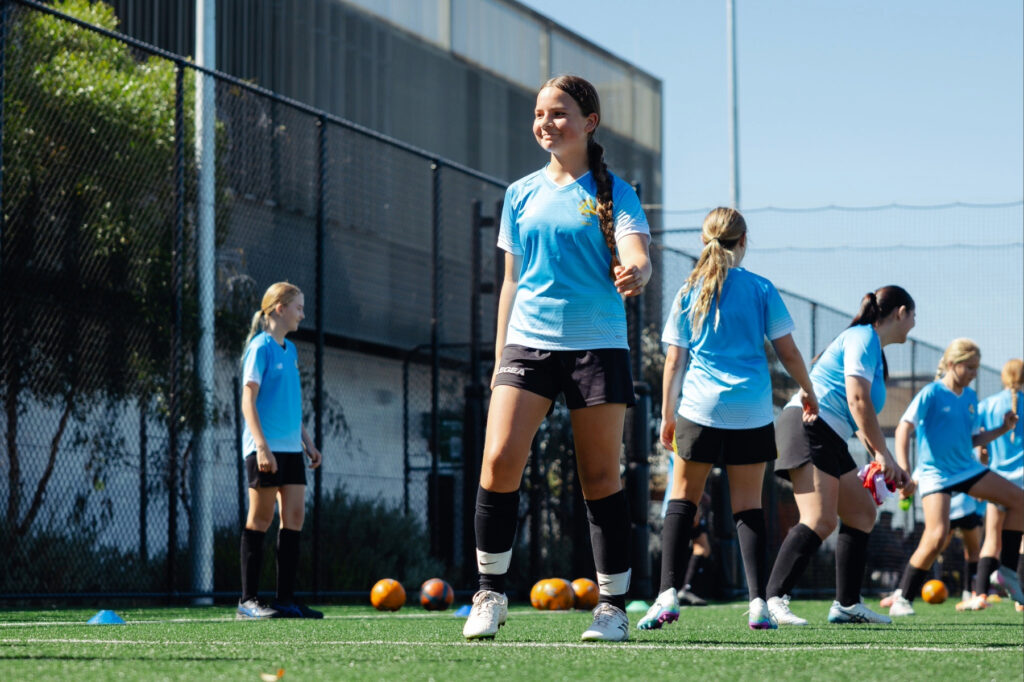
Earlier this week, nearly 100 players aged 10 to 17 converged on the State Centre for Football in Cannington. The three-day camp invited participants from the previous year’s Country Week carnival, represents the first tangible application of the “real-match” and high-performance philosophy outlined by Football West Development Manager Gareth Naven late last year.

While the previous announcement of the Regional Academy model focused on the structural shift from training camps to competitive “State Carnivals,” this current initiative addresses the resource gap. For stakeholders and policymakers, the camp serves as a case study in how centralised infrastructure assets can be leveraged to service a decentralised demographic.

Infrastructure as an equity lever

A lack of high-performance environments defines the economic reality of regional football. The facility gap between metro NPL setups and regional clubs is often vast. Football West uses the Sam Kerr Football Centre to subsidise the “professional experience” for regional talent.

Sarah Carroll, Female Football & Advocacy Manager, notes the purpose extends beyond simple engagement. The curriculum fused on-pitch technical training with athlete development workshops.

Geography usually blocks access to this sport science for a 14-year-old Pilbara or Goldfields player. By centralising this education, the governing body helps standardise the player pool’s knowledge base. Naven’s alignment strategy demands closing the “knowledge gap” alongside the technical one.

The economics of the “Legacy”

Critically, the WA Government funds the camp through the Female Community Legacy Program. This highlights the Legacy Program’s ROI for the Department of Local Government, Sport and Cultural Industries.

A stated aim to “enhance club capability” acknowledges that player development requires an ecosystem. The funding mechanism here is significant. Without state intervention, the cost per head would prohibit many families from attending.

Targeted funding bridges the gap between community participation and elite commercial viability. Regional Lead Tanya Amazzini calls these opportunities “essential” for player growth and confidence.

Strategic alignment with the 2026 pathway

Observers must view this camp alongside the Regional Academy system overhaul. The new “State Carnival” model demands players physically prepared for elite competition. This camp functions as the preparatory phase for that new competitive reality.

Football West uses elite exposure to mitigate the shock of transitioning to state programs. Furthermore, involving players from the Pilbara to the South West keeps the talent net wide. Maintaining sight on remote talent requires constant investment.

The residual challenge

However, the long-term impact warrants caution. The “re-entry” phase remains the primary challenge. Players return to clubs with significantly fewer resources than the Sam Kerr Football Centre.

Success depends on the “trickle-down” effect of the education provided. If players transfer this knowledge locally, the aggregate standard of regional football rises. If isolated, the experience may simply make the regional gap feel more pronounced.

Integrating 100 regional girls into the state’s premier facility executes the strategic plan. It signals that the Centre delivers dividends to the broader ecosystem, not just the elite.


Previous ArticleNext Article

Football NSW supports Female Coaches CPD as Women’s Football Surges

Football NSW has used the platform of the AFC Women’s Asian Cup to deliver a targeted professional development workshop for female coaches, bringing together scholarship recipients for an evening of structured learning and direct engagement with elite women’s football.

Held at ACPE last month, the session was open to female coaches who received C or B Diploma scholarships through Football NSW in 2025. Coaching accreditation carries a financial cost that disproportionately affects women, who are less likely to have their development subsidised by clubs or associations operating in underfunded community football environments. Scholarship access changes that equation at the point where many women exit the pathway.

Facilitated by Football NSW Coach Development Coordinator Bronwyn Kiceec, the workshop focused on goal scoring trends from the tournament’s group stage, with coaches analysing attacking patterns and exploring how those insights could translate into their own environments. The group then attended the quarter-final between South Korea and Uzbekistan at Stadium Australia.

The structure of the evening mattered as much as its content. Female coaches in community football rarely have access to elite competition environments as a professional resource. The gap between the level at which most women coach and the level at which the game is analysed and discussed tends to reinforce itself. Placing scholarship recipients inside a major tournament, as participants rather than spectators, closes that gap in a way that a classroom session cannot.

Female coaches remain significantly underrepresented across all levels of the game in Australia. The pipeline that will change that depends not only on accreditation access but on the professional networks, peer relationships and exposure to elite environments that male coaches have historically taken for granted.

The workshop forms part of Football NSW’s ongoing commitment to developing female coaches through scholarships and structured learning opportunities.

Marie-Louise Eta makes history as new Union Berlin head coach

In an historic appointment, Eta will take over as head coach of Union Berlin until the end of the season.

History in the making

Previously the first female assistant coach in Bundesliga history with Union Berlin, Eta will now take the reigns of the men’s first team on an interim basis.

Currently, the club sit in 11th place in the Bundesliga table, but with only two wins so far in 2026, relegation appears an all-too-real prospect, and one which the club is desperate to avoid.

“Given the points gap in the lower half of the table, our place in the Bundesliga is not yet secure,” said Eta via official media release.

‘I am delighted that the club has entrusted me with this challenging task. One of Union’s strengths has always been, and remains, the ability to pull together in such situations.”

Eta will begin as Union’s new head coach with immediate effect, and will be in the dugout for the club’s matchup against Wolfsburg this weekend.


A step into an equal future

Eta’s appointment signals a major step towards a more level playing field in the football landscape.

Furthermore, Eta joins other coaches including Sabrinna Wittmann, Hannah Dingley and Corinne Diacre who, in recent years, have blazed a trail for female coaches to step into the men’s game.

Wittmann currently manages FC Ingolstadt in Germany’s third division, and was the first female head coach in Germany’s top three divisions.

In 2023, Dingley became caretaker manager of Forest Green Rovers, and thus the first woman to lead a men’s professional team in England.

Diacre, now head coach of France’s women’s national team, managed Ligue 2’s Clerment Foot between 2014 and 2017.


Final thoughts

The impact therefore, is that Eta’s appointment will show future generations of aspiring female coaches that men’s football is an equally viable and possible pathway as the women’s game.

The time is now to level the playing field.

And while it may be a short-term role, its effect on attitudes towards equality and fair opportunities in the game will hopefully resonate long after the season ends.

Most Popular Topics

Editor Picks

Send this to a friend