





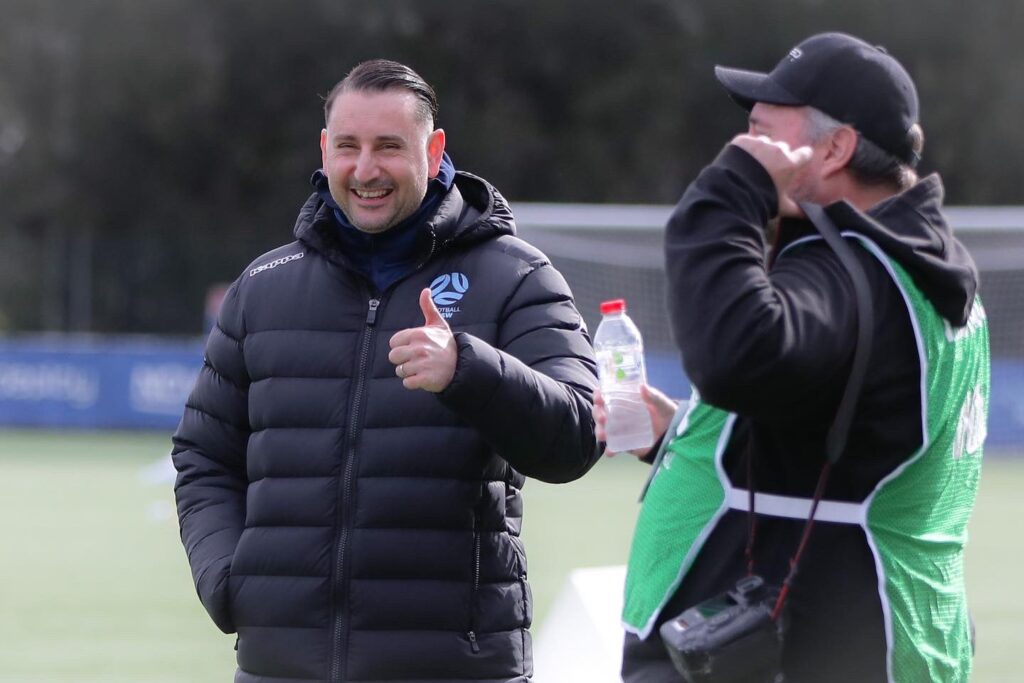
National Premier Leagues NSW fans have likely spotted Mark Stavroulakis conducting his duties as Media Manager at Football NSW on a game day across the various NPL tiers many a time. Mark’s infectious passion for the game and efforts to grow Football NSW’s social media presence have long flown under the radar, in a fashion similar to many who dedicate their life to the world game.
In a wide-ranging chat with Soccerscene, Mark speaks on being born into a football-mad Greek household, his excitement for the future of Australian football, and his pure love for the game. Without a doubt Mark’s story, insights and experiences within Australian football – particularly at a grassroots and semi-professional level – are valuable for any aspiring journalist to learn from and apply to their own professional trajectories.

What sparked you into football and how did you first become involved in it?
Mark Stavroulakis: Like any football-mad household – especially one with a multicultural background, myself being of Greek origin – I was pretty much born into it. My father was a footballer back in Greece and when he came over here to marry mum, he also played football here. I’d say that it was in our DNA, getting involved in football. And then in the media scene, my father got involved in media when he finished up as a footballer and became one of the leading Greek sports journalists in Australia.
I grew up with my younger brother Nick who also played football. I played as well and went as far as playing back in the old NSL with Sydney Olympic’s Colts and youth side.
I then played in what is now our NPL NSW Men’s competition with St George FC and then after that I pursued my career as a journalist while I was doing my studies at university. Whereas my brother became a professional footballer and represented Australia and played overseas in Italy and England. Long story short, as soon as we were born our dad was like ‘the only sport you’re going to be playing is football’ and we thank him for that, because it’s the best game around and I wouldn’t have had it any other way – it’s given us the life we have today.
In terms of getting involved in the media, I was fortunate enough with dad – there was an iconic publication called the Australian British Soccer Weekly that I had work experience at when I was 16. From then on I took that opportunity and became a freelance writer for the paper before I was given the chance to become the editor at 18, which spearheaded me to where I am today.
What have been your most significant achievements in your time at Football NSW?
Mark Stavroulakis: This is my 16th year at Football NSW, so it’s been a decent amount of time having spent most of my 20s and 30s at the one place. I’ve seen such significant growth in a lot of areas, but when I first got into the job there, one thing I was proud of was the creation of a proper media team and unit external to what you see in lieu of promoting weekend results and promoting our valued competitions. Once I got the job as media manager at Football NSW, I used my contacts at the Soccer Weekly and brought some of the journalists and photographers with me to create a great unit that to this day are still working with me.
The media unit in turn provided match reports, photo galleries, live scorers and basic weekly football info to our audience, and at that time with social media and channels still in its early stages, was the only way fans were able to receive their Football NSW weekly fix.
It wasn’t how it is now where we have loads of dedicated channels at our fingertips giving us updated info on scores, features etc.
So to have been part of this from its early stages was something I was very proud of, as we’ve managed to build and move with the times from there on.
Back then I kicked off the official Facebook, Twitter and Instagram pages for NPL NSW and Football NSW and have seen it rise from zero followers to 150,000 plus for both our NPL and company Facebook pages. To have overseen this from its early beginnings – because I was there when this digital engagement was in its early stages and wasn’t the norm – now grow into the audience we have today has been amazing to witness this in live format.
The other aspect I’m proud of is introducing the livestreams to our audience. We pioneered it as a member federation when I first got the job. We were doing one match a week with a company called Spot On Video Recording. Obviously, it wasn’t like it is now where we have the NPL.TV platform which is amazing and have most Member Federations involved.
Back then we had one camera and one commentator, and we selected the match of the round and beamed it live. That really started our journey to where we are today. We’ve been the leaders in terms of the livestreaming platform for NPL thanks to Brian Meinrath who saw the potential it had and gave it a sounding board.
Giving writers, photographers, contractors, and people I’ve hired internally in the media team an opportunity to have seen them flourish and grow was also another aspect of my job that I have been proud of. There’s some who have gone on to amazing things now. We’ve got Brendan Modini who’s now the head videographer for the English national football side, Marianna Galanopoulos who’s one of the head videographers at Football Australia, Matty Connellan is now an SBS presenter for news and is set to be the main face behind the camera in Qatar for the World Cup. There’s been so many people that I’ve given opportunities to because I’m all about giving people a chance and a road to getting to where they want to get to, it’s something that I enjoy seeing them flourish. On a personal level, it gives me a lot of satisfaction seeing where they started to where they end up. Football NSW is a factory for nurturing talent that then go on to other quality opportunities.
I’m very grateful to Football NSW for giving me a chance to administer this, they gave me an opportunity to do my thing back in 2007. Tony Peters was my first boss and was the one who saw potential in me. We’re all about continuing to kick goals and being a team unit at Football NSW, but it’s great to see that we are still growing. We don’t get things right all the time and we understand that, it’s the nature of our job, but one thing’s for sure we have a lot of football purists here. We’ve got the game in the best interests of our hearts and minds and we do whatever we can to try to make it as best as possible for everybody across all levels. It’s a massive job, we are dealing with grassroots football and then we’re dealing with our elite components, competitions, coaches, referees and volunteers – there’s so many touchpoints – and the Football NSW staff have done a phenomenal job in these spaces. It’s just crazy to see how much we’ve advanced and progressed since we started but its pleasing to see that we are heading in a positive direction.

What’s the biggest misconception the Australian footballing public have about your work at Football NSW and beyond?
Mark Stavroulakis: I think the misconception is that people think there are a cast of 1000s that work at these organisations, especially ours – there really isn’t. When you look at the fact that we have more than 300,000 players and you count how many are in the office, I think it gives you an answer to how can you possibly deal with all of these people out there? It’s tough and I don’t want to give out excuses, but it’s a fact. Overall, though, it’s probably that which is our biggest obstacle. People assume that there’s 300 people working here, but it’s probably closer to 50 or 60 across various departments.
From a media and communication perspective, there’s only three of us internally. And to churn out what we’re churning out – features, stories, results, press releases as well as keeping on top of all things social media and so much more. I’m big on the front that football is a game of opinions and everyone is entitled to one, and I respect that. You pay your fees or you pay to get into a game or watch a match, the fact that you’re investing your time into the sport you 100% have the right to have a say on our game. And with the abundance of comment, we read through you have to develop thick skin, you can’t take it all to heart. You have to think ‘what can be done’ and you’ve got to listen. As administrators we don’t want to be seen as not listening to the people. For me it’s important to listen to what the audience have to say and when you don’t that’s where you face issues.
How has it been for you operating in the National Premier League space? What’s it like engaging with turbulent times throughout the competition’s long history?
Mark Stavroulakis: One thing I’ve got to say with our NPL clubs and administrators is that I take my hat off to them all. A lot of these clubs and administrators have put their own money in to fund their respective clubs. A lot of these clubs have formed our competition history, and the reason that the A-League is here today is because of these historic clubs. If these clubs weren’t around then we wouldn’t have football as we know it, I’m a big believer in respecting the history of our game and every member federation has a few amazing historic sides that have done their bit.
We’re lucky that we’ve got the luxury of having a few of them playing in our leagues – Marconi, Sydney Olympic, Sydney United 58, Wollongong Wolves, Parramatta FC and so on – these clubs formed what was once the NSL. To be dealing with different nationalities it makes you grow as a person and understand how each community works. To be able to see that makes my job even more enriching to be honest. Being able to get to these grounds and speak to people of different backgrounds and understand what makes them tick, why they do what they do, how they are with football, I love that. And that’s the bonus of our sport. It’s why I think the NPL is so important to the makeup and the landscape, on top of the obvious reasons of providing a platform for players to go onto the next stage of their careers or even stay in the NPL.
The women’s game has also come a very long way, it’s so refreshing to see how far the women’s game has come. We are lucky as we have our own mini-A-League women’s league happening because all the girls that play in the top tier women’s competition come down to play in our Women’s NPL competition.
It’s awesome to be a part of that environment and it keeps me motivated to get up and go, but that’s the NPL part of it. And then obviously there’s the community and grassroots part of it where we’re doing our best to give back to the local associations that continually do so much. These absolute champion human beings who run grassroots clubs do it for next to nothing just to keep football afloat in our communities across the nation. Monday right through to Sunday there’s community football volunteers putting up nets, working at canteens, being club officials – they’re the biggest champions of all and they need to be recognised more. That’s why whatever we do in our space we try to make a difference with them as well.
Where do you feel Australian football is at presently?
Mark Stavroulakis: Its continually building and I think that we’re always learning. I know everyone is talking about the alignment process and that it’s taking a long time, but I feel we are in a position where we’re gradually building for a common goal and that’s to see this sport prosper in more ways than one. We’re in a transitional phase and we are finding where we are at with everything, and we’re in a position where we know that there’s better times ahead but to get to those better times you need to get through rough waters. And this sport has gone through a bit of that as we all know. We’ve got the right people behind football leading the charge and I think that as a sport the number one objective is that we all stick together.

What would you like to see the National Premier Leagues NSW grow into in the coming years?
Mark Stavroulakis: Everyone’s talking about having a national second division or a B-League, ultimately me as a football fan and as an administrator is to try and see the game succeed. To have a fully-fledged professional setup where we’ve got promotion and relegation happening across all levels is the dream that I’d love to see in my time.
I’d love to see the NPL grow in stature, I mean the NPL.TV platform has already given us a gauge that a lot of people have now switched onto our competitions and understand and support it more than ever before. We have seen many new football followers tune in and not just our valued traditional followers that have stuck with us from day one, but the new fans that have jumped onto football when the A-Leagues were created have slowly embraced our leagues. I think the more that we get them involved alongside our traditional fans, it’s only a good thing for the sport.
Hopefully generating more eyeballs to ensure that we’ve got more people coming to the matches, more awareness and I guess overall just getting a national look and feel of our NPL in a bigger light so that it’s shown on prime time television would be amazing. Getting all of the glitz and glamour of the people in mainstream media would be amazing. The end goal is to see the NPL excel as high as it can, with a dream of hopefully seeing these clubs become part of a B-League and then obviously with the women forming another pathway to their top-tier competition.
Women’s football is the fastest growing sport in this nation and is something we should pride ourselves on and continue to push – with the FIFA Women’s World Cup next year, the female game is only going to get stronger and better and we cannot wait to see more goals kicked in this area.
It’s all about collaboration and bringing the game forward.

