

Blacktown City CEO Bob Turner: “The council is exceptional in wanting to build pride”

Ahead of the National Premier Leagues NSW season, Blacktown City CEO Bob Turner chatted with Soccerscene about the NPL 1 side’s 2022 Season Launch and the recent developments being instigated to push the club towards greater growth and expansion into becoming a central sporting hub for the Blacktown region.

The Blacktown City 2022 Season Launch was hosted by Stephanie Brantz and marked a significant milestone moment for the club. The sheer magnitude of the launch well and truly represents a pivotal moment in Blacktown City’s recent history, which is due in no small part to the initiatives being introduced by Turner and the team at the club.

Unveiled at the event were the announcements of Blacktown City’s first ever Senior Women’s team, construction of new $1 million changerooms under the main grandstand thanks to the NSW Government, and full operational control of the side’s home Stadium – Blacktown City Sports Centre.

In addition, Blacktown City unveiled that they had become a Diamond Member of the Greater Blacktown Business Chamber, and utilised the evening to launch their recent induction and to host Chamber members in a restructured Business After 5 format.
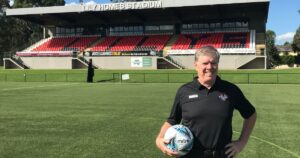
BCFC Bob Turner

Have Blacktown City regularly conducted season launches of this size? Or was this the first time where you’ve actively tried to bring the community together from all over Blacktown?

Bob Turner: They used to hold the launch at Lily’s Function Centre with Vince Camera when he was in control at the club. But we haven’t had one for a number of years, and we just felt with so many good things happening that it would be better to have a real season launch and make a big deal of it.

Blacktown Council came to the party and let us have their Bowman Hall which can accommodate up to 400-500 and is adjacent to the Council Chambers. But more importantly, because of social distancing it helped us to keep spread and thankfully the Mayor, and the Deputy Mayor, a couple of Councillors, and of course Stephanie Brantz – were all there. It just added to the whole credibility of the launch and it was also good to see both the men’s side and the women’s side together on the stage at one time. Which is a huge plus for the club moving forward.

Blacktown City have recently been inducted as a Diamond Member of the Greater Blacktown Business Chamber. What was the process of organising that and how did it feel being able to launch it?

Bob Turner: It’s fortunate that I’m Vice President of the Chamber, so that helps! One of the biggest things I’ve found in my year involved at the club is how do we make a bigger impact for the city of Blacktown. Both for the club, but importantly for the city. Because I think that the city of Blacktown is very sports conscious. It’s a very misunderstood city in my opinion over the last 10 years of being involved in it. It doesn’t have a main sports team that the city takes pride in and I think Blacktown City – by virtue of not just our name but also our history, credibility, stadium and the competition we play in – all are significant factors in being able to build Blacktown City into something elite.

Our goal is no different to when I first joined the Sydney Kings back in 1989. I could see the potential of what the Kings could do for the sport of basketball and also for the city. It was just a matter of time before we made the right inroads to get people to understand that it’s a good product and things took off. So, in my view, after a year of involvement we’ve made huge strides forward in so many different areas and winning on the field is a bonus. It’s everything else – it’s the business of building Blacktown City.

There’s a Women’s World Cup coming up in Australia and New Zealand, and along with that comes all of the excitement and momentum building around women’s football. What was it like for you to launch the first-ever senior women’s team for Blacktown City with such a promising future ahead?

Bob Turner: Last February we announced that I had become involved in the club and one of the first questions that I asked was ‘do we have any women’s players’? We had some junior teams but not anything significant. I said that with the World Cup coming in 2023 the game is going to explode as a result of that, and we need to jump now into that space. Our Head of Football Mark Crittendon had always wanted to build a women’s program, so collectively the new board and Mark decided that we’re going to have a go at this.

We appointed a Head of Women’s Football, David ‘Dok’ O’Keefe, and his background is one of building clubs. His task is very simple: within three years we want to be in NPL 1 and we want the Blacktown women’s team to be as credible as the men. It’s the same culture that Mark has established in the men’s team – where players want to play for the club and they know they’re going to get better by being a member of Blacktown City. In time, we can build the women’s program at the same level.

One of the key ingredients of that is the upgrades to the changerooms which are a bit ancient. We applied for a grant with the State Government to build new changerooms for our women’s program primarily, and we were successful in that grant application. So, now we’re busy preparing to build new changerooms under our main grandstand which was 20-odd years ago they wanted to do. The main benefactor of that will be our women’s program, and it will help us to recruit better young female talent, especially if they know that the coaching, culture, facilities and competition are all right.

Blacktown Women's

What was it like to finally solidify your home ground – Blacktown City Sports Centre – as being controlled by the club?

Bob Turner: Vince Camera from Lily Homes took over the club when it ran into financial trouble around 12 years ago. And he turned the licensed club into a function centre. He took over the stadium, installed the AstroTurf pitch, put in netting for 5-a-sides, improved the corporate suite area and the café, and did so many very positive things. But after 10-11 years he lost his momentum for it and came to us to see if we wanted to takeover the ground.

We started to negotiate that opportunity and in October of last year we took it over. Not only does that give us full control of what we can do to improve the stadium and the changerooms, but also greater revenue streams are now available to us as with running our own competition and hiring our ground out to other clubs, academies and people who want to train. So, now rather than just relying on gameday tickets and sponsorship, we have revenue streams that can help build a solid financial base for the club and make improvements. My end goal is to make our stadium a 4,000-5,000 seat niche venue and a good destination point for people to come and watch good football.

The theme you’ve introduced for Blacktown City this year is ‘Bring it home Blacktown’. Obviously, you’re wanting to amplify the region itself and to give Blacktown the respect it deserves, but what does this theme represent for you?

Bob Turner: Back in 2011, NSW Baseball and the Sydney Blue Sox asked if I would get involved because they needed to restructure. They made the comment at the time that Major League Baseball actually owned the league and I thought that was pretty impressive. If I had never done that, I would’ve been like the vast majority of Sydney residents in that I would never understand Blacktown. But because I went out to the ballpark that is based in Blacktown, got involved in the Chamber and ran a not-for-profit business for a few years in Blacktown, I could really see the opportunity in the misunderstanding of what the city represents. I would often ask people to come out to watch the Blue Sox play and once they found out it was in Blacktown they’d not want to go, like there was some huge problem.

But that reinforced to me that if you live in Blacktown, you like Blacktown. If you don’t live in Blacktown, you’re not going to get it, for a long time at least. The council is exceptional in wanting to build pride in the 400,000 residents in the area and that population will grow to 550,000 over the next 10 to 15 years. If we can capture that through some emphasis on who we are, Blacktown City wins, the city of Blacktown wins and the sport of football wins. That’s really what it’s all about. To me it’s as much a play to help out the city.

Bob Turner Cup

Recently the Australian Association of Football Clubs (AAFC) announced the final report for the National Second Division. Is there a reason why Blacktown City were not part of the final plans put forward?

Bob Turner: No, other than we might not have been communicated to I would think. It’s definitely in our wheelhouse. Blacktown City used to be in the NSL and was a very solid club when that competition was growing. We definitely want to be involved in anything that’s improving the game. My one concern – having been in professional sport all my life – is how to pay for it all? And that’s something that everybody has to consider. Because on paper it all looks good, but remember you have to finance and fund paying players, building competitions, and flying around the country especially in Australia with a jam-packed sports calendar.

Nowadays there’s 50-odd sporting teams in Sydney alone and TV money is not going to answer the call because it’s not that big a country. If you rely only on games and sponsors, or somebody who has deep pockets, eventually those pockets get thin and you get tired of losing money. The future of any competition relies on how you pay the bills and that has to be a number one consideration.

Previous ArticleNext Article

Record Pathway Breakthrough: Football NSW Report Highlights Power of Access and Equity

Playing soccer

Football NSW has released its 2025 Player Development Report, documenting a year of significant growth across its Talented Player Pathway programs for girls, boys and regional players, and offering the clearest picture yet of how the state’s talent identification infrastructure is reshaping who gets access to elite football development in Australia.

The report distinguishes between three streams: girls, boys and regional, where each operate under the umbrella of the Talented Player Pathway, which encompasses Football NSW’s Youth Leagues, Talent Support Program and state teams. Across all three, the numbers point to a system that is identifying more players, reaching further into the community, and producing more national team representatives than at any previous point in the program’s history.

A Girls Pathway Coming of Age

The girls program recorded some of its most significant outcomes to date in 2025, headlined by the inaugural Future Sapphires Program, a dedicated development environment for 2009, 2010 and 2011-born players that ran 140 training sessions, 16 high-level matches against boys teams, and identified 20 players for national team involvement across its first year alone.

The Talent Support Program conducted 494 player assessments across 119 club visits, with 117 additional games provided for TSP players throughout the season. At the Emerging Matildas Championships, Football NSW fielded three state teams, with the Under-15s Sky team claiming the championship, the Under-16s finishing as runners-up, and the Under-15s Navy placing third.

The pathway-to-national-team conversion rate was striking. Of the 23-player squad selected to represent the Junior Matildas at the AFC Under-17 Women’s Asian Cup Qualifiers, 13 were from Football NSW, a 56.5 percent representation rate from a single state federation.

“This report does not simply provide data and numbers,” said Girls Player Development Manager Nadine Shiels. “It highlights our progress and validates the standards we set.”

The equity implications of that pipeline are significant. Elite female footballers in Australia, have historically faced a narrower and less resourced development corridor than their male counterparts. Programs like the Future Sapphires and the TSP are structural interventions in that imbalance, reshaping access mechanisms that determine which players get seen and which do not.

Boys Program Deepens its Reach

The boys Talent Support Program underwent deliberate restructuring in 2025, reducing squad sizes from approximately 90 players and five teams to 54 players and three teams per age group, while extending match duration from 50 to 70 minutes. The intent was to raise the standard of the best-versus-best environment rather than simply widen it.

The results support that confidence. To date, 155 players who have participated in the boys TSP have transitioned to A-League academies, with approximately 35 progressing to A-League Men’s competition and a further 30 representing Australia at junior national level across the Under-17, Under-20 and Under-23 squads.

The 2025 season added four Talent Development Scheme matches for players born between 2007 and 2009, delivered in collaboration with Football Australia and targeting potential Junior Socceroos and Young Socceroos selection. The program also hosted the inaugural A-Leagues/TSP Tournament at Valentine Sports Park in December, featuring Melbourne City, Melbourne Victory, Western Sydney Wanderers, Sydney FC, Macarthur Bulls Academy and a TSP Select team.

“Our purpose is clear- not only to identify talent, but to prepare it,” said Boys Player Development Manager Philip Myall.

The Regional Question

Perhaps the most structurally significant section of the report concerns regional development- the stream that most directly addresses the geographic equity gap in Australian football’s talent pipeline.

Talent identification in Australia has historically concentrated in metropolitan areas, where NPL clubs, A-League academies and state federation programs are most densely located. Players in regional and rural NSW face a structural disadvantage that has nothing to do with ability and everything to do with geography. Fewer club visits, reduced access to high-performance environments, and reduced visibility to the coaches and scouts who determine national team selection saliently reflect a systemic barrier.

The 2025 regional TSP involved 241 players across 57 training sessions, 18 hub matches and 58 additional tournament games, with Football NSW coaches present at local association fixtures and regional tournaments including the Bathurst Cup and Country Cup. Regional players were also integrated into Elite Game Days at Valentine Sports Park, directly competing against metropolitan TSP cohorts and A-League academy players.

“The program has continued to enable identified players to progress and be part of the greater football elite player pathway,” said Regional Development Manager Andrew Fearnley, “with opportunity to progress and be identified into national youth teams.”

How Sunbury United Is Defying the Odds to Keep Grassroots Football Alive

Sunbury United stands as a cornerstone of the local community in Melbourne’s outer northwest. But for all the hard work given by local families and volunteers, the lack of funding continues to prohibit a level of growth which matches both ambition and potential.


Consolidating growth across the club

Soccerscene recently spoke to Club President, Sherridan Long, about the club’s ambitions going forward, the family-oriented culture, and the challenges of operating at grassroots level in Australia.

“It’s gone really well in retention of players from 2025, [and] recruiting some players who have been really keen to come to the club and are really contending over just a small handful of spots,” explained Long.

“That’s been really rewarding to see the popularity of our programme and what the team is trying to develop in terms of culture and performance, to be somewhere that people want to go to.”

Furthermore, Sunbury United’s reputation in the community continues to inspire waves of prospective junior players, who are lining up for squad vacancies.

“We’ve got waitlists for almost every age group,” Long continued.

“We’ve seen a growth in interest coming into the club and girls wanting to play football, but also lots of families wanting to move to Sunbury and join our club, or move from other clubs.”

Sunbury United is ensuring that its culture and matchday atmosphere remains a safe, welcoming place for those who matter most in grassroots football: families, players and volunteers who sustain it every week.

Planning for success on and off the pitch

Despite solidifying a successful culture off the pitch, Sunbury United are refusing to slow down. From the senior men’s team to junior age groups, high-performance remains a key objective.

“Everyone is trying to win leagues – this is something we’ve been working towards for a few years,” said Long.

“Each little milestone across the year means we’re getting closer to a senior men’s promotion or championship – it’s been over ten years since a promotion or championship at the club.”

Although several years have passed since Sunbury United saw success in the form of silverware, the club’s progress in recent seasons may yet lead to a trophy in the very near future.

But reaching this goal requires not only a cohesive effort from players and coaches, but from all stakeholders and participants within the club space. To this end, Sunbury United underwent a strategic plan set-up to align their operations with the ambitions and thoughts of everyone involved.

“We undertook some survey and stakeholder analysis through our members to understand what it is they love about Sunbury United, why they participate, where they see the club going and how they can be a part of that.”

“It was nice to hear exactly what they wanted, what they thought of and what they felt by being part of United. So that shaped our strategic plan in terms of performance, community and working together as a team.”

Ultimately, it is this balance of performance, teamwork and trust in the community which can set clubs up for success. Whether at grassroots or professional level, if everyone involved operates under shared values and vision, the silverware becomes a question of when, not if.


Challenges of the grassroots game

As with any club or organisation in sport, progress inevitably encounters barriers, hiccups and challenges along the way. Facility access, infrastructure quality and investment are common issues not just for Sunbury, but for all in the grassroots space.

“Most places share winter and summer sports so you can only use your space a certain amount of months a year before it turns to the summer sport,” Long outlined.

“It means that there’s no space for juniors to conduct a proper pre-season, so they’re doing it at other reserves in Hume Council and not actually at our home.”

Indeed, we have seen already the lack of investment directed towards the football community. Soccerscene recently looked into The City of Hume’s current budget, which revealed a 10:1 funding imbalance between AFL and the beautiful game. For Sunbury United, and many other clubs, the impact is undeniable.

“We can’t fill the second or third women’s team because there’s no infrastructure to facilitate changing between boys and girls changing room on the flick of a dime. You’re not only balancing access between two squads and gendered safe spaces, but also junior and senior spaces,” Long explained.

“We’re limited by aspirations being within the lines and being within the physical building that we have. Investment in football infrastructure would be a game-changer.”

It’s a common theme in Australia’s grassroots landscape. Clubs with loyal supporters, interested players and a desire to develop, continue to be restricted by the boundaries of their facilities.

It is not about demand. It’s about necessity. If clubs like Sunbury United are to continue working towards player development and squad expansion, external investment is a must-have.


Fighting for the future

As Sunbury United continues to strengthen bonds with the surrounding community and within the club, the foundations are ready for the seasons to come. From youth teams to seniors, the club continues to emphasise connection as a fundamental principle.

“We sit under one umbrella. We’re not two separate committees or two clubs,” Long revealed, expressing the idea behind a connected senior’s and junior’s set-up.

“It’s important to the long-term sustainability and longevity of our club, not just to the performance side, that everyone’s invested and feels a part of something, and that they can be involved.”

One club, one philosophy and one family. Grassroots football will continue to throw its challenges for years to come, but Sunbury are, and will be, more united than ever.

Most Popular Topics

Editor Picks

Send this to a friend