






Adam Centofanti’s insight into the contemporary Australian football landscape is unique to say the least. As a player, Centofanti spent time across the Victorian NPL with the likes of Dandenong Thunder and Hume City, learning plenty along the way to apply to his endeavours as a performance/strength and conditioning coach which ran parallel to his playing career.
As a qualified coach, Centofanti’s passion for the game has led him on a coaching journey which has seen him work his way to Major League Soccer side Houston Dynamo, with a stopover at Melbourne City during their transition as the Melbourne Heart into becoming the super club they are today.
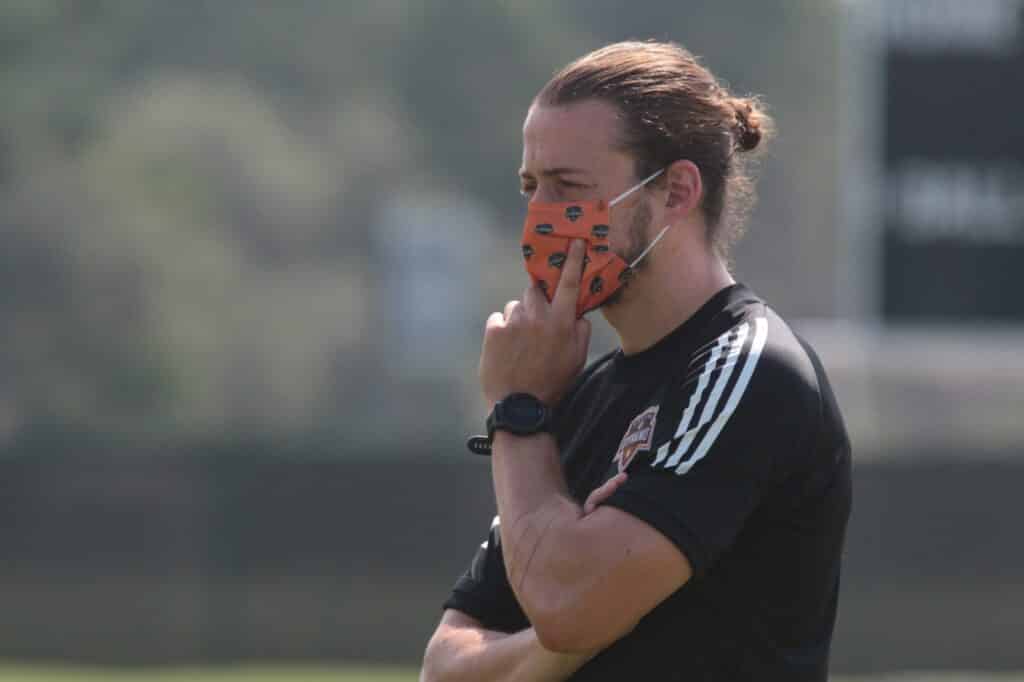
Currently, Centofanti’s role as the Head of Academy Strength & Conditioning with the Dynamo sees him predominantly working with the U-23s and U-17s squad, a position that has given him a direct lens onto the league which has produced the likes of RB Leipzig’s Tyler Adams and Manchester City’s Zach Steffen.
To start things off, what drew you to the sports science side of football?
Adam Centofanti: I think the original thing that drew me to the sports science side of the game is just my love for working hard, training hard and the intensity of the game. And as a player – when I was younger – I always wanted to compete at the highest level I could. And to do that I thought the only way was through fitness, so I began to love that side of the game.
Ultimately, as a player, it didn’t work out for whatever reason, but you meet some people along the way and in particular for me, it was a mentor named Loris Bertolacci who got me into the sports science world. [With him] I was able to experience working with athletes and exposure to a professional football team for the first time, Melbourne Heart.
From being at Melbourne Heart and then Melbourne City, how did you end up making your way to the Houston Dynamo?
Adam Centofanti: Obviously I started at Melbourne Heart, but then they became Melbourne City and I was able to get a job as a Community Development Coordinator. So, basically, I would go out and coach kids at schools, which was sort of my foot in the door to getting paid by a professional team. At the same time, I had been volunteering my time for many years to the sports science department of the youth team.
So, it was many long hours, but it was something I knew I had to do. Because it was something where you had to commit to doing what you actually want to do long-term and fortunately, I was given a role at Melbourne City. I then spent a good part of five to six years there plying my trade, and ultimately there was an opportunity [at the Dynamo]. I had a contact at Houston through my current colleague Alex Calder, who is another Australian performance coach, and went through the interview process and got the role that way.

I did notice that there are a lot of Australians that have worked as physios, sports scientists and strength & conditioning coaches overseas over the past few years. Why do you think this area of Australian football is growing so well?
Adam Centofanti: I think across the world Australians are quite respected in the performance side of things. It’s definitely something I noticed when I first got to America, they just thought that Australians must be good at strength and conditioning. Obviously, that’s also down to the people who came before us, the big names of Darren Burgess and Phil Coles, guys that have been in the game for a long time and have set the premise for what Australians are all about.
If you look at the players we’ve produced in our nation in the past, from a conditioning standpoint they were excellent. And they all played in the top divisions. So, we sort of started to earn this reputation of being a fit country who work hard, which makes it positive for people like myself when they do come to an overseas team as you’re respected from the get-go in that regard.
As you mentioned, in addition to working in the sports science area of football you have played the game yourself, representing the likes of Bulleen Lions, Hume City and Dandenong Thunder. What did you learn from playing the game yourself that you have taken into your strength and conditioning work?
Adam Centofanti: The first thing I’ll say is playing the game can’t help you enough in this type of role whether it was at a good or okay level, the experience of playing gives you great insight into what is required physically and mentally to perform. Knowing what it feels like to be a player is important from a communication point of view, but then also now your understanding of the game is better. So, you can apply best practice to drills and you can talk to coaches in a certain way that maybe other people who haven’t played the game.
As well as that, for me, I was always extremely competitive and intense as a player and I’ve become that type of coach, which is sort of a stereotype for a conditioning coach but if you’ve got that edge and drive about you, it does brush off on the players.
Football – and the world today – is completely different to where it was 10, 20 and even 30 years ago. Why has sports science become such a pivotal part of football around the world?
Adam Centofanti: The main thing is the game is obviously faster, the players are fitter and stronger, the style of play has changed as well. We’re seeing a lot more pressing teams, which from an intensity standpoint means it’s gone to another level, meaning that the preparation for these players needs to be at an even higher level to ensure you can keep them on the field [for longer].
As well as this, due to advances in science these types of positions are becoming part of general practice in football clubs. So, now it’s baseline standards to have these people to help the environment. It’s reached a point where now you see performance staff and technical staff collaborating as one team, and it’s not so much a hierarchy where the coach dictates everything.

In terms of working to circumvent injuries, what is the methodology behind that?
Adam Centofanti: In terms of injuries, programs are designed in such a way to address all the potential issues in the gym and on pitch before they happen with the hope that we can get guys to a higher level physically and increase their robustness.
We’re training guys to match the high standards of modern football so that these issues don’t occur. Which is why I think the mentality needs to be – especially with the youth players – get them to a level of conditioning where you can throw a whole lot at them. We’ll do things where we’re testing players physically and mentally to the point where we’re potentially red-lining them, but it’s an important part of development having the body exposed to those kinds of demands. [It means that] when they’re asked to do it in a game, multiple times a week potentially, they can tolerate it.
You obviously spent time working with Melbourne City in the A-League, who have developed into the powerhouse side they are in the A-League today. What was it like being in that environment as its facilities and infrastructure were being built to the standard they are at today?
Adam Centofanti: The Melbourne City experience was absolutely amazing, first and foremost. Seeing the club transform from what I saw at Melbourne Heart days to where it is now is day and night. I remember [at the Heart] doing gym sessions with my ex-colleague Raffaele Napoli on the field with bands and tying them up against a fence because that was the best gym that we could provide. To the point where, just before I left, you’ve got two world class gyms and top-level fields that are hard to come by anywhere in the world.
So, the transformation was remarkable. But I think the biggest thing about the Melbourne City development was that not only did the facilities improve overtime and obviously the team got better, but the technical staff and performance staff were just top-level practitioners. So, that is a club that is not only evolving from a logistical standpoint, but the quality of the individuals they’ve hired to fill certain roles has been exceptional.
What was the transition like between working with Melbourne City and Houston Dynamo?
Adam Centofanti: It was a really interesting experience at the beginning because I was heading into a role that was brand-new. So, it was very much a blank canvas to create processes, new standards, education around how we train and why we train – whereas all that was established already in Melbourne. So, I found early on that it was an educational experience to get my point across about why we do certain things and why this can improve the level of the players.
The best thing about Houston since I’ve been here has been the exceptional buy-in from day one. They’ve been very open to ideas and it does come from the fact that Melbourne City and City Football Group is a respected entity. So, going into it they already respected what I was going to talk about, which made the transition a lot easier in terms of implementing similar ideas that I had done in the past into a new environment with a completely different cohort of players. This was a cohort of players who, unlike in Melbourne, had minimal experience in any sort of hard conditioning or gym. Another major positive I noticed very early was the hunger of the players to work. Coming from a range of backgrounds, football means the absolute world to them, so the players were more than willing to put in the hard work to improve.
The first 6-12 months were about education and exposure to the different types of training that we were going to do for years to come. Fast-forward to now, the players are at a very good level and are able to do everything that I’ve seen players do in the past. So, it’s been a really good evolution in my time here.

