

The importance of the professional football coach in Australia

Bobby Walker was the first professional football coach appointed in Australia when he took the helm at the Gladesville-Ryde club in 1939. Walker had played professionally in Scotland for Motherwell FC and Falkirk FC.

He was the first of many from the British Isles to venture to the footballing outpost that was Australia for much of the 20th century. The contributions that he and many others made played an important role in the growth and development of the game.

Sadly, the notion of fully professional coaches mentoring young players in their formative years has been more of a dream than a reality in Australian football. Enthusiastic parents often took on official duties at a grass roots level and the number of officially qualified coaches in schools has traditionally been low.

The reality for players blessed with talent not deemed worthy of representative level play; those perhaps destined to bloom and flourish as a player a little later in life, is that the influence of a professional to guide and nourish their football development is rarely a reality.

In recent times, parents keen to encourage and fast track their child’s development have sought other avenues. As a result, the unregulated and often absurdly expensive academy system has become a necessary evil for parents of talented and enthusiastic young footballers.

It is a somewhat surprising reality that it took nearly 80 years from the time of Walker’s appointment for a fully professional coaches association to appear. It is long overdue. There is a current and urgent need to ensure that the hundreds of thousands of young people playing football in Australia are given qualified and professional instruction.

Conjointly, immediate action is required to reform/rewrite the National Curriculum which has proven nothing but a failure.

With an intention to represent, advocate, develop and support professional coaches, Football Coaches Association (FCA) will play a key role in addressing such issues.

The association’s work extends beyond the obvious need to continually improve coaching standards in Australia. It is also focused on providing opportunities for professional and community based coaches to contribute to Australia’s football narrative.

As an extension of both a raising of the bar in terms of professional standards and providing a supportive, community based and inclusive environment for all coaches involved in the game, FCA also aims to enhance the reputation of Australian football and its coaches on the world stage.

As we speak, former Socceroo manager Ange Postecoglou stands within a handful of wins and just a few weeks of becoming Australia’s most successful coaching export. Should Yokohama F.Marinos manage to seal the deal over the final month of the J-League season, his achievement would be considerable and well deserved.

Postecoglou forms part of a group of Australian coaches who have dominated the top flight of domestic football since the inception of the A-League. Alongside Socceroo and Olyroo boss Graham Arnold, current Perth manager Tony Popovic and former Victory coach Kevin Muscat, Postecoglou completes an impressive quartet.

As a collective, the four men possess six A-League championships, countless grand final appearances and a staggering seven premierships. Their sustained success confirms the importance and value of a proven coach. In spite of playing personnel changes, injury concerns or absences due to international duty, their message always remained consistent, firm and effective.

Now, Western United’s Mark Rudan and Sydney FC’s Steve Corica loom as the new generation of Australian coaches, yet with only Popovic employed on the domestic scene, the stocks do look a little thin elsewhere.

It is potentially where Australian football is slightly off the mark when it comes to player development. Rather than mad capped international searches to find the right visa player or marquee man, A-League and NPL clubs would be better served investing more heavily in the person they ultimately choose to mentor their playing squad.

Acquiring the services of an elite international coach would do far more for young Australian players seeking to learn and develop their footballing nous.

Playing professionally alongside an experienced ex-La Liga or Bundesliga journeyman will no doubt count for something. However, young players like Riley McGree, Elvis Kamsoba and Al Hassan Toure will benefit far more from time spent under a truly world class manager than mingling with an ageing veteran merely visiting our shores.

Postecoglou, Arnold and Popovic have all had a taste of coaching abroad and our best minds will now always attract Asian Confederation interest. What remains on their departure will always be young and developing coaches, coaching young and developing players.

Redressing that cycle is vital and something within which the FCA can play a key role; both in improving standards and enunciating the importance of the coach at all levels of football.

Previous ArticleNext Article

AFC Women’s Asian Cup: How do we sustain growth and success?

This year’s AFC Women’s Asian Cup 2026 was not just another tournament. It was a momentum shift for women’s football in Australia. Match quality, crowd numbers and national pride have never been higher – but how do we ensure this success continues after the final whistle?

Financial input and output

Ahead of the tournament, the Australian Government demonstrated their support and commitment through a $15 million investment.

With such significant financial backing behind the Matildas’ pursuit of victory on home soil, the tournament seemed poised to be hugely successful – and it didn’t disappoint.

Projections point towards an overall revenue of over $250 million, with over 24,000 international visitors and 1000 jobs created. It proves that when money is invested into the women’s game, the rewards on and off the pitch are undeniable.

Federal Minister for Sport, Anika Wells, was present at the official announcement of the Australian Government’s funding boost.

“The Tillies and the 2023 Women’s World Cup redefined Australian sport and now the Albanese Government is backing the Matildas again with a $15 million investment for the Women’s Asian Cup,” said Wells.

“Women’s sport is not nice to have or a phase, it is brilliant, nation-stopping, and here to stay.”

With huge revenue numbers and contributions to local economies, this year’s AFC Women’s Asian Cup has demonstrated the financial power and potential of the Matildas, and ultimately of women’s football across Australia.

Attendance numbers skyrocket

Beyond finances, however, the standout factor throughout the tournament was the record-breaking crowd sizes.

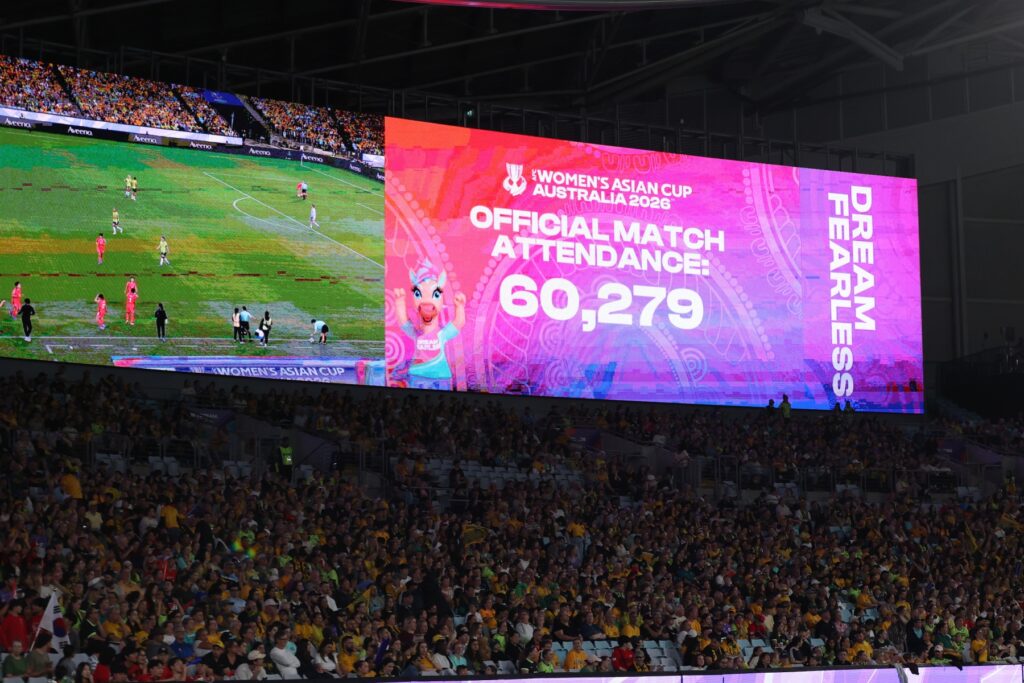
60,279 fans packed into Stadium Australia in Sydney to witness an entertaining 3-3 draw between the Matildas and South Korea, a huge number which was later smashed by Saturday’s final attendance of 74,397.

However, support wasn’t exclusive to the Matildas. At Japan’s semi-final demolition of South Korea, a 17,367 crowd set a record for the highest attendance at a Women’s Asian Cup match between two visiting teams.

Although skeptics will highlight that many games failed to sell out, the crowds attracted during this year’s tournament highlight two decades of immense growth. In 2006, the final brought in little more than 5000 people.

In fact, with 250,000 attendees over three weeks, and ticket sales increasing five-fold from the previous record, the proof of a nationwide buzz is there for all to see.

But creating a buzz is not enough. We must act on it, and sustain it, if we want to see true, long-term development.


Avoiding past mistakes

Following the excitement of the 2023 FIFA Women’s World Cup, women’s football in Australia looked set to launch into a new era of development and expansion.

Although female participation increased in New South Wales by 31% between 2022 and 2025, attendance numbers at ALW matches fell by 26% between the 2023-24 and 2024-25 seasons. The ‘buzz’ – without genuine commitment or backing to sustain it – wore off far too quickly.

This year’s AFC Women’s Asian Cup was a second chance for Australia’s football industry to correct its past mistakes, and ensure that state federations, governments and teams align in their commitment to growing the ALW and women’s football as a whole.

Furthermore, given the on-pitch prowess and off-pitch success over the past few weeks, the Asian Cup could play a major role going forward. It may yet be the catalyst, the long-awaited springboard that can propel women’s football to new heights in years to come, both on the international stage and within Australia.


How do we prolong the buzz?

So, while the success of the Asian Cup can encourage important discussions, the key is to inspire stakeholders and decision makers into taking real action.

On Saturday, Football Australia expressed their commitment to progressing the women’s game in NSW after the tournament ends. Joined by Football NSW and Northern NSW Football, they called upon the NSW government to address facility imbalances over the next decade.

“The growth of women’s football in New South Wales is not a short-term trend – it represents a fundamental shift in participation and expectation across our communities. To sustain this momentum, we must invest in infrastructure that is inclusive, accessible and fit for purpose, ensuring everyone has the opportunity to play, develop and thrive in the game,” said Football NSW CEO, John Tsatsimas.

“We call on the government to invest in the largest participation sport in NSW to bridge the growing facilities gap in NSW which will deliver economic and social long-term benefits through connected communities.”

To this end, a proposed NSW AFC Women’s Asian Cup Australia 2026 Legacy Fund – worth $343 million over a ten-year period – would address several issues at grassroots level. These include:

  • Delivering upgraded community facilities to accommodate growing participation numbers among women and girls
  • Improving accessibility, safety and playing capacity across metro, regional and remote communities
  • Supporting multi-use and multi-sport facilities
  • Strengthening pathways for women and girls across all age groups
  • Continuing the legacy of the AFC Women’s Asian Cup 2026

Should this fund be implemented in NSW over the next ten years, fans and players within the women’s game will be at the heart of a major, long-overdue realignment.

Final thoughts

Despite the bitter disappointment of losing in the final on home soil, there is nevertheless an important reminder to take away: we can’t control results on the field, but we can control intent, attitude and commitment off it.

The AFC Women’s Asian Cup 2026 was a huge success for women’s football in Australia. Matches were of extremely high quality, crowd numbers smashed tournament records, and the nation was united in their support for one of Australia’s most popular sporting outfits.

There may not be silverware to show for it, but the past few weeks have provided something far greater: recognition, respect and a platform to continue growing long after the final whistle. The demand is undeniable, participation and interest is soaring, and the voice of the women’s game can no longer be ignored.

10:1 Against the World Game: Hume City Council’s Budget Is a Kick in the Guts for Football

The numbers don’t lie. While football leads participation across the state, Hume City Council is spending ten times more on AFL infrastructure - exposing a funding imbalance that can no longer be ignored.

Across Melbourne’s northern suburbs, football clubs are doing everything they can to keep up with demand.

Participation is rising. Teams are expanding. Young players inspired by the Matildas are flooding into community clubs. Training schedules are being pushed later into the night and volunteers are stretching limited facilities simply to keep pace with growth.

But behind the scenes, there is a problem quietly building and it is one that has little to do with the passion of players or the commitment of grassroots clubs.

It sits inside council budgets.

And when the numbers are examined closely, the picture becomes impossible to ignore.

The City of Hume’s current budget reveals a funding reality that should concern every football participant and every ratepayer in the municipality.

For every dollar spent on football infrastructure, Hume City Council is spending roughly ten dollars on AFL and oval-based facilities.

A 10:1 funding ratio against the world game.

For a sport that leads participation across Victoria, that figure isn’t just disappointing – it’s a kick in the guts for football communities across the municipality.

And for those watching the game grow while infrastructure continues to lag behind, it represents something even more troubling.

Ignorance hiding in plain sight.

The Numbers Inside Hume’s Budget

The City of Hume’s 2025-26 capital works program allocates roughly $1.55 million to football-specific infrastructure projects.

That includes:

$1.265 million for the renewal of the synthetic pitch and lighting upgrade at John Ilhan Memorial Reserve

$250,000 for portable change rooms supporting Upfield Soccer Club at Gibb Reserve

$35,000 for a goal cage for Roxburgh Park United Soccer Club

Important projects for the clubs involved, without question.

But when placed alongside the rest of the sports infrastructure spending in the same budget, the disparity becomes glaring.

Oval-based facilities – primarily serving AFL and cricket – receive close to $15 million in funding.

Projects include:

$4.71 million for the Willowbrook Recreation Reserve pavilion expansion

$3.45 million for the Vic Foster Reserve pavilion upgrade

$1.795 million for the redevelopment of Johnstone Street Reserve

$1.294 million for change room upgrades at Lakeside Drive Reserve

$1.207 million for the Bradford Avenue Sports Ground upgrade

Lighting upgrades, pavilion improvements and reserve master planning across additional oval facilities push the total even higher.

The bottom line is simple.

Ten dollars for AFL infrastructure.

One dollar for football.

The Participation Gap No One Wants to Acknowledge.

The imbalance we see in Hume mirrors a broader trend across Victoria.

Participation data shows football sitting comfortably at the top of the sporting ladder, yet infrastructure investment tells a very different story.

Across the state:

Football: approximately 260,000 participants, receiving around $9.31 million in infrastructure investment annually

Netball: around 100,000 participants, receiving $14.35 million

Cricket: roughly 80,000 participants, receiving $33.55 million

AFL: about 140,000 participants, receiving $39.17 million

The sport with the largest participation base receives dramatically less infrastructure funding than codes with significantly fewer players.

Football is carrying the participation numbers.

Other sports are receiving the infrastructure.

And when councils continue allocating funding based on outdated participation assumptions, the gap only widens.

The Pattern Across Melbourne

Hume’s spending decisions sit within a broader trend across metropolitan Melbourne.

In Whitehorse, $28 million has been committed to the redevelopment of Box Hill City Oval.

In neighboring City of Boroondara, significant funding is being directed toward the refurbishment of the Michael Tuck Stand.

Again, the issue is not whether these facilities deserve investment.

Community infrastructure should absolutely be maintained.

But when tens of millions are flowing into upgrades for oval venues while football clubs across Melbourne struggle to secure additional pitches, the imbalance becomes difficult to ignore.

Participation growth is happening in football.

Infrastructure investment is happening somewhere else.

The Frustration From Industry

There is another dimension to this issue that is rarely discussed.

In recent conversations I’ve had with business leaders and industry advocates working across the sports technology and recreation sector, many have openly vented their frustration about the lack of understanding from government when it comes to football’s broader ecosystem.

These are entrepreneurs and innovators working in areas such as performance data, AI scouting platforms, wearable technology, fan engagement systems and digital broadcast infrastructure.

Industries shaping the future of global sport.

Yet many say football innovation in Australia continues to be misunderstood by policymakers who still frame sport through traditional codes rather than recognising the scale of the global football industry.

The irony is clear.

While councils debate whether football deserves additional community pitches, the global football economy is expanding rapidly across technology, data, manufacturing and commercial innovation.

If Australia fails to recognise that opportunity, we risk missing out on industries that will define the future of sport.

A Growing Movement for Change

Last week, the Level the Playing Field campaign was launched at the Victorian State Parliament to raise awareness about exactly this issue.

The campaign highlights the growing gap between football participation and football infrastructure investment across the state.

It shines a light on a reality that grassroots clubs experience every week.

Football participation is surging.

Infrastructure investment is not keeping pace.

And unless that imbalance is addressed, the sport’s growth will eventually collide with the limits of available facilities.

If Not Now, When?

Australia has never had greater momentum behind football.

The Matildas have inspired a new generation of players.

Participation continues to grow across communities.

Clubs are expanding.

Demand is rising.

And yet the infrastructure conversation remains stuck in the past.

If councils cannot recognise football’s growth now – when participation is leading the state and the global opportunity around the sport continues to expand – then the question becomes unavoidable.

If not now, when?

A Civic Responsibility to Speak Up

As CEO of Australia’s leading football business magazine, Soccerscene, I believe it is our civic duty to raise awareness about these issues and help break down the barriers that continue to hold the game back.

For too long, football’s infrastructure challenges have been discussed quietly within the sport itself.

That must change.

Advocating for the growth of the game – and ensuring decision-makers understand the participation reality – is not just about football.

It is about communities, opportunity and fairness for the sport played by more Australians than any other code.

Championing that conversation is part of our responsibility to the game, to the industry that surrounds it, and to the communities that continue to drive its growth.

The Question That Cannot Be Ignored

The numbers inside the Hume City Council budget are clear.

A 10:1 funding ratio against the world game.

For the largest participation sport in the state, that statistic should prompt serious reflection.

As I’ve said before:

“When Hume City Council spends ten times more on AFL infrastructure than the world game, despite football’s participation growth, the problem isn’t demand – it’s ignorance staring us in the face as ratepayers.”

Football is not asking for special treatment.

It is asking for proportional investment that reflects participation, growth and opportunity.

Because if the sport with the largest participation base continues to receive only a fraction of infrastructure investment, the problem is no longer participation.

The problem is how decisions are being made.

And communities across Melbourne are starting to notice.

Most Popular Topics

Editor Picks

Send this to a friend