




US investment could strip European football of traditional values

Since its inception, football has remained fundamentally Eurocentric in both its structure and cultural dominance.

As football expanded from England into Western Europe, foundational institutions such as IFAB, FIFA, and UEFA were formed under established European models of governance, cultural traditions and sporting philosophy.

However, a transatlantic threat in the form of American involvement in boardroom negotiations, network acquisitions, and media rights portfolios looms over these European models.

A subtle but systemic Americanisation of football is now underway, with American capital inserting itself into European football more than ever.

As of the 2025/26 season, 10 of the 20 Premier League clubs, 9 of the 20 Serie A clubs, and a quarter of Ligue 1 clubs are majority US-owned.

This year, American investors have been involved in 19 of the 30 ownership transactions recorded in Europe.

Even lower-league clubs and merging football markets are becoming increasingly targeted by US investors in pursuit of undervalued assets with high growth potential.

Growing transatlantic interest in football extends beyond investors. The US Government utilises sport, especially football, as a geopolitical tool for projecting American power and identity.

Chelsea’s victory and subsequent trophy-lift featuring Donald Trump at the US-hosted 2025 Club World Cup offers the most visible example yet.

The Trump administrations use of sport as a platform for political messaging and national branding highlights the inseparability of sport and politics.

Implications of increased US involvement

US capital is normalising and enforcing operations that contradict traditional European models.

Investors are partaking in multi-club ownership to create operational efficiencies across player transfers, global brand development and content dissemination.

This goes against the values of local identity and member governance that constitute traditional club ownership models.

A report published by the International Centre for Sports Studies highlights the rising prevalence of multi-club ownership in the ten European leagues it examined.

A total of 78 multi-club ownership investments were finalised between 2019 and 2023.

Close to 40% of the 341 clubs analysed in the report were directly connected to another football club through shared ownership.

Moreover, European leagues are experiencing the introduction of profit-driven, scalable business models inspired by American sports.

It is global brand building and revenue maximisation strategies like this that are replacing traditional European models.

Governing bodies have already faced challenges surrounding American investment, which now extends beyond individual clubs and encompasses entire commercial frameworks.

Most recently, UEFA was forced to deny Crystal Palace entry into the Europa League due to ownership conflicts involving American shareholder John Textor, who at the time held significant shares in both the English club and Olympique Lyonnais.

The situation highlights how the influx of American capital, and the multi-club ownership models it introduces, can create regulatory complications even when sporting merit has been earned.

What does the future of European football look like?

US capital has already reshaped the operational frameworks of European football clubs.

If things continue as they are, we could see a sport-wide shift to American entertainment industry models, characterised by broadcast revenue optimisation.

Football clubs tend to have deeply rooted fan bases and strong cultural significance, offering investors access to new markets to extend their influence.

Given this reality, club acquisition could soon become little more than a vessel for commercial strategy for corporations.

Recent developments in the La Liga indicate that this idea may be closer to reality than expected.

Barcelona vs Villarreal is currently being planned to be played in Miami as a standalone international league fixture, with Real Madrid and many other clubs ‘strongly’ rejecting the concept.

Private equity firms are now targeting not only clubs, but also the organisations that manage and control broadcast and commercial rights.

In doing so, these companies place themselves at the core of the revenue-generating aspect of football.

The International Centre for Sports Studies report shows that private equity comprised the majority share of all foreign investment deals in European football between 2019 and 2023. US-based investors were responsible for just under 90% of transactions.

Should this trajectory of US investment and the search for global commercial success continue, the beautiful game will inevitably risk losing its traditional values.

As US influence grows, it will become harder to balance profit with football’s traditions. To protect the game, investors must show both long-term vision and respect for its culture.

Previous ArticleNext Article

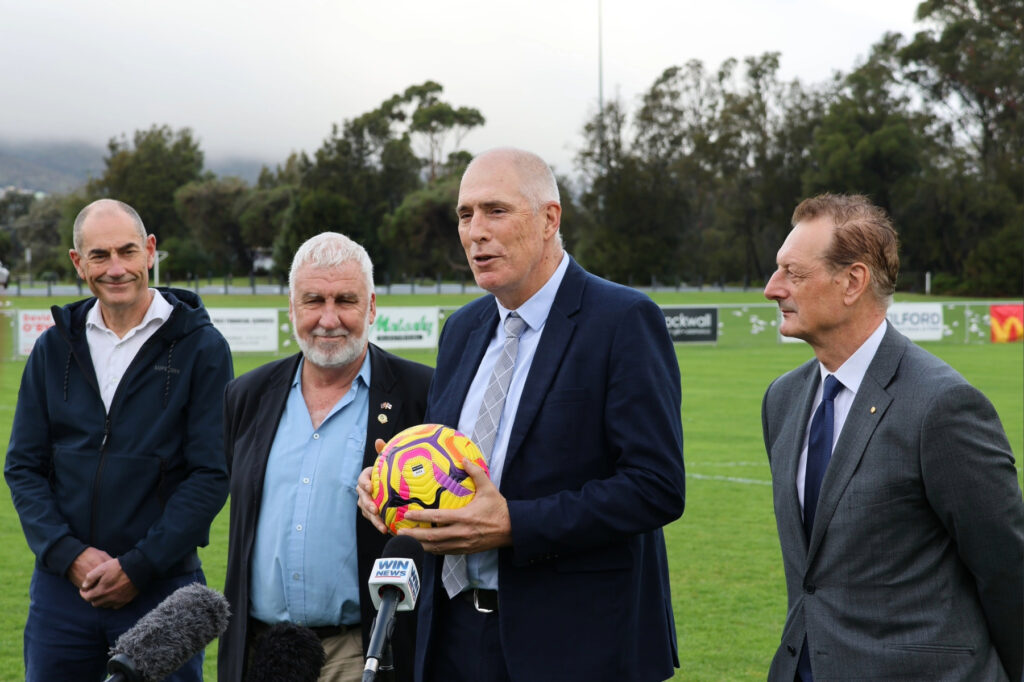
Tasmania’s State Budget Commits $350,000 to Football Facility Planning as $80 million Home of Football Moves Closer to Reality

The Tasmanian State Government has committed $350,000 in seed funding for the next stage of planning for Football Tasmania‘s proposed Home of Football, moving the state’s most significant football infrastructure project closer to construction and signalling political recognition that demand for rectangular facilities in Tasmania has outgrown what currently exists.

The funding, confirmed in the 2026-27 State Budget handed down last week, sits within an almost $200 million investment in sport and recreation across the budget and forward estimates: a package the government describes as designed to improve access and participation for Tasmanians of all ages. The football allocation is listed alongside a $25 million community sporting infrastructure commitment at Kingborough, $12.5 million for new multipurpose indoor sporting courts at New Town Bay, and $8 million for the Domain Tennis Centre redevelopment.

Football Tasmania CEO Tony Pignata OAM welcomed the commitment as an acknowledgement of the structural gap between participation numbers and available infrastructure, particularly in the state’s south.

“The State Government’s delivery on this commitment shows us that they understand that demand outstrips supply for rectangular facilities in the state,” Pignata said. “If we are to continue to grow and develop future Matildas and Socceroos, we need to invest in the infrastructure our game so desperately needs.”

The proposed $80 million facility would include six full-sized pitches, three synthetic and three turf, alongside four five-a-side pitches, modern changerooms for both men and women, and dedicated training facilities. The design is intended to serve every level of the game simultaneously, from grassroots junior competitions through to national-level tournaments.

From grassroots to A-League ambitions

Football Tasmania has framed the facility’s purpose across a deliberately wide range of uses. At the community end, it would provide a permanent home for junior games and regional tournaments that currently compete for limited rectangular ground availability across the state. At the elite end, it would create the capacity to host national competitions including the Emerging Matildas and Emerging Socceroos Championships, flagship state competitions such as the Statewide Cup finals, and potentially, in time, an A-League team.

That last ambition is the most significant and the most distant. Pignata was measured but direct in raising it, situating a Tasmanian A-League club alongside the NBL’s Jackjumpers, the WNBL’s Jewels and the AFL’s Devils as part of the state’s emerging identity as a home for national sporting competition.

“One day down the track, we anticipate this would become home to our very own A-League team, so that we take our rightful place in the nation’s elite competition,” he said.

The pathway from planning funding to A-League admission is long and would require sustained political and commercial support well beyond the current commitment. But the logic is consistent with how football infrastructure investment has worked elsewhere in Australia. The facility comes first, and the competitive pathway follows. Without a purpose-built ground that meets the standards required for elite competition, the conversation about an A-League team cannot begin in earnest.

The equity dimension

The inclusion of modern women’s and men’s changerooms in the facility’s design carries more weight than it might appear. Community and semi-professional football facilities across Australia have historically been built to male standards, with women’s changerooms added as afterthoughts or not included at all. That inadequacy has been consistently identified as a barrier to female participation and to the hosting of women’s competitions at venues that cannot accommodate them properly.

A purpose-built facility that treats women’s infrastructure as a design requirement rather than a retrofit positions the Home of Football to serve the growth of women’s football in Tasmania in a way that existing facilities cannot. The state recorded 41,395 registered football participants in 2025, a number that has been growing and that the current rectangular facility stock was not built to support at this scale.

Additionally, the government’s Ticket to Play program, which provides eligible children with two vouchers worth up to $100 each for sporting participation, and the Ticket to Wellbeing program offering $100 vouchers to eligible seniors, represent indirect but meaningful support for football participation across the state’s communities.

Pignata also acknowledged outgoing Football Tasmania President Bob Gordon, who he said had dedicated almost a decade to the organisation and had been instrumental in lobbying for this and other facilities across the state.

The $350,000 planning commitment is a beginning. The $80 million facility it is intended to progress remains subject to further government investment and development approval.

Community Spirit Shines on AFC Grassroots Football Day 2026

This week, Football Australia (FA) celebrated AFC Grassroots Football Day 2026, championing the people and communities who continue to hold up a safe, inclusive and supportive environment in the football landscape.

‘For all, for life’

In collaboration with Football NSW, Canterbury Football Association and community club, Balmain & District Football Club, the day reflected the very best of what football provides.

The event brought in participants of all ages – from 4-74 years-old – and reached a total of 400 people. Girls-only programs, all-abilities sessions and over-age football ensured all were catered for.

Such a diverse range of participants builds on a wider drive during FIFA World Football Week, which seeks to promote the sport not just as the dazzling lights of 100,000-seater stadiums, but as a way to foster community spirit and social development.

Furthermore, FA support through its Club Changer program was a welcome addition to the action, emphasising the organisation’s commitment to nurture a real love for the game across communities in Australia.

“Through Club Changer we support our clubs to provide a safe, fun and enjoyable environment where everyone is welcome; whether that be as a player, volunteer, referee or supporter,” explained National Program Manager Club Development at FA, Grace Lambourne.

“Everyone should feel they belong and are welcome to play, stay, and love the game.”


A welcome celebration

While the upcoming FIFA World Cup will no doubt inspire millions of future Socceroos and Matildas, events like the AFC Grassroots Football Day represent something beyond just inspiration.

It is a platform. An opportunity to express a love for football and to connect with others while doing so.

And connections between the professional and grassroots game is more important than ever if Australia is to nurture the next generation of talent.

This is particularly clear in the rise of women’s football across the nation. Since the FIFA Women’s World Cup, female participation rose by 32%, and registrations for the MiniTillies Program skyrocketed from 264 in 2023, to 1223 in 2024.

The professionals spark passion. But communities turn that passion into playing time.

That is why celebrating grassroots football – and the volunteers and families who sustain it – is a vital part of Australia’s football future. Together, FA and the AFC are creating strong foundations built on positivity, engagement, and inclusivity for all with a love for the beautiful game.

Most Popular Topics

Editor Picks

Send this to a friend