
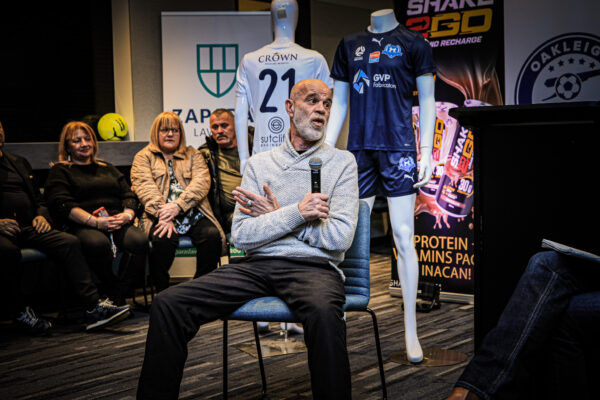


When I asked Greg Werner why he was interested in researching and recording the grassroots clubs of each and every Socceroo and Matilda, his answer was simple.
“It was born out of frustration, frustration that the largest sector of the game in this country was being ignored.”
In 2014, the Sutherland Shire based writer set about righting that ship and his journey continues to this very day. Over the last five years, Werner has ventured to all points of the domestic compass in an attempt to shed light on the origins of Australia’s representative footballers and in an effort to flesh out Australia’s footballing story.
His travels led to an unexpected publication, yet his passion to create a more in depth and detailed narrative of the Australian game has always been the most powerful driver behind what is a bold and broad reaching vision.
The trigger for the time consuming and often frustrating quest was an SBS piece on the Matilda, Servet Uzunlar. Werner recalls it vividly.
“I discovered during the segment that Unzular grew up playing in the same association in which I had spent 10 years playing & coaching. I asked myself why. If I was unaware of such a wonderful local players’ presence, how much else had escaped me?”
By extension, the key question for Werner became, “How many clubs were going completely unacknowledged for their contribution to our national teams.”
Such are the holes in the Australian footballing narrative and oft is the point made that the game existed on the national sporting landscape well before the heroics of the Socceroos at the 1974 World Cup. Equally emblematic of a poorly recorded history is the fact that many young A-League fans appear somewhat ignorant of the glory days of the NSL and the contributions made by community clubs during that period.

Werner’s ambition focusses specifically on the individual players who have worn national colours; those whose early years of development are often overlooked and unrecorded at the expense of the contemporary concerns of the team they represented.
I put Werner’s claim that “If you are to go to just about any player’s Wikipedia entry you would think that they did not start playing until the age of 15,” to the test and in most cases, it proved correct.
Appearing as something of an enormous task, I asked Werner where he began.
“I started with what I knew from conversations on the side lines of the Shire and personal experience. The Griffiths brothers (Joel, Adam and Ryan) played at Menai, Graham ‘Arnie’ Arnold played at Gwawley Bay, Murray Barnes began at Kissing Point & my best mate Richie Bell started with Cronulla RSL.”
“Beginning with those bare bones, I realised there were only 800 more players to research,” recounted Werner with something of a tired chuckle.
“The search for answers began with Facebook, and was continued on the side lines of international training sessions, after A & W-League games, at NPL matches and even at FFA Cup and Champion of Champions finals. It also, beyond everything else, involved thousands of hours trawling through programs, magazines and newspapers going back to whenever.”
Werner has seen every major Socceroos game in Sydney since 1969, bar the disaster of 1981 and every home Matildas game since 2015.
It was the insistence of Fox Sports commentator Andy Harper that Werner’s mission would only be taken seriously with a supporting website to present the material. Now overflowing with history and memory, http://www.grassrootsfootballproject.com/ presents the accumulated research in a written and visual form.

Perhaps both the intention behind and the potential impact of the Grassroots Football Project is best encapsulated in Werner’s own words, “I have had the absolute honour of meeting men who were my footballing heroes and men whom I had never even heard of before the GFP.”
Such a sentiment now extends to the women’s game and no doubt the next generation of female players currently competing in junior play will be advantaged by the opportunity to read about the pioneering Matildas; those women who paved the untrodden and difficult path towards support and acceptance of the women’s game.

The collated facts and data proved too enticing for renowned publisher of football books Fairplay Publishing to ignore. Werner became a co-author of the Encyclopaedia of Matildas; a visually stunning text that journeys through the history of the team and the women at the core of its success.
“It was an honour to have been given the opportunity to co-author the text and also beyond my wildest dreams. Now my dreams have shifted and I already have another book in the works and the one after that is already in the planning.”
Research has sent Werner to hundreds of gatherings in recent years.
“When Brazil toured here in 2017, I took the day off work to go to Newcastle to the first Matildas Reunion, a gathering of 60 players from all over the country. That night I added almost 20 entries to my list and had the best night of my footballing life apart from November 16th 2005. I left there at 1am to drive home to Cronulla, dealing with 40kph speed zones all the way down the freeway.
I have had the honour of spending time with some of the legends of the Australian game.”
Not seeking personal gain, Werner’s simple ambition is to “change the way the powers that be regard the most important clubs in the country,” and in turn “to make the history of our game relevant”.
It is an admirable and bold endeavour and one destined to continue.
“The GFP was never designed to be completed, for as long as internationals were being played, new players would be picked. My only aim was that their stories would be told, something which is now starting to be done. The end game would be that a plaque would be placed at the home ground of each of these clubs to make tangible their contribution.”
Something tells me that Greg Werner’s passion and energy may well make those plaques a reality. What a fitting tribute they would be to the grassroots clubs that have provided the Socceroos and Matildas with such wonderful players and people throughout Australia’s footballing history.