

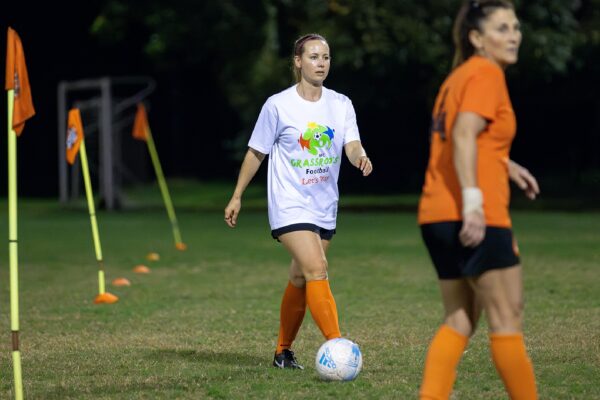



Stress Fractures: Are Hard Play Surfaces At Fault?

In a previous article where Soccerscene spoke with a member of a localclub about playing pitches, they commented on stress fractures being an issue when their younger teams played on the hard fields every season. Though they were not quoted in the story, the thought of young athletes sustaining life-changing injuries due to preventable factors is quite serious.

Stress fractures (or hairline fractures) occur when the bone is being overused, leading to the body being unable to repair the hard tissue over a period of time, resulting in a break in the bone. For this to happen, a person would have to repeatedly perform the same action where the injury is located, which is more likely to be in the foot and ankle and shin bones.

Knowing now how stress fractures occur and what leads them to occur in the first place. Is it the pitches or something else?

The Pitches

Football pitches and outdoor sports grounds are usually regulated by the governing body and state government in Australia; however, bodies like FIFA have larger control over the sport in a larger area. This includes what type of pitch is used.

Artificial footballpitches (or synthetic turf pitches) are common in sports grounds due to their versatility. The pitch can be used year-round and is independent of the seasons and weather and is used in both professional and amateur league sports grounds. Most artificial pitches are made of plastic fibres sewn to rubber matting to help with shock absorption.

Installing artificial turf also means the grounds do not have to be maintained as much as if it were natural grass. However, in the Premier League, several instances and complaints about player conditions on artificial fields have resulted in player injuries due to their mobility.

Though FIFA has conducted several research and development projects to create the perfect artificial turf since 2015, and recent academic papers have proven players are less likely to be injured on artificial turf, sustaining injuries could be from changes in the types of training and playing surfaces athletes are used to.

In Australia, major sports grounds will have artificial turf installed, while outdoor areas will have natural grass, which is what most of the young-aged teams usually play on.

In the Sports Injury Survey 2024/25, 41 per cent of leg and ankle/foot injuries which resulted in hospitalisation were fractures; the second were soft-tissue injuries like muscle sprains. Boys aged 10 to 19 were more likely to be hospitalised by their injuries than girls aged the same.

The Other Factor(s) of Football Injuries

It is true the conditions of a soccer pitch, like all sports grounds, affect how a player will perform; it isn’t the only issue, according to Sam Turner, podiatrist and founder of ThatFootballPodiatrist, who has worked with athletes in the AFL and the A-League Men’s and Women’s.

He told Soccerscene there are many factors which go into why athletes develop injuries like stress fractures.

“What is the player’s history? Are they having the right nutrition? There are many factors,” he said to Soccerscene.

Sam believes simply blaming hard sports grounds for athletes sustaining injuries can be a bearing on the cause, but factors like how players recover from previous injuries, strength training, and the inappropriate size and condition of soccer boots are just as important.

“Is it the smoking gun? Probably not.”

At the start of September this year, Sam posted on Instagram an open letter to the Professional Football Association to aid the financial burden of soccer players who cannot afford to buy the recommended three to four pairs of boots to meet the physical demands of the A-League.

“The AFL collective bargaining agreement provides the player five pairs of shoes total, which can be things like boots and runners,” he said.

“When I go to Western United, especially to the women’s, they have no idea that it is possible for clubs to provide these entitlements.”

Though the club’s allowance for uniform and other expenses depends on sponsorships, some soccer player are paid as little as $40,000 annually after tax.

After paying for amenities and other expenses, given the choice of new boots costing hundreds of dollars or trying to extend the lifespan of boots that need replacing after training four times a week plus matches, players are more likely to choose the latter.

“Being comfortable can help players play better for 90 to 100 minutes of performance,” Sam said.

Besides having the correct and appropriate footwear, recovery and ‘listening to your body and acting on it’ may counteract the negative effects of exacerbating the injury, and in some serious cases, Relative Energy Deficiency in Sport, a syndrome found more in women athletes than men.

However, hard surfaces have proven time and time again to be detrimental to the health of players across all sports, and this needs to be considered by leagues around the country.
Previous ArticleNext Article

Victory unites with Roasting Warehouse in culture-led partnership

The Melbourne-based anf family-owned business will join the Victory family, uniting two institutions which represent the city’s culture and identity.

A partnership with local roots

As the newest partner of Melbourne Victory, Roasting Warehouse joins forces with a vital part of the city’s sporting landscape.

The club’s Managing Director, Caroline Carnegie, outlined why the partnership bears so much value to both parties.

“We are excited to collaborate with Roasting Warehouse, a community-oriented destination for high-quality coffee, proud of its foundations in Melbourne,” said Carnegie via official media release.

“Football and coffee sit at the epicentre of Melbourne’s culture. The two go hand-in-hand, consistently at the centre of the conversation that stirs Melburnians, which is no different to the conversation sport and Melbourne Victory stir in the State.”

Indeed, this is a partnership which combines the identity, passions and culture of an entire city, therefore giving it the foundations required for long-term, mutual success.

Representing the best of Melbourne

Both Victory and Roasting Warehouse are hugely successful in their respective industries. They are institutions with community-oriented philosphies, who pride themselves on craft and quality.

“We’re incredibly proud to partner with Melbourne Victory, a club that represents the heart, passion, and ambition of Melbourne,” revealed Roasting Warehouse Head of Brand, Alexander Paraskevopoulos.

“As a Melbourne-founded, family-run business, supporting a team that means so much to the local community feels very natural for us.”

Furthermore, through their high-quality blends, Roasting Warehouse will look to prepare Victory’s players and staff for high performances on the pitch as the seasons nears completion.

But this is about far more than just fueling athletes.

This is a partnership which embodies and unites two of Melbourne’s greatest strengths and cultural markers – a connection forged from the city’s very own DNA.


For more information about Roasting Warehouse, click here.

Stop Complaining, Start Building: Why Proactive Clubs Always Win

It’s a tale as old as time in grassroots sport: your club is stuck in a “time warp” facility, sharing a severely overused pitch with another code, while a club a few suburbs over just scored millions of dollars in council funding.

It is incredibly frustrating. The disparity in local government funding, the draconian facility-sharing arrangements, and the feeling that your sport is constantly fighting an uphill battle in certain heartlands can make committee members want to throw their hands in the air.

But when faced with this reality, your club has a choice. You can go on a rampage of advocacy – bitching, moaning, and focusing on everything the council or state sporting body isn’t doing – or, you can focus on what you can control.

The Post-COVID Divide

Think back to the clubs that emerged from the COVID-19 lockdowns. During that time, every club faced the exact same external restriction: nobody could play.

However, two distinct types of clubs emerged.

The first type went dark. They complained about the government, complained about the lack of support from their Peak Bodies, and disconnected from their members. They took years to recover.

The second type of club stayed connected. They acknowledged the reality but focused entirely on what they could do. They posted backyard drills on TikTok, sent training plans to parents, and kept their community engaged. As soon as restrictions lifted, they were on the front foot, miles ahead of the competition. Same environment, entirely different mindset.

The Circle of Control

In business and in sport, there is a circle of concern (things you care about but can’t change) and a much smaller circle of control (your own thoughts, behaviours, and operations).

If you have signed a 10-year lease on a substandard facility, that is your playing field. You aren’t going to change it tomorrow. So, how can you win given the rules you have?

·  Run a tight ship financially.

·  Pay your rent on time.

·  Communicate brilliantly with your members.

·  Streamline your governance.

Government likes to back a winner. If you spend your time spinning up the flywheels of good marketing, membership growth, and volunteer connection, you build a small business that clearly has its act together. When it comes time to advocate for better facilities, you aren’t just a complaining club—you are a highly successful, proactive community asset that councils will want to support.

Is your club stuck in a cycle of complaining? It’s time to take control of what you can. Contact CPR Group today to find out how our clubMENTOR program and strategic planning services can put your club on the front foot.

Most Popular Topics

Editor Picks

Send this to a friend