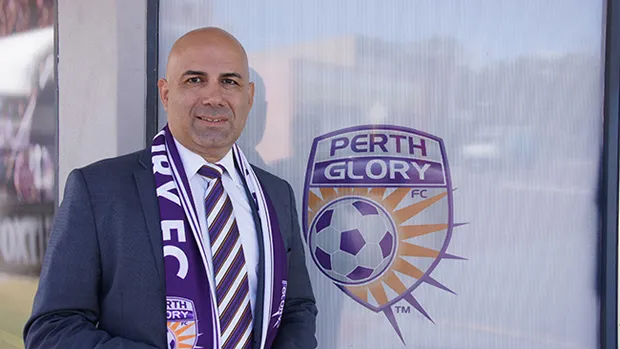


Sekulovski hits the ground running in Preston Sponsorship Management role

Naum Sekulovski might be in the twilight of his playing career, but he won’t be finishing up with football or his beloved Preston Lions anytime soon.

The former Perth Glory star has taken on the role of Sponsorship Manager for the 2021 season.

Preston has always been a club that has enjoyed enormous support from its community and its playing members.

The chants of “Ma-ke-don-ia” on game day bring goosebumps to all in attendance at BT Connor Reserve.

Even whilst playing at the relative depths of State League 1 for this former National Soccer League heavyweight, Preston has been able to rely on the incredible support of its fans who vote with their feet year in, year out.

However, it is the ability of the club to mobilise the support of the business network within its community that is truly impressive.

In recent years, the Preston Lions committee has enjoyed enormous success in mobilising the support of the business community within its ranks, signing on an extraordinary amount of sponsors a trend that has well and truly continued into 2021.

“At the top end of this year, back end of 2020, [Preston Lions President] Zak [Gruevski] approached me about taking on the role of Sponsorship Manager,” Sekulovski said.

“I’m coming to the twilight of my career as a player, so I’ve always wanted to understand how I can get more involved behind the scenes.

“I’m always going to have that football attachment and I’m interested in the business side of running a football club, so I jumped on board.”

Outside of football, Sekulovski works in pharmaceutical sales, meaning he felt he had a skillset that would allow him to hit the ground running in the role.

A cursory glance at the club’s social media feed over the last few months would demonstrate that Preston’s support goes far beyond boots on terraces and that Sekulovski has certainly gotten off to a fast start.

Since taking on the role, the Preston mainstay said he has been blown away by the business support afforded to the Lions.

“It’s been a really big eye-opener for me and one that I’ve really tried to translate over to the players and the people at a junior level,” he said.

“To be honest, the level of support has been a bit overwhelming.

“At last count, we’ve ticked over 100 sponsors for the year. We’re in a really, privileged position, but we’re here because of the hard work of all the people that have been on the committee over the last few years.”

Preston has kicked off its own “Preston in Business” program of business events for sponsors and is providing corporate hospitality on gameday, which started with a historic night of football at BT Connor Reserve when the club took on Melbourne City in it’s season opening match of the NPL3 Vic season, attracting a bumper crowd on the night.

The club saw another massive turnout last Friday night for their NPL3 Vic clash with Melbourne Victory, showing the Round 1 turnout was no flash in the pan.

“To have that many businesses and invited guests attend our first President’s Club function for 2021, it just made sense to have a program like “Preston In Business” that we could use to help those sponsors engage with and leverage off one another.

“We’ve got so many diverse businesses in our group.”

Following 2019’s State League 1-winning season, not even the loss of the 2020 year could slow Preston down.

“I think success breeds success,” Sekulovski said.

“And it’s not just about the men’s program. We are striving to get to the heights of Victorian football at all levels and we are firmly in the frame of mind that when a national second division presents itself, we want to be a part of that discussion.

“We’re a united front across our men’s, women’s and junior programs and everything is coming together.”

Facilities have also been a major agenda item for the club and redevelopment of BT Connor Reserve, which has been aided by the City of Darebin Council, as well as the generous donation of money and services from the Preston business community has been crucial to the club’s drive forward.

“I think we’re really only just scratching the surface of what’s possible in terms of our partnership with Council and Government,” he said.

“The administration of the club has been working so hard over the last six or seven years and it’s thanks to a passionate group of volunteers which makes the progress we’ve made extraordinary.

“To see that pay off with the night we had against Melbourne City and our new partnership with them, it was incredible.

“I grew up watching Preston. That Friday night I left the sponsorship stand to go and see some of the game with the rank and file and sitting there with so many people in the industrial back streets of Reservoir at our first official night game was something special.”

Preston remains on the lookout for businesses looking to support their charge forward.

Anyone interested in supporting the club or joining as a sponsor/partner should contact Sekulovski or Preston via their Facebook page or club website.

Image Credit: Preston Lions Football Club

Previous ArticleNext Article

New ‘Unfiltered’ Episode with Paul Klisaris and Oscar Yildiz

The ‘Unfiltered’ podcast by Soccerscene promises honest, thought-provoking conversations about football culture, identity and the stories fans don’t usually hear in mainstream coverage.

In the latest episode, Mihaila Kilibarda sits down with passionate councillors Paul Klisaris and Oscar Yildiz to debate the role of policy in shaping infrastructure, career opportunities and on-field success in the Australian football landscape.

From exposing flaws in policy making, to critiquing the A-League, Paul and Oscar discuss the future trajectory of football in Australia. With strong views on the disconnect between decision-makers and grassroots communities, this is an unfiltered look at the issues holding the sport back—and the urgent need for change.

“Bring back Preston, bring back South Melbourne, bring back that culture into the game. There was nothing wrong with that. Bring it back. Regulate it better, police it better, like they have in Europe. There is rivalry and that’s healthy!” says Paul Klisaris in this episode.

Oscar Yildiz agreed that “We might need to throw a bomb. There is no incentive for clubs to aspire to. You know, you can finish last and still stay in the league. They need to have people from state, from federal, people, again, who know the game, who genuinely know the game. And, it means understanding the politics around the game.”

Listeners can expect Unfiltered to go beyond match reports and transfers. Each episode will dive into the ideas, people and cultural forces that make football one of the world’s most compelling sports. Episode 2 is available now, hoping to challenge, entertain and inspire.

Listen now on Spotify: 

With Unfiltered, Soccerscene is giving fans a space to think, feel and debate about the game they love. Further, it is encouraging conversations that are as engaging as the football itself.

Stay tuned for future episodes, featuring more voices shaping the beautiful game.

Beyond the Pitch: Miyuki Kobayashi on the Real Challenges Facing Japan’s Women’s Game

Last week, Soccerscene spoke to pioneer of women’s football in Japan, Miyuki Kobayashi, about the game’s development in Japan and the intersection between sporting and social change in the country.


Talent, quality and recent silverware

After Japan’s recent AFC Women’s Asian Cup victory in the final against Australia, the women’s national team solidified its standing as the No.1 team in Asia.

Throughout the last 15 years, Japan’s women’s national team has grown into a formidable opponent, boasting a World Cup trophy, an Olympic silver medal, as well as three AFC Women’s Asian Cups.

The talent is undeniable. The quality is unwavering. And the team shows no signs of slowing down.

But these victories and trophies on the world stage wouldn’t be possible without the leaders behind the scenes – none more so than Miyuki Kobayashi, former WE League Board Member and current JEF United Ladies Scout and Academy Chief.


Laying the foundations

Kobayashi has led the charge for women’s football in Japan, promoting not only a sport which values success, but one which empowers female footballers across the nation.

“At university, not many girls were playing and we didn’t have an official team. I went to the US and the environment was so different,” Kobayashi explained.

“That opened my eyes – women can play. That’s how I started the women’s soccer league when I came back: to make an environment for girls to play.”

Thus, accessibility and opportunity became driving factors behind Kobayashi’s work, not only for those on the pitch, but for those in the dugout.

“I got involved at the JFA (Japanese Football Association) to promote women’s football. We wanted to create the opportunity for women to be coaches.”

“They are coached by men all the time, so even when the top players leave the football world, they never think to be involved.”

Furthermore, as a former coach of JEF United Ladies Youth and General Manager, Kobayashi was intent on employing as many female coaches as possible. It was not merely a personnel change, but a challenge to widespread social attitudes.

“When I started to employ female coaches, the girls’ parents asked why the coach wasn’t a man. But gradually, we started to make it equal – they didn’t talk about the gender, but about the quality of the coach.”


The mission to empower

In 2011, the same year Japan’s women won the World Cup, the domestic league was yet to become professional. Known as the Nadeshiko League, players would work during the day and train in the evenings.

The transition from an amateur to the current professional league required time, resilience and a change in perspective.

“The sports world in Japan is more traditional – it is dominated by men,” said Kobayashi.

“If you want to make the environment even, or (want) more women to come into the (football) world, you can change the mind of the players.”

Since 2021, the WE League has embodied a sense of growth and positive change for the women’s game. In name and nature, it looks to empower players, coaches and all involved in the industry.

“I was in charge of mission achievement for women’s empowerment. We wanted to educate the players, to inspire girls and women who watch the game.”

However, the drive to empower women in football was not without backlash and challenges.

“Some people don’t like that word: ’empowerment’. It’s too strong for them. Some women really appreciate it, but it’s not easy to change the mind of society through football,” Kobayashi admitted.


Growing and attracting talent

Although WE League clubs are accelerating youth development and expanding pathways across U15, U18 and first team football, Kobayashi acknowledged that the overall product must improve to bring foreign players to Japan and entice homegrown talent to stay.

“Most of the national team players go to Europe or North America. I don’t say it’s a problem, but from a young age, girls who can play in the WE League want to go abroad,” Kobayashi outlined.

Indeed, when looking at the starting XI in last month’s AFC Women’s Asian Cup final, only one player – Hana Takahashi – plays in the WE League.

But the key to attracting domestic and international players to the WE League, is aligning financial investment and industry attitudes.

“The reason why women’s football has developed in European countries is the social thinking – you have to be equal and have the same opportunities as men in football. The Japanese way of thinking, especially in the football world, is not that at all,” Kobayashi continued.

“When I speak to people at Spanish clubs, women’s football is not a charity, but an investment.”

“We have assets. We have good, young players, but we’re exporting them, so we need to import too.”

Indeed, Spain is a perfect example of what can happen when investment becomes intentional, not optional. Back-to-back UEFA Women’s Nations League titles, 90% television viewership increase since 2016, and record-breaking crowd numbers reflect what can happen when the industry aligns in vision and commitment.

Japan has the players to compete against any nation in the world. Purposeful investment, combined with its overall quality of players and style, could transform the WE League into a true, global powerhouse.


The vision for the future

Moving forward, Kobayashi hopes that girls progressing through JEF United’s academies develop confidence and resilience, whether as players or people.

“We want to make the girls – even if they aren’t in JEF United – continue playing football and continue to be leaders,” Kobayashi said.

“Some of them have a dream to be a coach or a leader off the field too, so that’s one of the attributes we want to develop.”

This resilience, reflected by the club’s ‘never give up’ philosophy, is testament to the vision of empowerment championed by Kobayashi across the women’s game.

Even in the face of social obstacles and a lack of financial investment, perseverance and hard work is at the bedrock of women’s football in Japan. It is not just that these values exist, but that they are consistently manifested on and off the pitch, which can show future generations that football is a sport for all – men and women alike.


Final thoughts

There is no limit to what the WE League and the national team can achieve if given the resources it deserves. All the ingredients are there: individual quality, a distinct playing style, football philosophy and ambitions to grow.

By following the example of industry leaders like Kobayashi, women’s football in Japan can hopefully continue to make waves of impact – in the sporting landscape and society as a whole.

Most Popular Topics

Editor Picks

Send this to a friend