


Record attendance growth in top four European Women’s leagues

UEFA Women's football

The 2023/24 season marked a milestone for European women’s soccer, with average attendance across the top four leagues rising by 24% compared to the previous year, according to data from sports marketing agency Two Circles. The growth highlights the increasing popularity of women’s soccer across Europe, with notable performances in England and France.

Record Attendance Growth in England and France

England’s Women’s Super League (WSL) recorded an impressive 41% year-over-year (YoY) increase in attendance, leading the charge among the four leagues. This surge was largely attributed to clubs hosting matches in larger venues.

Arsenal emerged as a standout, with an average attendance of 52,000 at the Emirates Stadium compared to just 3,595 at Meadow Park in Boreham Wood. The Gunners also achieved the highest average attendance per game across the leagues, drawing nearly 30,000 fans per match—almost triple the second-highest figure recorded by Manchester United (10,951).

France’s D1 Féminine also posted strong results, with a 38% YoY rise in attendance. This performance underscores the growing enthusiasm for women’s soccer in France, mirroring trends seen across Europe.

Modest Growth in Spain and Germany

Spain’s Liga F saw an 11% YoY increase, while Germany’s Frauen-Bundesliga experienced a smaller 6% rise. Despite having the lowest growth rate, the Frauen-Bundesliga achieved significant progress in reducing low-attendance matches. The league saw a 10% decrease in games with fewer than 1,000 fans, complemented by an uptick in matches drawing between 1,000 and 5,000 spectators.

World Cup Impact and Sustained Growth

The impact of hosting major tournaments close to home on women’s soccer is undeniable. The UEFA Women’s Euros held in England not only attracted new commercial partners but also introduced fresh audiences to the sport, boosting the Women’s Super League (WSL).

Interestingly, the 2023/24 season saw slower crowd growth following the FIFA Women’s World Cup than after the UEFA Women’s Euros in 2022. Two Circles attributed this to the World Cup’s location in Australia and New Zealand, which presented time zone challenges and geographical distance for European fans.

However, despite the slower rise in Europe, Australia’s A-League Women experienced a remarkable 92% increase in average attendance following the FIFA Women’s World Cup, showcasing the powerful influence of hosting a local tournament on fan engagement.

Visa’s Women’s Football Whitepaper, The Compound Effect in Women’s Football, highlights a key insight: in both England and Australia, the leading driver of new fan interest was simply the pride and excitement of hosting a major tournament. Fans recognised these events as historic milestones, further cementing their connection to the sport.

However, the season bucked trends from previous years by maintaining or increasing average attendance from the first to the second half of the campaign across all four leagues. This consistency stands in contrast to the 2022/23 season, which saw a mid-season drop in attendance for the WSL, Liga F, and Frauen-Bundesliga.

Growing Momentum for Women’s Soccer

The consistent rise in attendance across Europe’s top leagues demonstrates the growing appeal of women’s soccer, driven by a combination of strategic scheduling, larger venues, and increased investment in the sport.

Two Circles highlighted that a major factor driving the increase in attendance is clubs’ use of larger stadiums, often owned by their male counterparts.

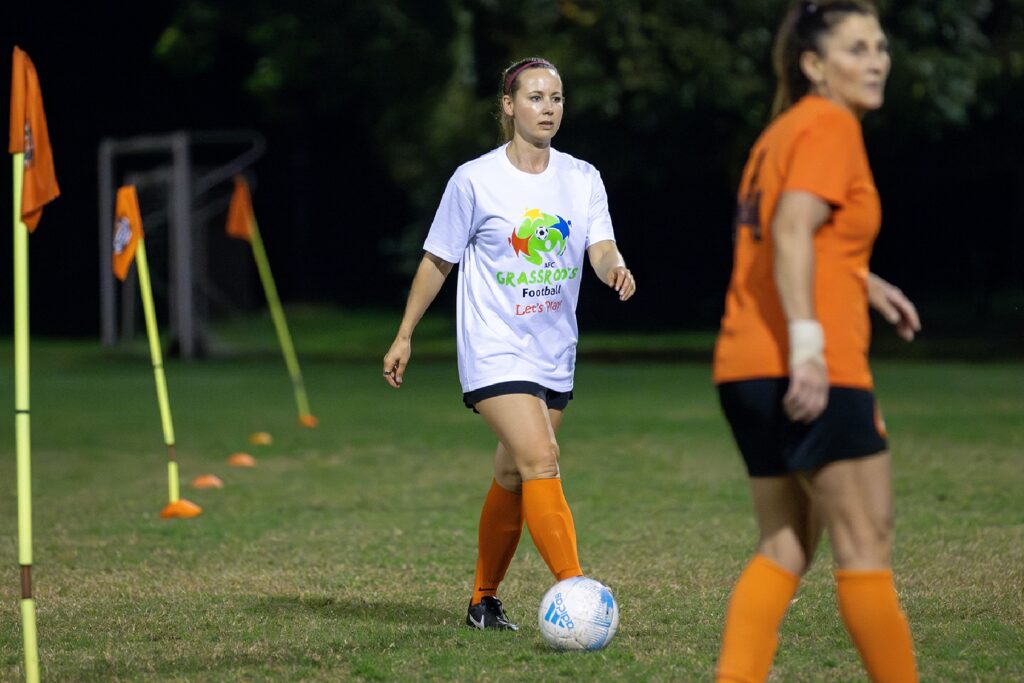
However, it’s the investment in training facilities, academies and grassroots football that has made the biggest impact in its current surge of momentum.

With these developments, women’s soccer continues to build a strong foundation for sustained growth in the coming years.

Conclusion

Women’s soccer has a uniqueness to it that is started to become celebrated and enjoyed by the masses.

With the UEFA Women’s EURO 2025 held in Switzerland, it gives women’s soccer another chance to grow the game in the host country and nearby regions, whilst also attracting a new casual audience.

If the past four years have told us anything it’s that women’s soccer is only going to grow, with increased broadcast rights, developed academies and CBA’s raising the minimum wage for players, it’s assumed that the quality on the pitch will coincide with its popularity surge.

Previous ArticleNext Article

Football NSW supports Female Coaches CPD as Women’s Football Surges

Football NSW has used the platform of the AFC Women’s Asian Cup to deliver a targeted professional development workshop for female coaches, bringing together scholarship recipients for an evening of structured learning and direct engagement with elite women’s football.

Held at ACPE last month, the session was open to female coaches who received C or B Diploma scholarships through Football NSW in 2025. Coaching accreditation carries a financial cost that disproportionately affects women, who are less likely to have their development subsidised by clubs or associations operating in underfunded community football environments. Scholarship access changes that equation at the point where many women exit the pathway.

Facilitated by Football NSW Coach Development Coordinator Bronwyn Kiceec, the workshop focused on goal scoring trends from the tournament’s group stage, with coaches analysing attacking patterns and exploring how those insights could translate into their own environments. The group then attended the quarter-final between South Korea and Uzbekistan at Stadium Australia.

The structure of the evening mattered as much as its content. Female coaches in community football rarely have access to elite competition environments as a professional resource. The gap between the level at which most women coach and the level at which the game is analysed and discussed tends to reinforce itself. Placing scholarship recipients inside a major tournament, as participants rather than spectators, closes that gap in a way that a classroom session cannot.

Female coaches remain significantly underrepresented across all levels of the game in Australia. The pipeline that will change that depends not only on accreditation access but on the professional networks, peer relationships and exposure to elite environments that male coaches have historically taken for granted.

The workshop forms part of Football NSW’s ongoing commitment to developing female coaches through scholarships and structured learning opportunities.

Marie-Louise Eta makes history as new Union Berlin head coach

In an historic appointment, Eta will take over as head coach of Union Berlin until the end of the season.

History in the making

Previously the first female assistant coach in Bundesliga history with Union Berlin, Eta will now take the reigns of the men’s first team on an interim basis.

Currently, the club sit in 11th place in the Bundesliga table, but with only two wins so far in 2026, relegation appears an all-too-real prospect, and one which the club is desperate to avoid.

“Given the points gap in the lower half of the table, our place in the Bundesliga is not yet secure,” said Eta via official media release.

‘I am delighted that the club has entrusted me with this challenging task. One of Union’s strengths has always been, and remains, the ability to pull together in such situations.”

Eta will begin as Union’s new head coach with immediate effect, and will be in the dugout for the club’s matchup against Wolfsburg this weekend.


A step into an equal future

Eta’s appointment signals a major step towards a more level playing field in the football landscape.

Furthermore, Eta joins other coaches including Sabrinna Wittmann, Hannah Dingley and Corinne Diacre who, in recent years, have blazed a trail for female coaches to step into the men’s game.

Wittmann currently manages FC Ingolstadt in Germany’s third division, and was the first female head coach in Germany’s top three divisions.

In 2023, Dingley became caretaker manager of Forest Green Rovers, and thus the first woman to lead a men’s professional team in England.

Diacre, now head coach of France’s women’s national team, managed Ligue 2’s Clerment Foot between 2014 and 2017.


Final thoughts

The impact therefore, is that Eta’s appointment will show future generations of aspiring female coaches that men’s football is an equally viable and possible pathway as the women’s game.

The time is now to level the playing field.

And while it may be a short-term role, its effect on attitudes towards equality and fair opportunities in the game will hopefully resonate long after the season ends.

Most Popular Topics

Editor Picks

Send this to a friend