

Pararoos Head Coach Kai Lammert: “We want to leave the place better than when we found it”

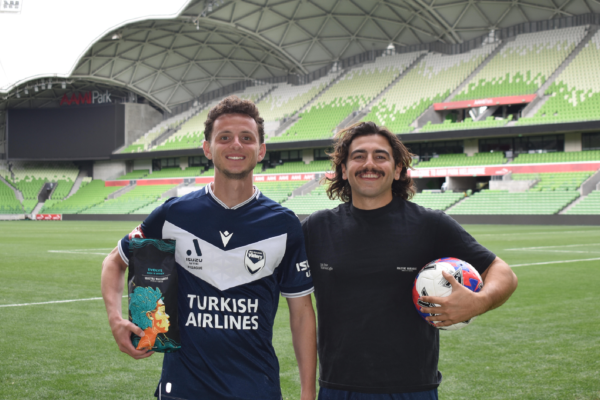
Kai Lammert

Australia’s Paralympic National Football Team, AKA the Pararoos, are Australia’s only male representative national football team for athletes with cerebral palsy, acquired brain injury or symptoms acquired from stroke.

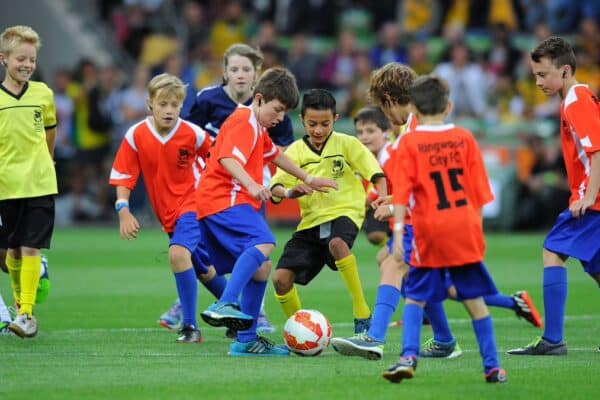
Alongside the recently launched ParaMatildas national team, the Pararoos compete in a modified 7-a-side format. Matches consist of two halves of 30 minutes each – there is no offside rule, throw-ins may be made with just one hand, and the field’s dimensions are reduced.

Currently, the Pararoos are ranked 10th in the International Federation of CP Football’s (IFCPF’s) World Rankings and are due to take on a USA side ranked equal fourth at Manly’s Cromer Park on February 4, their first home international since 2019.

Speaking with Soccerscene ahead of a significant 2023 for the Pararoos, Head Coach Kai Lammert discussed how the team has progressed since his start in the role from 2015, what the next steps are for the side, and the legacy the team is looking to leave for future generations of the Pararoos.

Kai

What does your role with the Pararoos involve on a day-to-day basis?

Kai Lammert: We all currently have other jobs besides the Pararoos. It’s a big commitment for all staff and players, but we all have a true passion for the players and the program. Besides the tactical, technical, physical, and mental preparation of the team, I have sponsorship commitments and media commitments, planning, and lots of video analysis of our own and the opposition team as well as going through player injury and fitness reports. All of this is a huge team effort and I am lucky to have the best staff any Head Coach could wish for. The most important work is the player wellbeing though. All our staff work around the clock to make sure the players can perform at their best in the Pararoos shirt and in their private life.

Currently, we are preparing for the upcoming home games against the United States, so it’s a big job but again I couldn’t do it without a super team behind the Pararoos.

How has it been for you seeing the team evolve and grow since you became head coach in 2015?

Kai Lammert: It’s the most exciting thing for me as a coach to see the players progress on and off the field. What stands out is that it’s a professional setup, but most players have a full-time job to support themselves and their family. In order for us to break in the top four, the players need to be able to devote the full day to the Pararoos similar to the top teams in CP Football at the moment. We’ve been able to add things to the program without it being overwhelming, and there were already a lot of things in place when I started that we’ve just carefully built upon.

As I said, the players have jobs as well and their individual programs need to be catered for their needs. We have school students on our team who probably have a bit more time and players who are married with two or three kids and that time is a very precious thing.

The Pararoos recently raised $80,000 to support their program going forward. How has that financial support helped the team over the past year?

Kai Lammert: It had a great impact – it got us to Spain for the World Cup so that is a start, and then it got us prepared for that tournament because we don’t want to go to a tournament just to make up the numbers. We want to go to a tournament to progress and be better. Currently the top 6-8 nations have got a financial advantage on us, and we want to close the gap. Every dollar that is raised helps because it costs $30,000 to get the team together for a camp; that’s a lot of money. Some of my counterparts in Europe can do 4-6 camps with that sort of money because they don’t have to fly everyone in.

So predominantly that money goes to preparation and getting us there, and the more we raise the more we can do.

Footballer

What facilities and infrastructure upgrades are needed to help take the Pararoos program to the next level?

Kai Lammert: I think a home of the Pararoos would be something significant. Obviously, that would need to be a top-standard, purpose-built place. Full-time players and full-time staff would allow us to devote more time to the game and improve the team overtime. We are very creative with our time and try to use every minute in and out of camp as effective as possible.

Play more games; we need to have more games. Obviously with a pandemic we had a long time without a game, and we’ve identified the need to play more international games, but everywhere we go we must fly. There’ve been some fantastic improvements, particularly now that the naming rights sponsorship has gone to Commonwealth Bank which is something we’ve wanted to do for a long time.

Our fundraising team led by Katrina Hicks is doing an awesome job and the support from the whole FA team has been fantastic.

It’s obviously a significant time for Australian football with the Socceroos and Pararoos having been to World Cups in 2022, and the Matildas set to co-host a World Cup this year. How are you feeling presently about where Australian football is at?

Kai Lammert: All this excitement around Australian football is great. That’s what we need, we need to have Australian football on the map. This is the buzz we need as we compete against the rugby’s and AFLs of the world in Australia. I heard the ticket sales are going crazy for the Women’s World Cup, so these are the sort of things we need. With that, our game (CP Football) will get more recognition and those who go to a game or tune in will appreciate the game because it’s an exciting game to watch. At the end of the day these guys are doing the same hours as the Socceroos and the Matildas, but they’re doing another job or Uni on top of it.

What are the next steps for the Pararoos?

Kai Lammert: For us we’ve got the home game against the USA in February, which is exciting because now the USA is still 5-6 goals away from us and we want to close that margin. That’s our main goal, to get closer to them. I felt over the years that we did get closer but it’s obviously we want to be really competing.

And then we will fine tune the way we play in two more camps. And then hopefully we’ve secured the Asian Cup in our country in November. That would be a great way to finish 2023.

What legacy do you hope to leave during your tenure with the Pararoos?

Kai Lammert: ‘Legacy’ is very important for us, that’s one of our core values of the team. We want to leave the place better than when we found it and want to make sure we keep raising our standards. That’s certainly one of mine, but when I say what legacy, I want to leave I have to say what legacy we want to leave, we are a team, and this team can achieve big things on and off the field and they can have a huge impact on generations of young boys and girls living with a disability. The program did and will continue to change lives.

Personally, I believe that every person with a disability should have the same opportunities as everyone else. We want to be named alongside the Matildas and Socceroos because the current and former Pararoos and ParaMatildas deserve exactly that.

Previous ArticleNext Article

Marie-Louise Eta makes history as new Union Berlin head coach

In an historic appointment, Eta will take over as head coach of Union Berlin until the end of the season.

History in the making

Previously the first female assistant coach in Bundesliga history with Union Berlin, Eta will now take the reigns of the men’s first team on an interim basis.

Currently, the club sit in 11th place in the Bundesliga table, but with only two wins so far in 2026, relegation appears an all-too-real prospect, and one which the club is desperate to avoid.

“Given the points gap in the lower half of the table, our place in the Bundesliga is not yet secure,” said Eta via official media release.

‘I am delighted that the club has entrusted me with this challenging task. One of Union’s strengths has always been, and remains, the ability to pull together in such situations.”

Eta will begin as Union’s new head coach with immediate effect, and will be in the dugout for the club’s matchup against Wolfsburg this weekend.


A step into an equal future

Eta’s appointment signals a major step towards a more level playing field in the football landscape.

Furthermore, Eta joins other coaches including Sabrinna Wittmann, Hannah Dingley and Corinne Diacre who, in recent years, have blazed a trail for female coaches to step into the men’s game.

Wittmann currently manages FC Ingolstadt in Germany’s third division, and was the first female head coach in Germany’s top three divisions.

In 2023, Dingley became caretaker manager of Forest Green Rovers, and thus the first woman to lead a men’s professional team in England.

Diacre, now head coach of France’s women’s national team, managed Ligue 2’s Clerment Foot between 2014 and 2017.


Final thoughts

The impact therefore, is that Eta’s appointment will show future generations of aspiring female coaches that men’s football is an equally viable and possible pathway as the women’s game.

The time is now to level the playing field.

And while it may be a short-term role, its effect on attitudes towards equality and fair opportunities in the game will hopefully resonate long after the season ends.

“20 Years Ahead”: The System Quietly Reshaping Korean Football

For all its consistency, Korean football has long carried an underlying tension.

On paper, it works. The national teams remain competitive, the player pool is technically sound, and the country continues to produce athletes capable of performing on the continental stage. But beneath that surface-level success, a more uncomfortable question has persisted about whether Korea has been simply maintaining its position while others evolve.

That question has driven the Korea Football Association (KFA) toward one of the most ambitious structural overhauls in modern football development: the Made in Korea (MIK) Project. Rather than focusing on short-term gains or isolated improvements, the initiative attempts to do something far more complex. It is rebuilding the foundations of how football is taught, understood and executed across the entire ecosystem.

Internally, the project has been described as having “brought Korean football 20 years ahead.” Whether that claim ultimately proves accurate remains to be seen, but what is already clear is the scale of the shift taking place.

From talent to system

The starting point was not talent, but structure. For years, concerns had been growing within Korean football circles about a lack of uniqueness in players, inconsistencies in long-term planning and an over-reliance on safe, risk-averse styles of play. The system, while producing disciplined and technically capable footballers, was not consistently producing players equipped to thrive in the most demanding environments. Environments such as Europe, where tempo, decision-making speed and adaptability define success.

Rather than attempting to patch these issues, the KFA chose to reimagine the system itself.

At the core of the MIK Project is the idea that high performance is not the result of individual excellence alone, but of an interconnected structure that allows that excellence to emerge consistently. Coaching, sports science, performance analysis, leadership and education are no longer treated as separate pillars, but as components of a single, integrated system designed to evolve continuously.

A new operating model

This philosophy is most clearly expressed through the project’s adoption of a cell-based operating model. In place of traditional hierarchies, the system is organised into small, cross-functional units, called “cells”. These cells are given autonomy over their work while remaining connected through shared frameworks and objectives. Each unit is responsible not only for delivery, but for learning, adapting and refining its approach on a constant cycle.

The intention is to bring decision-making closer to the pitch, allowing those working directly with players to respond faster and more effectively to the realities of the game. In an environment where marginal gains are often decisive, that speed of adaptation can be critical.

Closing the gap

Yet structure alone is not enough. The project is equally shaped by a clear-eyed assessment of where Korean football currently stands in relation to the world’s elite.

Comparative analysis has highlighted several consistent gaps: technical execution under pressure, the ability to operate at higher game speeds and effectiveness in decisive moments such as one-on-one situations. These are not deficiencies of talent, but of context. Korean players, while highly capable, have often developed within systems that prioritise control and precision over risk and spontaneity.

The consequence is a style that can become predictable under pressure.

Training for reality

To address this, the MIK Project has fundamentally shifted training methodology. Sessions are increasingly designed to replicate the intensity and unpredictability of real matches, placing players in situations where decisions must be made quickly, under pressure, and often in confined spaces. The focus is no longer on rehearsing ideal scenarios, but on preparing players for imperfect ones.

This approach reflects a broader philosophical shift that prioritises adaptability over perfection, and decision-making over repetition.

Evolving the Korean identity

Importantly, this evolution does not come at the expense of Korea’s existing strengths. Discipline, work ethic and technical proficiency remain central to the national identity. What the MIK Project seeks to do is build upon those foundations, combining them with the creativity, speed, and tactical awareness required at the highest level of the game.

It is, in many ways, an attempt to reconcile tradition with modernity.

A global ambition

The ambition underpinning the project is unmistakable. The KFA is not simply aiming to remain competitive within Asia, but to re-establish itself among the world’s leading football nations. That means producing players capable of not only reaching Europe, but succeeding there.

More than a project

What makes the MIK Project particularly compelling is that it does not present itself as a finished solution. Instead, it is designed as a system that evolves, adjusts and refines itself over time. In a sport where trends shift rapidly and competitive edges are constantly eroded, that capacity for continuous development may prove more valuable than any single innovation.

For other football nations, Korea’s approach offers an instructive case study. While many federations continue to debate philosophical direction, the KFA has committed to structural transformation, embedding its ideas not only in theory, but in practice.

Whether the project ultimately delivers on its boldest ambitions will depend on time, execution, and the unpredictable nature of the game itself. But one thing is already evident.

Korean football is no longer standing still.

Most Popular Topics

Editor Picks

Send this to a friend