






Keilor Park SC has a rich history dating back to 1957, established under an Austrian social club in Richmond. Two years later, the club evolved into Keilor Park Austria, embracing its Austrian heritage through its colours—Viennese violet, a shade of purple and a national symbol of Austria—and its emblem featuring the Austrian eagle. While the Austrian influence remains an important part of its identity, the club has grown into a diverse and inclusive hub for the local soccer community in Melbourne’s north-west.
The club is known for its commitment to inclusivity, offering a welcoming environment for players from all backgrounds. With a strong volunteer base, Keilor Park SC ensures that players and families receive exceptional service at every step, from registration to coaching and community events. Its reputation for being well-run and community-oriented has made it a popular choice for many aspiring soccer players.
As Keilor Park SC continues to evolve, its partnerships with Football Victoria, Brimbank City Council have been vital to its growth. While challenges like limited space and infrastructure persist, the club remains focused on its future goals—promoting inclusivity, expanding its programs, and striving for success in higher-level competitions.
Speaking with Soccerscene, President of Keilor Park SC Ben Di- Lorenzo shares insights into Keilor Park’s journey and its plans for the future.
What do you believe sets Keilor Park Soccer Club apart from other community-based soccer clubs in the region?
Ben Di-Lorenzo: We’ve always been known as the inclusive, welcoming club; we get feedback, that Keilor Park is welcoming to all types, the inclusive club. Our participation is our core differentiator in that we try not to discriminate against anybody, offering a range of programs so that everyone can participate. We have a large army of volunteers that help with our daily operations, providing professional service at a community level. When players and parents come to our club, they can expect exceptional service, from registering to trialling and receiving their uniforms to coaching or connection with the community events we hold. So yes, I think that’s our point of difference.
The other element is that our female program has always been strong, right? So, you know, diversity for us has been just integral. We’ve never had to try to be diverse or inclusive; our female program started in 1986. That’s when we tried to kick off with a senior female team. It didn’t take off right away, but it did kick off in the early 90s, and the rest is history. From there, we’re trying our best to make the 50/50 participation between boys and girls, and we have more than 630 registered players in 2025, with close to 40% of them female players.
Keilor Park Soccer Club has grown into a well-established community club. How have partnerships with Football Victoria, the local council, and other stakeholders contributed to this growth?
Ben Di-Lorenzo: Councils are in a sticky situation because they only have so much property. We’re fortunate to work closely with our council, and they’ve provided us with additional space and adapted some rules to accommodate our growth. Still, we have to turn away players because we simply don’t have enough space. That’s not on the council—they’ve given us what they can and recognise our growth path. They’re doing their best to increase the number of fields available to us. There’s a lot of parkland adjacent to the club with multi-sport use—basketball, softball, footy, cricket, even remote cars—so some outer fields have been repurposed as temporary soccer fields. The council has really come to the party to help where possible.
Football Victoria (FV) has always assisted us by setting the standard for what good looks like, but it’s up to us to achieve it. I always say, these programs are great, but if you don’t have volunteers, they won’t go anywhere. We’re lucky to have motivated volunteers who take on what FV offers. From a governance perspective, they regularly assess us to ensure we’re running the club properly, and they recognise our efforts. In some cases, we even get recognition and celebrate that with them, which is great.
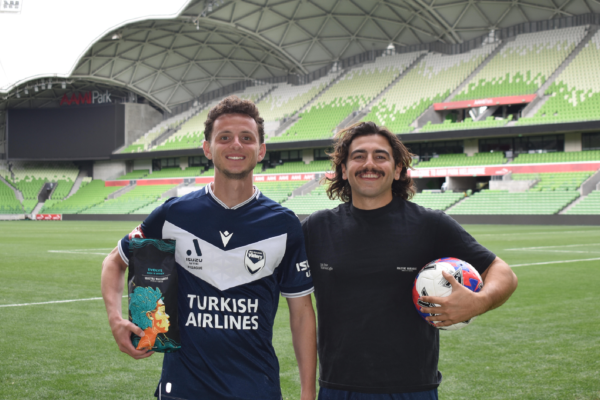
 Image provided by Ben Di-Lorenzo
How have community responses to the Go Soccer Mums and Go Girls programs reflected their impact on female participation in the sport, and what makes these initiatives stand out from traditional junior soccer programs?
Ben Di-Lorenzo: The Go Soccer Mums include mothers of some of our members, and former senior players from the 90s who come and have a kick, play in tournaments, and train every week. It’s fantastic to see that.
I think there’s this general perception, especially for women over 40, that they’ve never played a lot of sports. So, the fact that they’re getting out and playing soccer on weekends, wearing boots and shin pads is amazing. For me, I love that it’s an opportunity where we just say, “Who cares? Just come and have a kick.” That’s the enjoyment I get out of facilitating and enabling a program like Go Soccer Mums.
Go Girls is a little different. From what we’ve seen, girls don’t always come to soccer right away. The Matildas’ success brought in a lot of girls starting the program late, and it was hard for them to join a club, especially with trials in November for a season that doesn’t start until April. Go Girls is really an introduction to the sport—come once a week, pay as you turn up, no long-term commitment. This is a program that really suited that need, it gave girls the chance to say, “I want to give this a go,” without pressure. From there, we actually found some really good players who are now competing in our junior girls’ NPL. We’re quite proud that it became a pathway for identifying talent.
We host Football Victoria’s Girls Cup competition, they use our facilities, and we love to assist and enable community football as much as we can.
In terms of club governance and operations, The Executive Committee oversees a lot of key areas, from governance to strategic planning. What are some of the club’s biggest challenges and priorities in 2025?
Ben Di-Lorenzo: We have an ambitious strategy—we want to be a total football club that is well-run and well-governed. From a board perspective, it shouldn’t matter who’s in the seat, because we should be governed by rules, and we should be governed by the strategic intent of the club. That’s why we focus on having the right governance processes and decision-making frameworks in place to ensure stability and long-term success.
From an on-the-field perspective, our senior programs are performance-based, with the goal of promotion to higher leagues. Our senior women are in the VPL, one step below the NPL, and their ambition is to reach that level. For the boys, currently in State League 1, we aim to progress them to the VPL and then eventually the NPL .
For the first time this year, we are implementing more advanced level programs for MiniRoos and Junior level, and that’s sort of going to be challenging, right? Not to say that the community isn’t any different, it’s just that some of these players would like to have more training rather than the two days a week. Now, when you look to include 14 teams that are training three days a week, obviously there are challenges with having the right infrastructure in place. Making sure we’ve got the right coaches in place that can actually coach three days a week and be a lot more technical, and then having a football curriculum and making sure that they can follow the curriculum as much as possible.
Not every player wants the same commitment—some enjoy training twice a week and being part of the club, while others want to train four or five times a week. While we aren’t in a position to offer the highest intensity level, we strive to provide a strong middle ground that supports different ambitions.
Are there any exciting upcoming initiatives or projects that will be directly influenced by the partnerships the club has?
Ben Di-Lorenzo: Yes, we just recently signed a partnership with Kia Australia, and we’re looking to rename the main pitch to ‘Kia Park’ which is exciting for our club. Kia Australia prefers to have connections with more community-based groups where they can have a bit more influence on how their messaging gets out. The other exciting part is that Kia has an association with FIFA, and that association allows our members exciting opportunities, like the potential of carrying out the match ball at the next most appropriate FIFA-regulated game.
We also host what we would classify as one of the premium community club MiniRoos tournaments in Victoria, called the Keilor Cup, which has been running for 25 years. This year will be the 25th anniversary of the Cup which is for players from under sevens all the way up to under thirteens. It is only for community-based teams; no sort of academies can join it because we want to maintain it as a community-based competition. We invite over 220 teams to participate in more than 400 games across 17 pitches with matches played over the Thursday, Friday, Saturday, and Sunday of the AFL Grand Final weekend. That’s big for us, last year we had a team from New South Wales and Adelaide come across, and they’re committed to coming across again. So the 25th anniversary of the Keilor Cup is a big milestone for us and an exciting project and celebration.
In terms of future plans and club vision, what are the clubs long term goals, both for community engagement and competitive football?
Ben Di-Lorenzo: The goals are to extend our inclusivity and diversity into all abilities soccer. We do want to try to find a way in which we can facilitate all abilities competitive soccer at the club. We’ve started this with the council, and we’ve offered coaches to help at some of the council programs that are being run there, which we’d like to run on a more permanent basis. We’ve got some work to do to upgrade the facility, so that’s one of the things on our to –do list. From a competitive perspective, as I’ve mentioned before, our senior players need ambitions for our senior programs to climb up, to be more competitive in the NPL leagues. If there’s a licence open for the junior boys NPL program, we’d be open to applying for that.
However, on the girls side, the FV have extended the NPL girls from 10 teams through to 16. People would debate if there’s 16 clubs worth of talent out there for females, and we probably all agree that there isn’t. But actually, I look at it differently. I see it as if the FV puts standards out there for you to develop and train in a certain way or that you meant to train, then you will develop more talented female players. So our long-term goal is to be quite competitive at the NPL level for our girls, but have them grown from our internal club program.

