
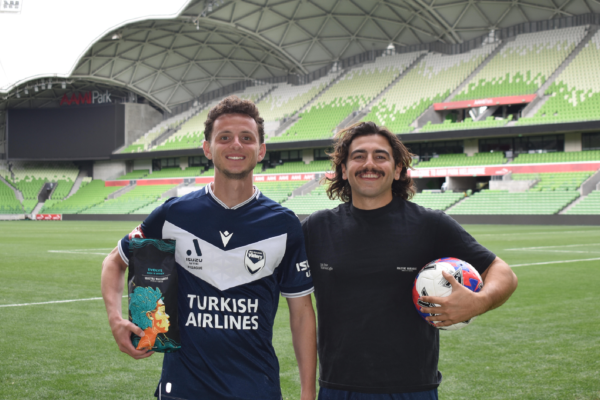
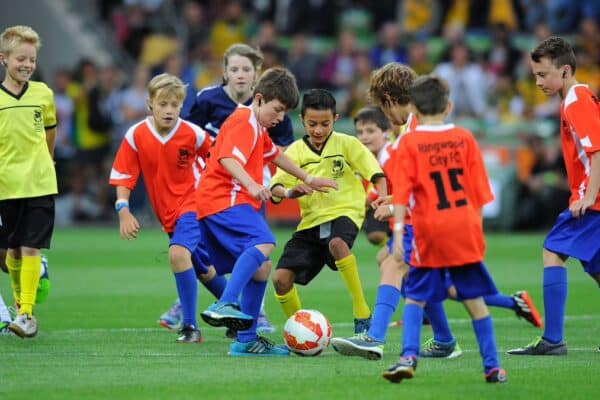
Johno Clemente: How Australia’s youngest NPL senior coach is reinventing leadership

With a number of Matildas thriving at top European clubs and Australia set to co-host the 2023 FIFA Women’s World Cup, administrators have the perfect opportunity to establish a sustainable national framework for women’s football in the country.

Despite progress at the elite level, work still needs to be done at the grassroots to ensure the women’s game reaches the heights FFA is aiming for. This means fresh ideas, investment, and buy-in from community clubs around the country.

Jonathan ‘Johno’ Clemente embodies this mantra. The young, ambitious coach has only just started his career, but is already driving change with a bold, new-age leadership style.

Appointed as Head Coach of Heidelberg in 2019, Clemente is only 21, making him the youngest senior National Premier League (NPL) coach in Australia. With wisdom beyond his years, he has built a strong people-centric culture which he hopes will set a new standard in women’s football around the nation.

Clemente joined Heidelberg after leading Essendon to promotion in his first season.

“There’s a good saying in football, male players need to perform to belong, whereas women need to belong to perform,” Clemente said.

“It’s about making everybody feel valued as a person and a player. That’s the way I want to lead, through emotional intelligence and building a culture which promotes that.”

“It’s a move away from that old style of leadership, where most coaches would have that ‘my way or the highway’ approach. I believe it’s a two-way street where we work towards a common goal, so it’s important the players know that I care about them as individuals and that I equally know what they need from me through direct feedback, so I can improve with them.”

Clemente’s has already enjoyed success during his short career to date. Following junior coaching at the Essendon Royals, he was appointed Technical Director before also taking the reigns as the Senior Women’s Head Coach.

“The team had been relegated and a lot of players were wanting to leave. I immediately thought long-term, with the vision of gaining promotion and how great of a challenge that was. It was a real sink or swim situation, but I knew I had to back myself because I wanted to coach seniors, so I jumped at the chance,” Clemente said.

“That’s where I began to adopt my philosophy. I was lucky to have had great coaches growing up. It took some time, but I learned to be confident in my decisions and be ruthless when I had to be. But ultimately, I thought the most important thing was to create a culture of respect and positivity, I knew that the rest would follow.”

After a rocky start, Clemente led the Royals to promotion, leading to him drawing the attention of Heidelberg United.

“As difficult as it was to leave Essendon, when I got the call from Heidelberg, I knew straight away that I had to go because it is a huge club and a huge opportunity to coach in the top division,” he said.

“The transition was seamless. One issue with women’s NPL is the high turnover of NPLW players. It can get toxic as a lot of players move in groups and chop and change teams regularly.”

“My goal is to change the perception of the league by ensuring that Heidelberg’s girls come here to enjoy football and get better as players and people. I set the standards early so that the players enjoy training sessions and want to come back.”

Although COVID-19 hampered Clemente’s first year in charge at NPL level, the foundations he set are already creating massive benefits for the club. Player retention is at an all-time high, vindicating his coaching philosophy and approach to building team culture.

Clemente is a vocal mental health advocate, something he incorporates into coaching.

“Every single player re-signed for next season. They’re all chomping at the bit to play for Heidelberg again which to me is a huge indicator that we are on the right track. I think it’s really important to give the girls ownership of the team. We’ve got a strong leadership group and I’ve told them this will only be as good as you make it and challenged them to set the standards,” he said.

Clemente’s attributes his successful approach having high-quality coaches when he played, but also his experiences outside of football. The young coach has had challenges with mental health and now is a strong advocate for mental welfare, something he incorporates into his coaching.

“It’s so, so important. That’s why I’ve resonated so well with the women players. The same applies for men, players will have off days and it’s important to be flexible and understanding,” he said.

“There are no no-negotiables in football anymore. If a player has to work every night until 6:30PM and needs to arrive a bit late to training, you need to understand that and make them feel welcome and warranted. It’s important to still set high standard but there has to be a balance.”

As part of this mental health conscious approach, Heidelberg FC has appointed Darby Dexter, a Leadership and Culture Consultant to assist player welfare.

The club has also invested in an app, Inspire Sport to help juniors report on their mood and mental wellbeing to assist coaches in understanding the needs of their players and how best to communicate with them.

“Football really needs to invest in mental health and not just tick boxes. It’s important to build a culture of high performance and open communication where the stigma of speaking about mental health is removed,” Clemente said.

With coaches like Clemente reinvigorating the grassroots of female football, the years leading up to the Women’s World Cup will be vital to establishing a sustainable framework.

Female participation rates have steadily increased over recent years and FFA has outlined its goal to achieve 50-50 gender participation by 2027, but while Clemente believes this is achievable, he says it is important to make sure this is done correctly through investing in the right people and programs.

“Women’s football is developing quickly, which is a positive but it’s important clubs are involved for the right reasons. It sounds simple, but sometimes councils give grants to clubs who have a girls’ programs, so it’s important that clubs are genuinely creating these programs to nurture talent and get young girls to fall in love with our game,” he said.

“That’s the challenge for all clubs. To care and invest in both genders equally. It’s all about getting the right coaches in and getting the contact hours in at an early age.”



Previous ArticleNext Article

Marie-Louise Eta makes history as new Union Berlin head coach

In an historic appointment, Eta will take over as head coach of Union Berlin until the end of the season.

History in the making

Previously the first female assistant coach in Bundesliga history with Union Berlin, Eta will now take the reigns of the men’s first team on an interim basis.

Currently, the club sit in 11th place in the Bundesliga table, but with only two wins so far in 2026, relegation appears an all-too-real prospect, and one which the club is desperate to avoid.

“Given the points gap in the lower half of the table, our place in the Bundesliga is not yet secure,” said Eta via official media release.

‘I am delighted that the club has entrusted me with this challenging task. One of Union’s strengths has always been, and remains, the ability to pull together in such situations.”

Eta will begin as Union’s new head coach with immediate effect, and will be in the dugout for the club’s matchup against Wolfsburg this weekend.


A step into an equal future

Eta’s appointment signals a major step towards a more level playing field in the football landscape.

Furthermore, Eta joins other coaches including Sabrinna Wittmann, Hannah Dingley and Corinne Diacre who, in recent years, have blazed a trail for female coaches to step into the men’s game.

Wittmann currently manages FC Ingolstadt in Germany’s third division, and was the first female head coach in Germany’s top three divisions.

In 2023, Dingley became caretaker manager of Forest Green Rovers, and thus the first woman to lead a men’s professional team in England.

Diacre, now head coach of France’s women’s national team, managed Ligue 2’s Clerment Foot between 2014 and 2017.


Final thoughts

The impact therefore, is that Eta’s appointment will show future generations of aspiring female coaches that men’s football is an equally viable and possible pathway as the women’s game.

The time is now to level the playing field.

And while it may be a short-term role, its effect on attitudes towards equality and fair opportunities in the game will hopefully resonate long after the season ends.

“20 Years Ahead”: The System Quietly Reshaping Korean Football

For all its consistency, Korean football has long carried an underlying tension.

On paper, it works. The national teams remain competitive, the player pool is technically sound, and the country continues to produce athletes capable of performing on the continental stage. But beneath that surface-level success, a more uncomfortable question has persisted about whether Korea has been simply maintaining its position while others evolve.

That question has driven the Korea Football Association (KFA) toward one of the most ambitious structural overhauls in modern football development: the Made in Korea (MIK) Project. Rather than focusing on short-term gains or isolated improvements, the initiative attempts to do something far more complex. It is rebuilding the foundations of how football is taught, understood and executed across the entire ecosystem.

Internally, the project has been described as having “brought Korean football 20 years ahead.” Whether that claim ultimately proves accurate remains to be seen, but what is already clear is the scale of the shift taking place.

From talent to system

The starting point was not talent, but structure. For years, concerns had been growing within Korean football circles about a lack of uniqueness in players, inconsistencies in long-term planning and an over-reliance on safe, risk-averse styles of play. The system, while producing disciplined and technically capable footballers, was not consistently producing players equipped to thrive in the most demanding environments. Environments such as Europe, where tempo, decision-making speed and adaptability define success.

Rather than attempting to patch these issues, the KFA chose to reimagine the system itself.

At the core of the MIK Project is the idea that high performance is not the result of individual excellence alone, but of an interconnected structure that allows that excellence to emerge consistently. Coaching, sports science, performance analysis, leadership and education are no longer treated as separate pillars, but as components of a single, integrated system designed to evolve continuously.

A new operating model

This philosophy is most clearly expressed through the project’s adoption of a cell-based operating model. In place of traditional hierarchies, the system is organised into small, cross-functional units, called “cells”. These cells are given autonomy over their work while remaining connected through shared frameworks and objectives. Each unit is responsible not only for delivery, but for learning, adapting and refining its approach on a constant cycle.

The intention is to bring decision-making closer to the pitch, allowing those working directly with players to respond faster and more effectively to the realities of the game. In an environment where marginal gains are often decisive, that speed of adaptation can be critical.

Closing the gap

Yet structure alone is not enough. The project is equally shaped by a clear-eyed assessment of where Korean football currently stands in relation to the world’s elite.

Comparative analysis has highlighted several consistent gaps: technical execution under pressure, the ability to operate at higher game speeds and effectiveness in decisive moments such as one-on-one situations. These are not deficiencies of talent, but of context. Korean players, while highly capable, have often developed within systems that prioritise control and precision over risk and spontaneity.

The consequence is a style that can become predictable under pressure.

Training for reality

To address this, the MIK Project has fundamentally shifted training methodology. Sessions are increasingly designed to replicate the intensity and unpredictability of real matches, placing players in situations where decisions must be made quickly, under pressure, and often in confined spaces. The focus is no longer on rehearsing ideal scenarios, but on preparing players for imperfect ones.

This approach reflects a broader philosophical shift that prioritises adaptability over perfection, and decision-making over repetition.

Evolving the Korean identity

Importantly, this evolution does not come at the expense of Korea’s existing strengths. Discipline, work ethic and technical proficiency remain central to the national identity. What the MIK Project seeks to do is build upon those foundations, combining them with the creativity, speed, and tactical awareness required at the highest level of the game.

It is, in many ways, an attempt to reconcile tradition with modernity.

A global ambition

The ambition underpinning the project is unmistakable. The KFA is not simply aiming to remain competitive within Asia, but to re-establish itself among the world’s leading football nations. That means producing players capable of not only reaching Europe, but succeeding there.

More than a project

What makes the MIK Project particularly compelling is that it does not present itself as a finished solution. Instead, it is designed as a system that evolves, adjusts and refines itself over time. In a sport where trends shift rapidly and competitive edges are constantly eroded, that capacity for continuous development may prove more valuable than any single innovation.

For other football nations, Korea’s approach offers an instructive case study. While many federations continue to debate philosophical direction, the KFA has committed to structural transformation, embedding its ideas not only in theory, but in practice.

Whether the project ultimately delivers on its boldest ambitions will depend on time, execution, and the unpredictable nature of the game itself. But one thing is already evident.

Korean football is no longer standing still.

Most Popular Topics

Editor Picks

Send this to a friend