



Indonesian Consul General hosted in WA by Football West

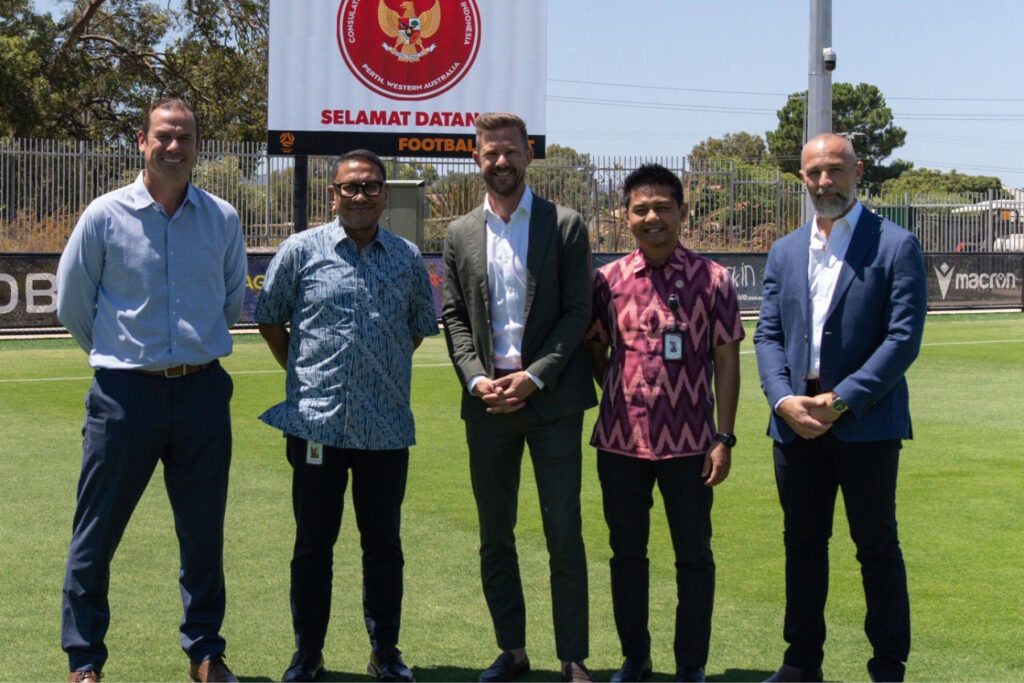
Football West has moved to strengthen its strategic footprint in Southeast Asia, hosting a high-level diplomatic delegation at the Sam Kerr Football Centre this week.

The newly appointed Consul General of Indonesia to Western Australia, Irvan Buchari, and Consul for Information and Cultural Social Affairs, Antonius Prawira Yudianto, met with Football West executives to map out the next phase of the state’s Asian Engagement Strategy.

Facilitated by Indonesia Institute President and former professional footballer Robbie Gaspar, the dialogue focused on leveraging the “world game” to deepen the sister-state relationship between Western Australia and East Java. This partnership was commercially validated last July during the historic exhibition match between the WA Men’s State Team and Liga 1 giants Persebaya Surabaya.

Operationalising Sports Diplomacy

Football West CEO Jamie Harnwell, who hosted the delegation alongside COO Perry Ielati, emphasised that the visit was about operationalising future opportunities rather than just a ceremonial tour.

“Football West has built very strong ties with Indonesia over the past decade… especially with our sister state East Java,” Harnwell said.

“We have sent many senior and junior sides to compete in Indonesia and hosted visiting teams. These occasions are great sporting and cultural experiences and help build mutual understanding and friendships.”

The meeting highlights the increasing role of sports diplomacy in state government relations. The Persebaya fixture notably attracted WA Premier Roger Cook and East Java Provincial Secretary Adhy Karyono, proving football’s unique capacity to open doors in the region.

Mr Gaspar, a key architect of the relationship, noted the potential for future growth.

“I look forward to continuing to work with Football West to grow the relationship and build meaningful, mutually beneficial partnerships with Indonesia,” Gaspar said. “Football is such a powerful platform for connection, trust, and long-term collaboration between our two countries.”

Football West acknowledges the vital backing of the WA Government in driving this strategy, ensuring the code remains a central pillar of Western Australia’s international outreach.
Previous ArticleNext Article

Arsenal x Meta: The Tech-Driven Fan Revolution You Didn’t See Coming

The current Premier League leaders announced last week the start of a new partnership with Meta, which will see WhatsApp and Facebook unite fans across the world.

A global partnership

The partnership between Arsenal and Meta will aim to bring fans together from across the world in digital spaces.

While WhatsApp and Facebook are already popular platforms for football fans to talk, review and connect over the course of a season, the new initiative will build on this existing engagement.

Head of Marketing for Meta Consumer Apps, Vivian Odior, outlined why a partnership with Meta contributes to the overall fan experience.

“We know that being an Arsenal supporter doesn’t start at kick-off and end at the final whistle,” Odior said via Arsenal’s Official Website.

“WhatsApp and Facebook are where that year-round passion lives – the transfer speculation, the tactical debates, the shared memories and hopes for next season.”

Indeed, as Arsenal looks to clinch a first league title since 2004, there will be plenty of discourse and conversation between fans in the coming weeks.


What can fans expect?

The digital space presents endless opportunities for football supporters to connect across continents.

Arsenal fans will be able to access an extensive range of new digital experiences, as well as activations at the Emirates Stadium throughout April.

But beyond the unique offers and experiences the partnership provides, there is a fundamental sense of community and family driving the project. Chief Commercial Officer at Arsenal, Juliet Slot, explained the importance of having digital spaces to allow fans to feel a part of the Arsenal family.

“Our partnership with Meta builds on how our supporters already come together, wherever they are in the world, and will create more ways to feel closer and more connected to our club,” Slot said via Arsenal’s Official Website.

“As we continue to compete to win major trophies, partnerships like this play an important role in supporting that ambition and strengthening our connection with supporters.”


The modern game

Furthermore, the expansion of digital spaces for Arsenal fans highlights a new era for the game as a whole.

As social media grows, the game must keep pace. And with so many fans across the world engaging with digital spaces, establishing a partnership with Meta is a step into the future where football and social media intersect more than ever.

How Football Victoria’s Opens Board Nominations will Address the Game’s Rapid Growth Demands

Football Victoria has opened nominations for two board director positions ahead of its Annual General Meeting on May 25, with the governing body explicitly seeking candidates with expertise in investment and fundraising, digital innovation, and people and culture to meet the modern challenges facing football administration in Australia’s most populous football state.

Nominations close at 6pm on Monday April 20. All candidates will be assessed by an Independent Nominations Committee against the requirements of FV’s 2024-2028 strategic framework, which is built around five pillars: clubs and competitions, participants, pathways, facilities, and the organisation’s future direction.

The appointments arrive at a moment when football in Victoria, and nationally, is navigating a participation boom that has significantly outpaced the infrastructure, governance and financial frameworks built to support it. The game is growing faster than the systems designed to manage it, and the people who sit at the top of those systems will determine whether that growth becomes sustainable or starts to work against itself.

A Sport at Crossroads

Football is now Australia’s largest club-based sport, and Victoria sits at the centre of that story. Participation numbers have climbed sharply in the years since the 2023 FIFA Women’s World Cup, and more recently the successful AFC Women’s Asian Cup, with junior registrations in particular placing pressure on community facilities, volunteer workforces and competition structures that were not designed to absorb growth at this pace.

The consequences are visible at ground level. Councils across Victoria, many of which did not anticipate the scale of football’s expansion when planning their sporting infrastructure, are now confronting a facilities gap that is measurable in cancelled training sessions, overloaded grounds and clubs turning away players for want of adequate space. Drainage, lighting, changeroom access and pitch availability, have become pressure points that no amount of elite-level visibility can resolve from above.

The incoming board directors will inherit that problem directly. Football Victoria’s strategic framework names facilities as one of its five core pillars, and the organisation’s ability to make the case to government, councils and private investors for the kind of sustained infrastructure funding the sport requires will depend significantly on the financial and advocacy expertise sitting around its board table.

Football Australia and Football NSW recently called on the NSW Government to establish a $343 million grassroots facilities fund in response to the same structural pressures. Victoria faces an analogous challenge, and the director recruitment process signals that FV is aware its board needs people who can drive investment portfolios and revenue streams, not merely administer existing ones.

The Commercial Dimension

The case for bringing investment expertise onto the board extends beyond facilities. Australian sport sits within a $41.7 billion economy, and football’s share of that landscape is growing in ways that create both opportunity and complexity. Broadcast rights, commercial partnerships, digital platforms, and the expanding role of sports betting in the revenue structures of sporting codes are reshaping how governing bodies at every level think about financial sustainability.

Football Victoria’s competitions, including NPL, state leagues,  and an increasingly significant women’s program, represent a substantial commercial asset that has historically been underleveraged relative to its scale. The appointment of directors with investment and fundraising competencies is a direct acknowledgement that the next phase of the sport’s growth in Victoria will require a more sophisticated financial strategy than the one that got it here.

The digital innovation competency sits alongside that commercial imperative. Football is generating more data, more content and more participant interaction than at any point in its history in Australia, and the governing bodies that build effective digital infrastructure now will be better positioned to manage participation, retain players and engage communities at a scale that was not previously possible.

Governance and Equity

Football Victoria’s nomination process includes a constitutional requirement for 40:40:20 board composition. It translates to 40 percent identifying as women, 40 percent as men, and 20 percent of any gender.

The equity means decisions made at the board-level, about facilities investment, participation pathways, and community engagement have a direct impact on who gets to play, where and under what conditions. A board composition that reflects the diversity of the football community it governs is better placed to identify the structural barriers that data alone does not always surface.

FV CEO, along with the Independent Nominations Committee, will assess candidates against the full range of competencies outlined in the strategic framework, including governance experience, demonstrated involvement in football as a player, coach, referee or administrator, and an understanding of the broader football ecosystem.

The sport is at an inflection point. The foundations have been laid by decades of community building, volunteer labour and grassroots investment. What happens next, whether the participation boom becomes a lasting structural shift or a wave that recedes from insufficient infrastructure to sustain it, will be shaped in no small part by the quality of leadership at the governing body level.

Most Popular Topics

Editor Picks

Send this to a friend