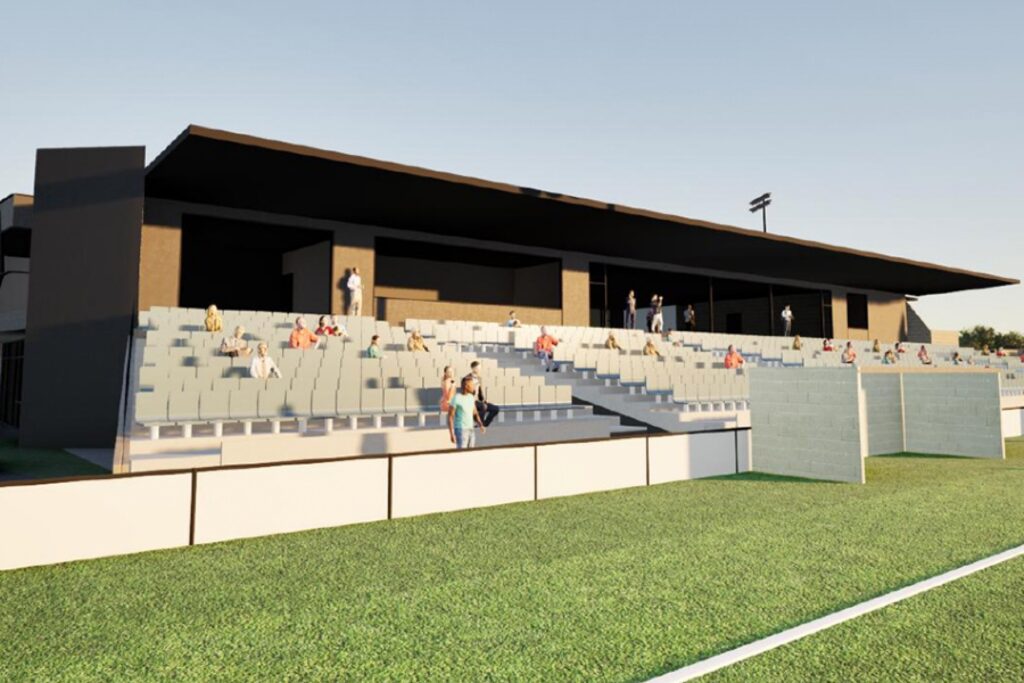



How Xtract One Is Reinventing Venue Security with AI

When fans pour through stadium gates or concert turnstiles, safety should feel effortless, it should just be a part of the experience, not an obstacle. Yet for decades, long queues, bag checks, and metal detectors have become a negative expectation in the entry process. 

Now, a Canadian company is rewriting that narrative. Xtract One, a leader in AI-driven threat detection, is transforming how venues protect guests, staff, and assets, all without slowing down the flow to the entrance. Its technology replaces traditional screening with intelligent, non-invasive systems that quietly identify potential threats while allowing thousands of people to enter freely and safely.

The company’s approach represents a broader shift in venue design, one where the emphasis is not only on safety but also on experience. For most large-scale events, traditional walk-through metal detectors and manual bag checks remain the standard. 

While effective in principle, these systems come with major drawbacks: they’re slow, intrusive, and labour-intensive. Queues stretch, tempers flare, and staff must constantly juggle responsibilities with hospitality.

Beyond inconvenience, these methods often generate inconsistent results. Human error such as fatigue, distraction, or simple oversight can compromise security effectiveness. As well as traditional systems detect metal rather than weapons, they trigger frequent false alarms, forcing staff to conduct additional searches that delay entry even more.

In an industry increasingly focused on fan experience and efficiency, these limitations are a major setback. Venue operators are looking for ways to protect guests without sacrificing the atmosphere they’ve worked hard to create.

That’s where Xtract One steps in. Using a combination of AI, sensor fusion, and machine learning, the company’s platform including SmartGateway and Xtract One View replaces reactive detection with intelligent analysis. 

Instead of sounding alarms for every metallic object, it interprets data in real time to differentiate between harmless personal items and true security threats like firearms or knives.

Through Xtract One View, operators can oversee multiple entry points, or even multiple venues all from a single platform. Data analytics track traffic flow, identify bottlenecks, and measure system performance, turning what was once a slow and tedious process into a source of operational insight.

The benefits are already being realised in high-profile venues across North America.

At the Moody Center in Austin, Texas, Xtract One’s system has helped streamline guest entry for concerts, basketball games, and university events. 

The arena reports shorter wait times, reduced staffing requirements, and a more relaxed atmosphere at the gates, making the product a win for both security teams and fans.

At Kia Georgia, the company’s screening solutions have been integrated into the automaker’s manufacturing facility, proving their versatility beyond entertainment venues. 

The technology’s adaptability to outdoor conditions and architectural design means it can blend seamlessly with different environments, from industrial campuses to stadium forecourts.

These implementations underscore the same principle that security doesn’t need to be visible to be effective. By combining intelligence with efficiency, Xtract One delivers peace of mind without performance trade-offs.

The global demand for smarter, safer, and faster security has never been greater. Stadiums, concert halls, convention centres, and even schools are facing mounting pressure to manage large crowds without creating stress or congestion. In Australia, a nation renowned for its sports and live events, the potential is particularly significant.

Major hubs like Melbourne, Sydney, and Brisbane continue to host world-class tournaments, concerts, and cultural festivals. Venues in these cities are increasingly focused on improving fan experience from the moment of arrival. 

As such, the adoption of AI-enhanced screening could become a key differentiator, helping local facilities align with international best practice while maintaining the relaxed, welcoming atmosphere Australian fans expect.

Furthermore, with sustainability and operational efficiency high on the agenda, AI-based systems offer long-term cost savings. By reducing the manpower needed for manual checks and cutting false-positive interruptions, Xtract One’s platform supports both financial and environmental goals, fewer lines, less energy consumption, and better use of human resources.

What makes Xtract One stand out isn’t just its technology, it’s the philosophy behind it. The company envisions a world where security enhances, rather than hinders, public experience.

Their tagline, Security that feels invisible,” reflects a deeper commitment to human-centred design.

As venue operators look to the future, the shift toward AI-driven protection will likely define the next decade of infrastructure investment. The move reflects earlier transformations in lighting, turf management, and digital ticketing, each a step toward smarter, more connected venues.

Xtract One’s momentum signals a broader industry evolution. As crowd sizes increase and expectations for safety rise, the ability to combine precision, privacy, and performance will separate world-class venues from the rest.

Conclusion

Whilst Melbourne Victory and the APL have thrown ideas and concepts around improving safety at the gates of matches in the A-League, it has yet to be implemented on a full scale despite the government hiring hundreds of officers to patrol the matches at night fixtures.

Xtract One is a new and proven technology that could be outsourced across all the major footballing venues in the country, making security seamless and more effective for larger crowds. One to keep an eye on for the future of sporting events across Australia, even beyond football. 

Previous ArticleNext Article

Victory unites with Roasting Warehouse in culture-led partnership

The Melbourne-based anf family-owned business will join the Victory family, uniting two institutions which represent the city’s culture and identity.

A partnership with local roots

As the newest partner of Melbourne Victory, Roasting Warehouse joins forces with a vital part of the city’s sporting landscape.

The club’s Managing Director, Caroline Carnegie, outlined why the partnership bears so much value to both parties.

“We are excited to collaborate with Roasting Warehouse, a community-oriented destination for high-quality coffee, proud of its foundations in Melbourne,” said Carnegie via official media release.

“Football and coffee sit at the epicentre of Melbourne’s culture. The two go hand-in-hand, consistently at the centre of the conversation that stirs Melburnians, which is no different to the conversation sport and Melbourne Victory stir in the State.”

Indeed, this is a partnership which combines the identity, passions and culture of an entire city, therefore giving it the foundations required for long-term, mutual success.

Representing the best of Melbourne

Both Victory and Roasting Warehouse are hugely successful in their respective industries. They are institutions with community-oriented philosphies, who pride themselves on craft and quality.

“We’re incredibly proud to partner with Melbourne Victory, a club that represents the heart, passion, and ambition of Melbourne,” revealed Roasting Warehouse Head of Brand, Alexander Paraskevopoulos.

“As a Melbourne-founded, family-run business, supporting a team that means so much to the local community feels very natural for us.”

Furthermore, through their high-quality blends, Roasting Warehouse will look to prepare Victory’s players and staff for high performances on the pitch as the seasons nears completion.

But this is about far more than just fueling athletes.

This is a partnership which embodies and unites two of Melbourne’s greatest strengths and cultural markers – a connection forged from the city’s very own DNA.


For more information about Roasting Warehouse, click here.

“20 Years Ahead”: The System Quietly Reshaping Korean Football

For all its consistency, Korean football has long carried an underlying tension.

On paper, it works. The national teams remain competitive, the player pool is technically sound, and the country continues to produce athletes capable of performing on the continental stage. But beneath that surface-level success, a more uncomfortable question has persisted about whether Korea has been simply maintaining its position while others evolve.

That question has driven the Korea Football Association (KFA) toward one of the most ambitious structural overhauls in modern football development: the Made in Korea (MIK) Project. Rather than focusing on short-term gains or isolated improvements, the initiative attempts to do something far more complex. It is rebuilding the foundations of how football is taught, understood and executed across the entire ecosystem.

Internally, the project has been described as having “brought Korean football 20 years ahead.” Whether that claim ultimately proves accurate remains to be seen, but what is already clear is the scale of the shift taking place.

From talent to system

The starting point was not talent, but structure. For years, concerns had been growing within Korean football circles about a lack of uniqueness in players, inconsistencies in long-term planning and an over-reliance on safe, risk-averse styles of play. The system, while producing disciplined and technically capable footballers, was not consistently producing players equipped to thrive in the most demanding environments. Environments such as Europe, where tempo, decision-making speed and adaptability define success.

Rather than attempting to patch these issues, the KFA chose to reimagine the system itself.

At the core of the MIK Project is the idea that high performance is not the result of individual excellence alone, but of an interconnected structure that allows that excellence to emerge consistently. Coaching, sports science, performance analysis, leadership and education are no longer treated as separate pillars, but as components of a single, integrated system designed to evolve continuously.

A new operating model

This philosophy is most clearly expressed through the project’s adoption of a cell-based operating model. In place of traditional hierarchies, the system is organised into small, cross-functional units, called “cells”. These cells are given autonomy over their work while remaining connected through shared frameworks and objectives. Each unit is responsible not only for delivery, but for learning, adapting and refining its approach on a constant cycle.

The intention is to bring decision-making closer to the pitch, allowing those working directly with players to respond faster and more effectively to the realities of the game. In an environment where marginal gains are often decisive, that speed of adaptation can be critical.

Closing the gap

Yet structure alone is not enough. The project is equally shaped by a clear-eyed assessment of where Korean football currently stands in relation to the world’s elite.

Comparative analysis has highlighted several consistent gaps: technical execution under pressure, the ability to operate at higher game speeds and effectiveness in decisive moments such as one-on-one situations. These are not deficiencies of talent, but of context. Korean players, while highly capable, have often developed within systems that prioritise control and precision over risk and spontaneity.

The consequence is a style that can become predictable under pressure.

Training for reality

To address this, the MIK Project has fundamentally shifted training methodology. Sessions are increasingly designed to replicate the intensity and unpredictability of real matches, placing players in situations where decisions must be made quickly, under pressure, and often in confined spaces. The focus is no longer on rehearsing ideal scenarios, but on preparing players for imperfect ones.

This approach reflects a broader philosophical shift that prioritises adaptability over perfection, and decision-making over repetition.

Evolving the Korean identity

Importantly, this evolution does not come at the expense of Korea’s existing strengths. Discipline, work ethic and technical proficiency remain central to the national identity. What the MIK Project seeks to do is build upon those foundations, combining them with the creativity, speed, and tactical awareness required at the highest level of the game.

It is, in many ways, an attempt to reconcile tradition with modernity.

A global ambition

The ambition underpinning the project is unmistakable. The KFA is not simply aiming to remain competitive within Asia, but to re-establish itself among the world’s leading football nations. That means producing players capable of not only reaching Europe, but succeeding there.

More than a project

What makes the MIK Project particularly compelling is that it does not present itself as a finished solution. Instead, it is designed as a system that evolves, adjusts and refines itself over time. In a sport where trends shift rapidly and competitive edges are constantly eroded, that capacity for continuous development may prove more valuable than any single innovation.

For other football nations, Korea’s approach offers an instructive case study. While many federations continue to debate philosophical direction, the KFA has committed to structural transformation, embedding its ideas not only in theory, but in practice.

Whether the project ultimately delivers on its boldest ambitions will depend on time, execution, and the unpredictable nature of the game itself. But one thing is already evident.

Korean football is no longer standing still.

Most Popular Topics

Editor Picks

Send this to a friend