




How the J.League Turned Engagement Into Impact

As the J.League embarks on its one-off J1 100 Year Vision League, as well as a planned calendar realignment to match Europe’s major leagues, 2026 promises to be a year of seismic shift and growth for Japan’s football industry. 

Building foundations to last 

The secret to sustainable clubs and footballing nations is the capacity to consistently nurture the next generation of talent.

Take Barcelona’s academy, La Masia, for example. Even despite intermittent seasons of underperformance, the team regular produces world class talent capable of stepping into La Liga or moving to leagues abroad.

Therefore, it is not enough to only invest in professional leagues; a footballer’s careers is short, and a team’s fortunes can change drastically from one season to the next. But with investment into the youth and regular influx of homegrown talent, stability can be achieved.

This is one of many reasons why Japan has seen such impressive growth and engagement with the sport. It’s youth development system is an exemplary asset of the nation’s football pyramid.  


Record-breaking crowd numbers

January’s All Japan High School Final attendance was testament to the nation’s longlasting commitment to supporting youth football. With a record-breaking 60,142 fans – almost equivalent to the attendance at the Spanish Super Cup Final of 60,326 – football fever has well and truly spread. 

Furthermore, the crowd number highlights several factors which point towards a steadfast and promising future for footballers in Japan:

  • Quality of youth football and capacity to draw in huge crowds 
  • Effective stadium utilisation 
  • Recognition of the tournaments prestige as players can showcase talent to move into professional leagues in Japan or overseas

We spoke to J.League Competition and Sales Management Manager, Hisao Shuto, regarding youth development in Japan and the J.League’s role in this.

We don’t believe any single factor is prioritized above all others in player development. Each club equally values the development environment, including facilities, coaching staff, and the philosophy cultivated by the club itself,” Shuto explained.

J.League clubs contribute in multiple ways to increase youth football participation (for both boys and girls), going beyond mere technical instruction to focus on both ‘promotion’ and ‘development’ within their communities.” 

“Promotion activities include running football schools and conducting football clinics at local elementary schools. Development activities include establishing academies and supporting women’s football by creating women’s teams within the club.”

The formula to increasing engagement

Whether at high school or professional level, the J.League has consistently drawn in high attendances. 

In 2025, the J.League’s average attendance was 21,246, with the highest crowd number reaching an incredible 59,574. In comparison, the A-League Men’s average attendance during the 2024-25 season was 8788, as well as a season-high of 32,741 in the Sydney Derby. 

So, of course, there is an unavoidable deficit facing the game in Australia. But what are the driving factors behind fan engagement and attendance?

The key, as Shuto continued to explain, is identifying people yet to experience the contagious buzz of live football matches.

By repeatedly implementing invitation campaigns targeting fans who have yet to attend J.League matches—such as those who have only seen games at the National Stadium or club matches—we first aim to introduce them to J.League experience and subsequently increase their repeat attendance rate,” Shuto outlined. 

“By increasing exposure on terrestrial television in each region, we convey that the J.League is a vibrant and exciting content offering.”

Ultimately, when organisers are able to identify new demographics, they take an active role in driving fan engagement and crowd attendances. 

What are the ambitions moving forward?

Despite the J.League’s meteoric rise, it shows no signs of slowing down in the seasons to come. 

“In 2023, the J.League established two growth strategies. One is the growth of J1 top clubs. This involves making the J.League’s top clubs competitive with clubs from the world’s top leagues, both in terms of playing strength and management,” Shuto highlighted.

“By aligning the season schedule with Europe, the aim is to improve the level of competition through reduced summer matches and expand the transfer business.”

 “The other is for clubs in all divisions to shine within their respective regions. This involves increasing the club’s visibility locally, boosting interest in soccer, and growing the fanbase. This has also contributed to the recent increase in attendance figures.”

 “We also established the following as our vision for the next decade: win in Asia and consistently compete globally, increase the number of J.League players in the Japan national team, and expand the operational scale of each club (by 1.5 to 2 times).”


Final thoughts

The J.League is building on a local, national and international stage. Its dedication to youth development, fan engagement, and increasing exposure is a fearsome combination setting up the nation for success. 

And let’s not forget what the nation has already achieved on the pitch. 2022 saw the Men’s National Team top their World Cup group ahead of Spain and Germany, and the Women’s National Team win the AFC Asian Cup. Both will be looking to replicate their successes in the same tournaments in 2026.

Japan has cemented a terrific footballing pedigree, and has established itself as a trail-blazer in how to build a football system designed to last for generations.

Previous ArticleNext Article

Tasmania’s State Budget Commits $350,000 to Football Facility Planning as $80 million Home of Football Moves Closer to Reality

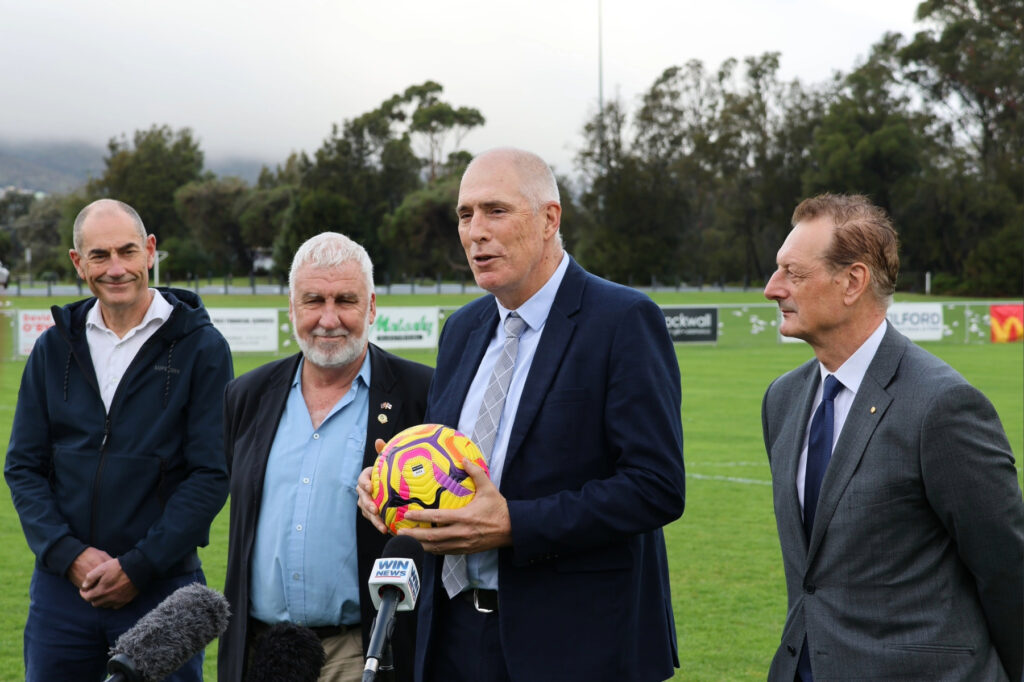
The Tasmanian State Government has committed $350,000 in seed funding for the next stage of planning for Football Tasmania‘s proposed Home of Football, moving the state’s most significant football infrastructure project closer to construction and signalling political recognition that demand for rectangular facilities in Tasmania has outgrown what currently exists.

The funding, confirmed in the 2026-27 State Budget handed down last week, sits within an almost $200 million investment in sport and recreation across the budget and forward estimates: a package the government describes as designed to improve access and participation for Tasmanians of all ages. The football allocation is listed alongside a $25 million community sporting infrastructure commitment at Kingborough, $12.5 million for new multipurpose indoor sporting courts at New Town Bay, and $8 million for the Domain Tennis Centre redevelopment.

Football Tasmania CEO Tony Pignata OAM welcomed the commitment as an acknowledgement of the structural gap between participation numbers and available infrastructure, particularly in the state’s south.

“The State Government’s delivery on this commitment shows us that they understand that demand outstrips supply for rectangular facilities in the state,” Pignata said. “If we are to continue to grow and develop future Matildas and Socceroos, we need to invest in the infrastructure our game so desperately needs.”

The proposed $80 million facility would include six full-sized pitches, three synthetic and three turf, alongside four five-a-side pitches, modern changerooms for both men and women, and dedicated training facilities. The design is intended to serve every level of the game simultaneously, from grassroots junior competitions through to national-level tournaments.

From grassroots to A-League ambitions

Football Tasmania has framed the facility’s purpose across a deliberately wide range of uses. At the community end, it would provide a permanent home for junior games and regional tournaments that currently compete for limited rectangular ground availability across the state. At the elite end, it would create the capacity to host national competitions including the Emerging Matildas and Emerging Socceroos Championships, flagship state competitions such as the Statewide Cup finals, and potentially, in time, an A-League team.

That last ambition is the most significant and the most distant. Pignata was measured but direct in raising it, situating a Tasmanian A-League club alongside the NBL’s Jackjumpers, the WNBL’s Jewels and the AFL’s Devils as part of the state’s emerging identity as a home for national sporting competition.

“One day down the track, we anticipate this would become home to our very own A-League team, so that we take our rightful place in the nation’s elite competition,” he said.

The pathway from planning funding to A-League admission is long and would require sustained political and commercial support well beyond the current commitment. But the logic is consistent with how football infrastructure investment has worked elsewhere in Australia. The facility comes first, and the competitive pathway follows. Without a purpose-built ground that meets the standards required for elite competition, the conversation about an A-League team cannot begin in earnest.

The equity dimension

The inclusion of modern women’s and men’s changerooms in the facility’s design carries more weight than it might appear. Community and semi-professional football facilities across Australia have historically been built to male standards, with women’s changerooms added as afterthoughts or not included at all. That inadequacy has been consistently identified as a barrier to female participation and to the hosting of women’s competitions at venues that cannot accommodate them properly.

A purpose-built facility that treats women’s infrastructure as a design requirement rather than a retrofit positions the Home of Football to serve the growth of women’s football in Tasmania in a way that existing facilities cannot. The state recorded 41,395 registered football participants in 2025, a number that has been growing and that the current rectangular facility stock was not built to support at this scale.

Additionally, the government’s Ticket to Play program, which provides eligible children with two vouchers worth up to $100 each for sporting participation, and the Ticket to Wellbeing program offering $100 vouchers to eligible seniors, represent indirect but meaningful support for football participation across the state’s communities.

Pignata also acknowledged outgoing Football Tasmania President Bob Gordon, who he said had dedicated almost a decade to the organisation and had been instrumental in lobbying for this and other facilities across the state.

The $350,000 planning commitment is a beginning. The $80 million facility it is intended to progress remains subject to further government investment and development approval.

FA partners with Coca-Cola ahead of FIFA World Cup 2026

The two-year partnership will place the global soft-drink giants as the Official Supplier for Australia’s Men’s and Women’s senior national teams.


Global partner, global stage

As the Socceroos look to deliver performances on the pitch at this summer’s tournament, it is a move off the pitch which will capture the imagination of fans across the country.

Football Australia announced an exciting deal with Coca-Cola, designed to align the global reach of football – and of the brand itself – to unite and engage fans this summer as well as during the FIFA Women’s World Cup 2027.

Thus, through national campaigns featuring prize draws and the chance to access various rewards, Coca-Cola will help to drive passion and interest in upcoming major tournaments.

“This partnership brings together the global scale of Coca-Cola with the passion and reach of football in Australia, creating new opportunities to connect with fans across the country,” explained FA CEO, Martin Kugeler, via press release.

“The upcoming FIFA World Cup 2026 represents a key moment for the CommBank Socceroos, and the Coca-Cola campaigns will help bring supporters closer to the team through unique and engaging experiences.”

Furthermore, with the FIFA Women’s World Cup 2027 also set to enjoy similar campaigns by Coca-Cola, the partnership’s impact and reach will extend across both the men’s and women’s game.


Marketing power

As football continues to grow – both in financial power and population reach – collaborations with global brands are now an expected aspect of tournament build-ups.

The Royal Spanish Football Federation (RFEF) also struck a deal with fashion brand Loewe, set in place for the next four years. In a similar vein, England’s off-pitch teamwear will feature the marks of both Nike and Palace Skateboards, while France will receieve their prematch jersey from Nike and Jacquemus.

This is the state of the landscape. Aligning global brands and household names with a sport capable of reaching billions at once.

Values, reach and connecting with fans. Three key ingredients to a successful collaboration.

Such alignment is key to the partnership between FA and Coca-Cola, as recognised by Managing Director, Coca-Cola Europacific Partners, Orlando Rodriguez.

“For nearly 90 years, Coca-Cola has been a part of the fabric of Australian life – bring people together through shared moments,” said Rodriguez.

“Partnering with Football Australia reflects our continued commitment to connecting communities through experiences that unite the nation, with the CommBank Socceroos and Matildas at the heart of that.”

Most Popular Topics

Editor Picks

Send this to a friend