



Football Victoria and School Sport Victoria unite to bring more football and Futsal to schools

Football Victoria (FV) have announced a significant partnership with School Sport Victoria (SSV) that will see opportunities to participate in football and futsal enhanced for school students across the state.

Pending COVID Safe guidelines, three tailor-made programs are set to kick-off in Term 4 which are designed for students of different ages and abilities to get involved in the world game.

FV CEO Kimon Taliadoros was excited to be teaming up with SSV to launch the initiatives, which will provide students a range of new and exciting pathways into football.

“Our partnership with School Sport Victoria continues to grow, with our united goal of providing more sporting opportunities for students, not only as players but as officials through our new Referees Academy program,” he said.

“With an objective of achieving 50/50 participation by 2027, the partnership with SSV enables us to provide equal access for boys and girls to kick-start a lifelong love of football for many who have not yet played our beautiful game.

“We look forward to guiding more young Victorians on their football journey.”

With the 2023 FIFA Women’s World Cup Australia and New Zealand on the horizon, there has never been a better time for young women and girls to try football.

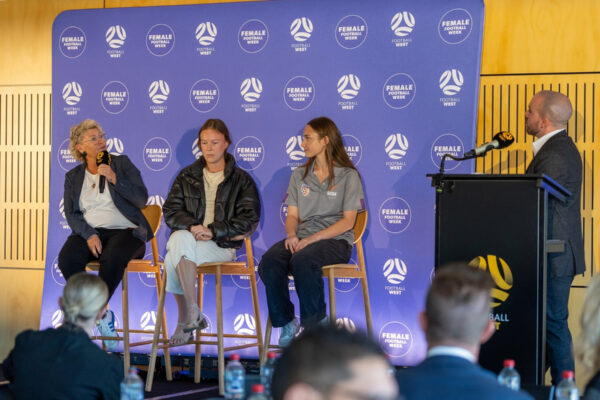
FV and SSV will partner to host Gala Days for primary school students in Grades 4, 5 and 6. These events will be exclusively girls-only so participants can shine in a fun and safe environment.

In addition, FV in conjunction with SSV are seeking Expressions of Interest (EOI) from SSV Primary and Secondary Schools who wish to participate in ‘Futsal’ 5-A-Side Indoor Football competitions in 2021 and 2022.

The program will be kicking off in December with a Futsal Gala Day at La Trobe Sports Stadium located in Bundoora.

A Futsal Champions Cup is also being proposed for Runners-Up and Champions who qualify from any SSV Divisional and Regional Futsal events that can be held in 2021.

Finally, FV and SSV have offered their Refereeing Academy program to students who are aged between 15 and 18.

The program will take students through the Level 4 Refereeing Course, which includes an online component that teaches the laws of the game and a practical component, where students will be trained by a qualified instructor out on the pitch.

Previous ArticleNext Article

Northern Motor Group joins FV as Official Automotive Partner

In an announcement made last week, Football Victoria (FV) announced the Bundoora-based company as its Official Automotive Partner for the next three years, ushering in a new partnership driven by local identity.

Built in Victoria

The alliance betwen FV and Northern Motor Group stands as the latest locally-backed partnership in Victoria’s football landscape.

Furthermore, FV Executive Manager of Commercial, Chris Speldewinde, outlined why a connection with Northern Motor Group is an exciting step forward for the organisation.

“Northern Motor Group are one of the biggest and most respected automotive businesses in Melbourne and we look forward to working with them as our official automotive partner,” Speldewinde explained.

“It’s been an exciting offseason here at FV, with several key partnership signings coming on-board, and we are thrilled to welcome Northern Motor Group to the family.”

This season, partnerships within the Football Victoria pyramid have highlighted immense support from local businesses. With shared identity, values and commitment to the community, partnerships like this are set-up for success.


What the partnership will bring

The three-year partnership will look to provide Melbournians and FV staff with a range of benefits, from vehicle access to offers including:

  • 2-years free servicing
  • $500 cash back
  • $500 worth of accessories

Thus, the partnership will look to help locals and participants across FV, reflecting both parties commitment to giving back to the community.

“As enormous supporters of football in Victoria, signing on as Football Victoria’s official automotive partner is something we are very proud of,” said Northern Motor Group Dealer Principal, Nick Soklev.

“For over 40 years, we have been helping Melbournians find the car that is right for them, and we look forward to welcoming he Victorian football community to our dealerships.”


Final thoughts

Helping the community, providing exceptional service and creating a welcoming environment – the common values shared by both parties.

For FV and all its participants, Northern Motor Group can be the driving factor which propels football in Victoria to new standards in the years to come.

How Football Victoria’s Opens Board Nominations will Address the Game’s Rapid Growth Demands

Football Victoria has opened nominations for two board director positions ahead of its Annual General Meeting on May 25, with the governing body explicitly seeking candidates with expertise in investment and fundraising, digital innovation, and people and culture to meet the modern challenges facing football administration in Australia’s most populous football state.

Nominations close at 6pm on Monday April 20. All candidates will be assessed by an Independent Nominations Committee against the requirements of FV’s 2024-2028 strategic framework, which is built around five pillars: clubs and competitions, participants, pathways, facilities, and the organisation’s future direction.

The appointments arrive at a moment when football in Victoria, and nationally, is navigating a participation boom that has significantly outpaced the infrastructure, governance and financial frameworks built to support it. The game is growing faster than the systems designed to manage it, and the people who sit at the top of those systems will determine whether that growth becomes sustainable or starts to work against itself.

A Sport at Crossroads

Football is now Australia’s largest club-based sport, and Victoria sits at the centre of that story. Participation numbers have climbed sharply in the years since the 2023 FIFA Women’s World Cup, and more recently the successful AFC Women’s Asian Cup, with junior registrations in particular placing pressure on community facilities, volunteer workforces and competition structures that were not designed to absorb growth at this pace.

The consequences are visible at ground level. Councils across Victoria, many of which did not anticipate the scale of football’s expansion when planning their sporting infrastructure, are now confronting a facilities gap that is measurable in cancelled training sessions, overloaded grounds and clubs turning away players for want of adequate space. Drainage, lighting, changeroom access and pitch availability, have become pressure points that no amount of elite-level visibility can resolve from above.

The incoming board directors will inherit that problem directly. Football Victoria’s strategic framework names facilities as one of its five core pillars, and the organisation’s ability to make the case to government, councils and private investors for the kind of sustained infrastructure funding the sport requires will depend significantly on the financial and advocacy expertise sitting around its board table.

Football Australia and Football NSW recently called on the NSW Government to establish a $343 million grassroots facilities fund in response to the same structural pressures. Victoria faces an analogous challenge, and the director recruitment process signals that FV is aware its board needs people who can drive investment portfolios and revenue streams, not merely administer existing ones.

The Commercial Dimension

The case for bringing investment expertise onto the board extends beyond facilities. Australian sport sits within a $41.7 billion economy, and football’s share of that landscape is growing in ways that create both opportunity and complexity. Broadcast rights, commercial partnerships, digital platforms, and the expanding role of sports betting in the revenue structures of sporting codes are reshaping how governing bodies at every level think about financial sustainability.

Football Victoria’s competitions, including NPL, state leagues,  and an increasingly significant women’s program, represent a substantial commercial asset that has historically been underleveraged relative to its scale. The appointment of directors with investment and fundraising competencies is a direct acknowledgement that the next phase of the sport’s growth in Victoria will require a more sophisticated financial strategy than the one that got it here.

The digital innovation competency sits alongside that commercial imperative. Football is generating more data, more content and more participant interaction than at any point in its history in Australia, and the governing bodies that build effective digital infrastructure now will be better positioned to manage participation, retain players and engage communities at a scale that was not previously possible.

Governance and Equity

Football Victoria’s nomination process includes a constitutional requirement for 40:40:20 board composition. It translates to 40 percent identifying as women, 40 percent as men, and 20 percent of any gender.

The equity means decisions made at the board-level, about facilities investment, participation pathways, and community engagement have a direct impact on who gets to play, where and under what conditions. A board composition that reflects the diversity of the football community it governs is better placed to identify the structural barriers that data alone does not always surface.

FV CEO, along with the Independent Nominations Committee, will assess candidates against the full range of competencies outlined in the strategic framework, including governance experience, demonstrated involvement in football as a player, coach, referee or administrator, and an understanding of the broader football ecosystem.

The sport is at an inflection point. The foundations have been laid by decades of community building, volunteer labour and grassroots investment. What happens next, whether the participation boom becomes a lasting structural shift or a wave that recedes from insufficient infrastructure to sustain it, will be shaped in no small part by the quality of leadership at the governing body level.

Most Popular Topics

Editor Picks

Send this to a friend