



Football Australia marks strong 2021 progress in Annual General Meeting

FA AGM

Football Australia’s 18th Annual General Meeting (AGM) was held on Tuesday afternoon (November 23) via video conference, in line with the release of the national governing body’s 2021 Annual Review.

At the AGM, Football Australia’s Members voted to re-elect Amy Duggan and Joseph Carrozzi as Directors. The Football Australia Board now comprises nine members, of which five are female and four are male – a first of the major sporting bodies in Australia with a gender split of 55% female and 45% male.

Football Australia’s Members also ratified changing the financial year of Football Australia from a financial year (July 1 to June 30) to a calendar year (January 1 to December 31).

This step is made in the spirit of the ‘One Football’ concept outlined in the XI Principles for the future of Australian football and increases alignment of financial years across the entire game, as Football Australia seeks to create greater operating efficiencies.

Following the AGM, Chris Nikou was installed unanimously by his fellow Directors to the position of Football Australia Chair – a role he has fulfilled since November 2018. Carla Wilshire was elected as Deputy Chair.

Nikou was pleased that 2021 was a year of implementation and action.

“It is with great satisfaction that the Board of Football Australia can report that 2021 has indeed been a landmark year for our sport. We are taking transformative steps for the future, driven by our 15-year vision outlined in our XI Principles for the future of Australian football and by our commitment to a strategic growth agenda,” Nikou said.

“In recent times, we have embarked on crucial and at times, difficult structural changes. Reforms that will see the continued evolution and growth of our great game. I am proud to say that we have completed making many of those changes.

“Over the last year, I have been pleased with the increased level of collaboration among the game’s stakeholders. Their strong appetite for working hand-in-hand will ensure that the game will continue to evolve and grow in ways not seen before.

“Pleasingly, with all the work undertaken in developing a new 15-year vision for the sport and our clear strategic growth agenda, and in re-creating and re-imagining our value proposition commercially, we entered FY 2021/22 with a budgeted revenue double what we achieved in FY 2020/21. In a COVID-19 affected world, this is a remarkable turnaround,”

In the second year of his tenure, Chief Executive Officer James Johnson said:

“Australian football is in a vastly different position today than what it was 18 months ago, with noticeable and significant change taking place across the game this year.

“2022 will provide the opportunity to focus our strategic agenda on key initiatives, such as digital transformation and the establishment of more exciting football products, which we believe will enhance our connection to our broad and diverse football community.

“We have set the foundations for positive transformation of Australian football in 2021 and we are optimistic and excited about the future of the game.”

Football Australia’s 2021 Annual Review can be accessed here.

Previous ArticleNext Article

Football NSW calls on clubs to Make It Red for Heart Health Round

Football NSW is calling on clubs and associations across the state to register for the 2026 Make It Red campaign, joining a national awareness movement aimed at reducing heart-related deaths on sporting grounds ahead of Heart Health Round on the weekend of June 5 to 7.

The campaign, developed by the Heartbeat of Football Foundation, asks sporting clubs to wear red, raise funds and build awareness around heart disease and sudden cardiac arrest, which is the leading single cause of disease burden and death in Australia for both men and women, and one that health authorities say is largely preventable through modifiable risk factors.

The call to action comes as the Foundation continues its work to map and register Automated External Defibrillators across NSW sporting facilities, a project that has already engaged twelve football associations and fed data into both the NSW Ambulance GoodSAM registry and NSW Health’s public AED map. The availability of a functioning, registered AED on site is among the most significant determinants of survival following sudden cardiac arrest, with survival rates declining sharply for every minute without defibrillation.

Football NSW is encouraging clubs to engage with the campaign across three areas. Clubs can register for the Make It Red campaign to help fund research, education and prevention programs. Participants, particularly those aged over 35, are encouraged to seek a free heart health screening test from their local GP or enquire about hosting a Heartbeat of Football testing day. Clubs are also urged to ensure their grounds have active, accessible AEDs in place, with guidance available through Football NSW’s Rescue Ready Guide.

The Make It Red campaign runs from June 5 to July 12, with Heart Health Round taking place across the opening weekend. Clubs can register and access participation resources at makeitred.org.

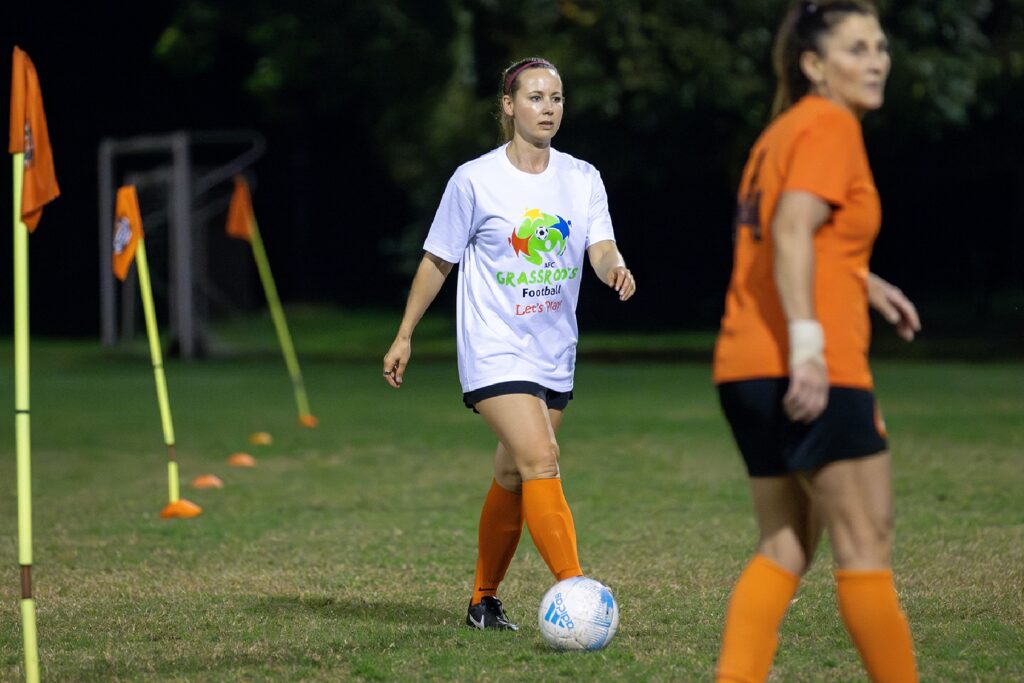
Community Spirit Shines on AFC Grassroots Football Day 2026

This week, Football Australia (FA) celebrated AFC Grassroots Football Day 2026, championing the people and communities who continue to hold up a safe, inclusive and supportive environment in the football landscape.

‘For all, for life’

In collaboration with Football NSW, Canterbury Football Association and community club, Balmain & District Football Club, the day reflected the very best of what football provides.

The event brought in participants of all ages – from 4-74 years-old – and reached a total of 400 people. Girls-only programs, all-abilities sessions and over-age football ensured all were catered for.

Such a diverse range of participants builds on a wider drive during FIFA World Football Week, which seeks to promote the sport not just as the dazzling lights of 100,000-seater stadiums, but as a way to foster community spirit and social development.

Furthermore, FA support through its Club Changer program was a welcome addition to the action, emphasising the organisation’s commitment to nurture a real love for the game across communities in Australia.

“Through Club Changer we support our clubs to provide a safe, fun and enjoyable environment where everyone is welcome; whether that be as a player, volunteer, referee or supporter,” explained National Program Manager Club Development at FA, Grace Lambourne.

“Everyone should feel they belong and are welcome to play, stay, and love the game.”


A welcome celebration

While the upcoming FIFA World Cup will no doubt inspire millions of future Socceroos and Matildas, events like the AFC Grassroots Football Day represent something beyond just inspiration.

It is a platform. An opportunity to express a love for football and to connect with others while doing so.

And connections between the professional and grassroots game is more important than ever if Australia is to nurture the next generation of talent.

This is particularly clear in the rise of women’s football across the nation. Since the FIFA Women’s World Cup, female participation rose by 32%, and registrations for the MiniTillies Program skyrocketed from 264 in 2023, to 1223 in 2024.

The professionals spark passion. But communities turn that passion into playing time.

That is why celebrating grassroots football – and the volunteers and families who sustain it – is a vital part of Australia’s football future. Together, FA and the AFC are creating strong foundations built on positivity, engagement, and inclusivity for all with a love for the beautiful game.

Most Popular Topics

Editor Picks

Send this to a friend