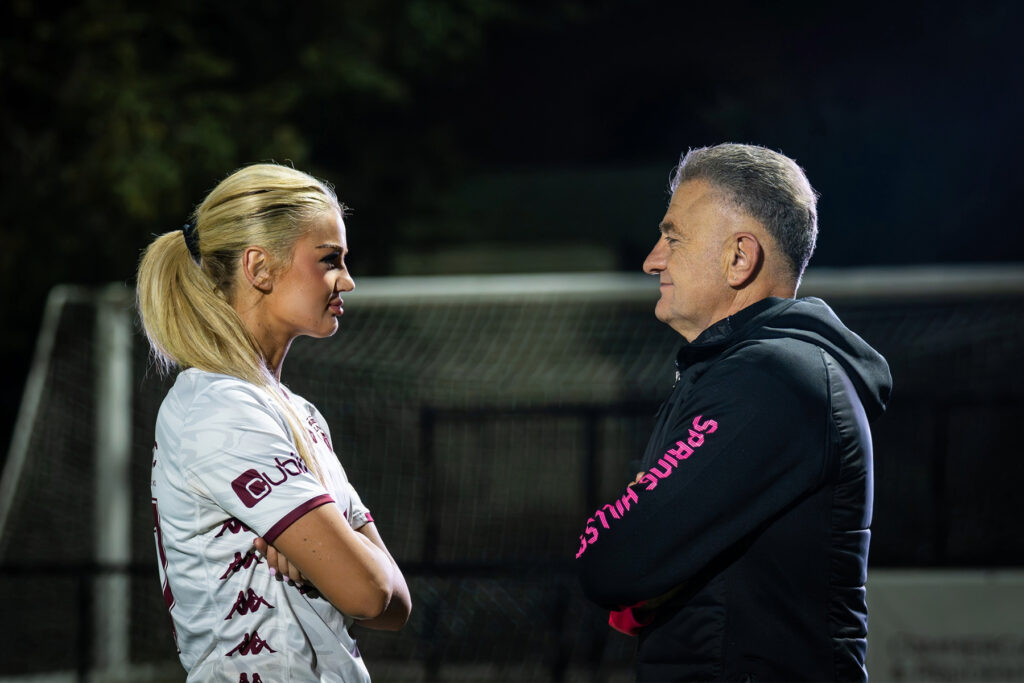





The merger of Cumberland United and Flinders Flames in 2021 marked a transformative moment for what would become Flinders United, a club that has quickly become one of the biggest women’s only football clubs in South Australia.
For Flinders Flames, it was an opportunity to overcome limited facilities and a stagnant player base, while Cumberland United aimed to revive its senior women’s program and offer its juniors a clear progression into senior and elite football.
Together, they have formed a club that champions development, loyalty, and equitable opportunities in a rapidly evolving football landscape.
However, like other women’s football clubs in SA, they face challenges for funding and finding a permanent home to play matches.
SoccerScene had a conversation with Flinders United President Shannen Connolly where she discussed the future for Flinders United, the club’s successful philosophy on player development, and the funding problems for women’s football in South Australia.

Theo Athans:
What motivated the merge between Cumberland United and Flinders Flames in 2021?
Shannen Connolly:
I came from the Flinders Flames side so we were just a senior women’s football club on our own. When I first joined the club, we had four pitches and we were just senior women, and then the university started building on top of all the land so we were decimated down to one real pitch and no real training space because we shared that with AFL, Softball and Baseball.
We would only rely on senior player numbers so there was nothing feeding into our teams, we just relied on players sticking around year after year.
On Cumberland’s side, they used to have a senior women’s cohort that just became non-existent, and they only ended up with juniors. At Flinders Flames we started exploring options around and eventually this opportunity presented where we could create what we call a ‘lifetime pathway’ so juniors had somewhere to feed into to senior football and then the senior women’s competition could elevate into the WNPL competitions.
That wasn’t happening, for Cumberland United WFC, their juniors would age out and go to clubs where senior football was offered. Cumberland had recently upgraded facilities at the Women’s Memorial Playing Field, they had a brand new changeroom facility built and a dedicated space for the girls, so it meant that Flinders Flames had an option to extend on their location.
We now maintain three sites for Flinders United which is the Women’s Memorial Playing Fields, which is our main home ground, we have Flinders University as a backup, and we are also partnered and affiliated with Club Marion who allow us to use their facilities as well.
TA:
Facilities seem to be a big issue in women’s football. With the club hosting such a big group of players, are the facilities good enough as it is or is the club looking to upgrade?
SC:
We’re now looking to expand because at the moment our Women’s NPL team can’t play at any of our grounds because they’re not up to the minimum facility requirements.
We have to invest in fencing, scoreboards and other requirements in order to host games at our grounds so there is definitely room for improvement. We’ve only got the home and away changerooms at Women’s Memorial [Playing Fields] where we’ve got multiple teams on one day so ideally, we need another set of changerooms or two.
The car park at our facility, it’s a dirt road to get into the facility so that’s another difficulty. Office, Rec, Sport and Racing did not have the funding to complete that full project.
TA:
So where does the NPL side play their home matches now?
SC:
The last two seasons, we have been playing out of SA Athletic stadium but that no longer meets Football SA’s requirements because the pitch dimensions are changing, and the viewing is not up to that elite competition standard.
We’re now looking at our options to try and fence our facility at Women’s Memorial [Playing Fields], having our main pitch fenced off and adding those additional requirements such as a scoreboard and scaffolding for any media.
Women’s football has been overshadowed because a lot of men’s affiliated clubs will get what I call the ‘token women’s team’ because they’re eligible to apply for greater grants than the females are if they’re a sole female club.
There are a lot of clubs who get facility upgrades but the unfortunate thing is most of the time the girls don’t get to use these facilities; they go preferentially to their male counterparts.
TA:
Player development has been pushed by Football SA. For a club as big as Flinders United, how do you get the best out of each and every player to eventually have them playing top level football?
SC:
We were recognised by Football Australia as Club of the Year in the Club Changer Programme for the way that we foster and develop our players.
We go against the grain and typically try and keep our players in their age groups in the juniors so we’re not pushing 13- or 14-year-olds into senior football just to make a team. We are privileged in the fact that we can cater them correctly and foster their development and pathways, so we offer our older junior girls’ pathways into senior football in a more holistic environment.
They get to train with the seniors, they get introduced into the seniors and overall, it’s a managed progression whereas most clubs tend to dump their u17’s or senior teams for example with 13- and 14-year-olds or they push them into a state league or community teams because they need to fill one.
As a club we don’t have to focus on that, we’ve got every age group. This year we’re going to have u7’s, 9’s, 10’s, 11’s, 12’s, 13’s, 14’s, 15’s, 16’s, 17’s and then we’re going to have at minimum seven community or elite competition teams so there is a transgressional process through each stage.
All the junior and senior coaches will sit down weekly and identify players that are showing potential or need improvement by chatting and conversing about it which fosters that enhancement for them.
It seems as if every player gets a focus because of the coaches’ hard work which is great for a club of this size.
Our coaches work really hard together, we’ve had Holly Hayes as our Junior Technical Director over the last couple of years and she’s really focused on player development, growth and not pushing these girls beyond their limits but giving them those opportunities to pathways forward.
We get players from other clubs saying they don’t want to play juniors, but we have this pathway and way of operating where when they do join, they see a benefit in not getting dumped into a team or not knowing what the structure is. All of that gets integrated into their learning and development.

TA:
There seems to be an issue across all states with player retention in boys and girls football. How does the club ensure that players stay and are loyal to the club for many years?
SC:
Loyalty is a big question mark these days because you get clubs over offering so we might give a girl an u15 red position, but she goes and trials somewhere else and they offer her an u17 spot because that’s all their going to have or need to fill.
It’s creating a massive monster because girls are being over offered and in reality, when they go there, they’re not getting what they’ve been promised and it’s a regular pattern that we’re seeing at the club. The Players and even parents that join us have to trust the process that we are genuinely trying to do the right thing and benefit their development. It’s a hard mentality to change.
In relations to us, I think the way that we talk to our players, the way that we engage our players, it’s not just what we do on the pitch as well, we do off-field stuff with them like nutrition, mental health, periodisation, barista skills and more which goes above and beyond what translates on the field.
I’m very fortunate to say that 90% of our senior cohort have stayed with us for years and I’m talking in excess of 5-10 years. We have one player who celebrated 20 years with Flinders Flames and Flinders United recently, I’ve got a junior player now entering senior football who has been with Cumberland since she was 7 and she has continued all the way through.
It’s just identifying those that continue their loyalty, and we constantly engage with their parents or the players directly to make sure their hopes and desires align with what we’re trying to offer them.
We’re really honest with our players, if we say ‘this is where we think you’re at, at the moment’ then that’s exactly what it is and that’s what we’re offering and promising to deliver you. There is obviously extension opportunities but at the end of the day we’re not going to overpromise someone at the start on something and then not deliver on it, this is how I believe clubs can help build loyalty and stop feeding the monster that is being created.

TA:
There’s few grants going out to women’s football so what are your personal thoughts on the current competitive nature of the grant structure in South Australia?
SC:
The Power of Her grant is the recent one that is coming up but that requires 50% buy-in from the club itself, now for a club like ours that is a new entity, we don’t have hundreds of thousands dollars in the bank account. That’s a big stretch for us.
There haven’t in the past been great opportunities for grants for just girls and women. Like I mentioned before, there have been grants that have been “token” grants if you have one girls or women’s side to upgrade facilities.
I understand the boys generate a lot of revenue through sponsors but also it comes down to some of the fees that clubs are charging, it’s exorbitant. I’ve seen fees for MiniRoos in excess of $1000, what parent can pay that money for a kid aged 7-11? That to me is ridiculous, our MiniRoos fees are about $500 and that covers their uniform and registration but only a small portion gets kicked back to us. I want to make it more affordable for players and families.
There needs to be more funding for women and girls’ football, and it must be solely for girls and women’s football not in conjunction with a men’s side. Girls and women in sport are now gaining greater recognition, breaking barriers, and receiving the visibility and support they deserve on and off the field. It’s time for S.A to step up to support this new era.