



The prospect of a National Second Division below the A-League Men has captivated the day-to-day speculation and debate of Australian football’s dedicated adherents for some time now.
For the Association of Australian Football Clubs (AAFC) – the body which represents the collective of National Premier League clubs looking to initiate the National Second Division – it is about transforming the aforementioned hypothesising and conversation into a tangible reality.
Realistically, the implementation of a National Second Division has taken its time for myriad of reasons, namely due to having to balance multiple stakeholders, needing to meet Football Australia’s (FA) requirements during their transition from Football Federation Australia, and recovering from the collateral damage caused by the COVID-19 pandemic.
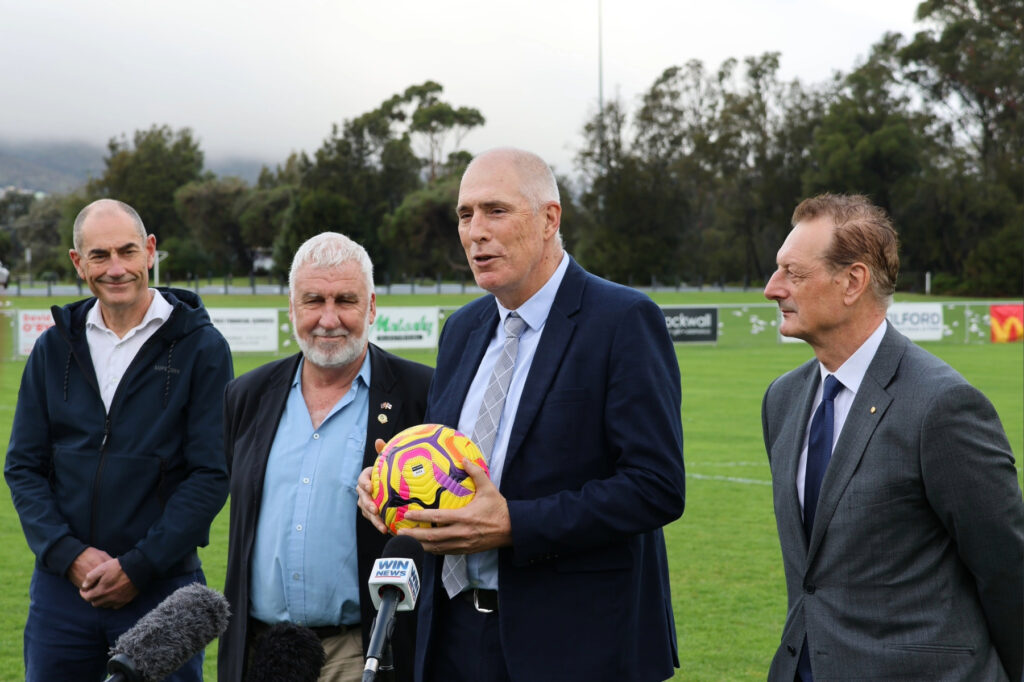
In a conversation with Soccerscene, AAFC Chairman Nick Galatas discusses how the National Second Division is shaping up ahead of the organisation’s 2024 deadline (which has been confirmed by FA CEO James Johnson via ESPN) and what the next steps are for the clubs involved.

What was the outcome of the AAFC’s meeting in late October regarding the prospective National Second Division?
Nick Galatas: We convened that meeting at the conclusion of FA’s presentations to the clubs about the work FA have done on the National Second Division. The FA met with the various clubs and sought feedback from the clubs on a state-based format. After attending those meetings, we thought it would be helpful to convene all the interested clubs from around Australia – after they’d had time to consider what FA put to them and the issues about which FA sought their feedback.
We met in Sydney, and together the clubs considered the important issues about which FA sought their input and feedback and reached consensus on those areas. We’ve given that feedback to FA to inform FA’s further work in completing the structure of the NSD.
Undoubtedly the establishment of a National Second Division is going to require a lot of impetus and momentum alongside the knowledge and experience of various industry experts. What areas of expertise are the NSD’s organisers looking to utilise in order to drive the league forward effectively?
Nick Galatas: Impetus and momentum are key. That’s both from our perspective in keeping FA and the public onto it, and also our clubs in reminding them of what’s coming so that they keep getting ready and maintain that momentum.
To preface your question on industry experience and expertise, just to break this up a little bit, this will be a FA run competition – that’s what’s proposed. Football Australia will be the administrator as they were when the A-League started and the clubs understand and agree with that. FA will look to commercialise it, implement strategies, and engage various experts.
Having said that, at the same time the clubs as a group operating through us are also working with some experts in order to inform club thinking individually and collectively, which in turn we hope to inform FA with. The clubs are individually and collectively working on revenue-raising, how to best capitalise themselves for the increased expenditure that will come with a National Second Division, and how to cooperate within that national environment to grow the competition and their clubs.
As well as that, some market research and surveying – a lot of these clubs have now been operating within a much smaller market within the NPL for a long time, and they currently connect with their larger latent supporter base only on special events. For example, having a deep run into the Australia Cup tournament – as we’ve seen recently – and lots of their supporters who long to see their clubs on the national stage playing bigger matches emerge but they’re not necessarily in contact with these clubs on a regular basis while they’re NPL clubs, restricted in what they can do.
Assisting the clubs to understand what their supporter base is likely to look like now for some of the existing clubs who were previously playing at national level 20 years later is important. So, work has been done there, as well as about the available broadcast options.
As stated by the AAFC following that meeting, the 30 clubs collectively welcomed FA’s proposal to “proceed with a financially viable national ‘Home and Away’-style second division competition which will sit between the NPLs and the A-Leagues which largely mirrors AAFC’s model”. How close are we to having this now implemented?
Nick Galatas: Again, this comes back to FA, but we’ve said in our press release now that 2024 is our goal. FA had said 2023 – that’s obviously unfeasible and can’t now happen, but we think it will happen in 2024 and it must. The understanding that we have is that FA will complete its modelling and put out an expression of interest in the first quarter of next year, by around the end of March.
Interested clubs will all basically be with a deep history and involvement in football, grassroots and otherwise – that’s part of FA’s model. Clubs will apply through an expression of interest. After that, with a view to that process taking place over a two-three month period, so that FA can select the teams and announce the participants of the second division for ’24 in ’23. It will be a fantastic impetus to our game, helping with its unification and growth, following the Women’s World Cup here and New Zealand and the Matildas playing in another World Cup, by starting in 2024.

How is the NSD looking to engage sponsors and investment into the league?
Nick Galatas: No doubt this question is predicated on what’s been done by the entities in the A-Leagues. For the National Second Division, many of its clubs will already have a presence – whether they be clubs in their current form or clubs in combination with others – and will have a tradition and reputation to draw on from the start. Therefore, that will become apparent when the clubs are known and they’ll have those reputations and traditions both individually and collectively, so, there’ll be a multiplying effect.
You’ll be able to tap into the past and you’ll be able to look at matches that go back 20, 30 years and that’s one element. Other elements are there could be clubs that are rising in particular regions – such as growth areas in Brisbane and other cities – which will have a very strong local flavour. These clubs, with their current reputations given that they exist already, will be able to leverage that reputation, history, knowledge, and tradition in attracting sponsors.
When the historic clubs overseas were proposing the European Super League, one of the British members of Parliament referred to the English clubs as “cherished cultural institutions”. And that’s what we’ve got here. Now, I think what we haven’t appreciated properly yet – in our rush for our game to become major in this country – is that a lot of clubs that were formed by various communities have so much to offer on our quest for growth and we shouldn’t lose that. It’s irreplaceable.
From the oldest club established in Newcastle over 100 years ago, to some now being 60, 70 or 80 years old, to some being a bit newer, I think we’ll eventually come to realise that we’ve got in this country. Organisations that have been formed by members of various communities and they have grown and evolved and continue to do so – which really, we should be cherishing. Instead of doing what we did 20 years ago and that is to bury them effectively, we should be cherishing them, understanding their cultural significance and with successful, major sports being embedded in our culture, that such clubs are key to game’s growth here.
We’ve come a long way recently, but for example, while we’ve still got a long way to go with our First Nations recognition, understanding that they are a major part of our society in every sense, that’s one area of our community. What I think will happen is – as we deal with that – the next part will be to go back again and look at the great immigration waves in Australia and realise their importance too, in their own way. They played key roles in the development and enrichment of our communities, people and social structures. Football, and our football and community, are interwoven in that way. And I think that understanding will also be a major sponsorship driver. Sponsors will want to associate themselves with the fantastic positives of what these grassroots cultural institutions have brought to this country.
Similarly, we’ve seen how women’s football has grown and attracted sponsors who understand the obvious central role women have in our community. I think we are poised to embrace the whole of our cultural heritage and see the migrant waves segment grow in a similar way. And as the younger generation comes through there will be a desire to appreciate whole of our history.
Is there enough fan interest for these historic clubs to properly be a part of an NSD? Will there be a benchmark of supporter numbers that clubs have to meet?
Nick Galatas: What we did at AAFC when we prepared our report for FA is we conducted a capability study among our clubs. The purpose of that was to inform FA of what we can do, because there’s no point coming up with an arbitrary set of benchmarks with parameters and criteria that we don’t have the clubs to meet. Then we won’t have a second division or anything like it.
So, the idea is not to create a second division as such, but the idea is to look at the clubs that you’ve got available and look at how to best organise it. Now, are they all the same? If not, and if you’ve got 12, 14, 16 clubs that emerge across the country as being in a position to play nationally and grow from there, a second division is created. So, what we say is, let’s look at our strongest clubs, let’s reflect what they can do individually and collectively. Obviously, they’re going to be stepping out of the NPL as the new competition will afford them better opportunities to grow from where they are and they’ll be better once there. And that will be the initial level. The level will be informed by the capability of the clubs, rather than the clubs being required to meet an arbitrary level. That’s absolutely, fundamentally key for it to be financially viable.
Some of these historic clubs have been in a state-level environment for the last 20-odd years and that’s not their natural environment nor is it for their supporters as their clubs’ DNA and background is national. So, they haven’t been there for years and what they are now is not what you’ll hopefully see when they’re back on the national stage. Start low and grow, rather than setting an arbitrary benchmark and not being able to reach it and crash.
It will be a good thing to have a National Second Division; we all agree on that. In order to ensure it works however, it needs to reflect the capability of the clubs. We think therefore it can work, and there are clubs with sufficient numbers and supporters which will be significantly in advance of what they’re delivering now in the NPL.

One of the outcomes of the National Second Division is to initially provide development opportunities for players dropping down from the A-Leagues or coming up from the National Premier Leagues. How critical is it that this then develops into a second division under the A-Leagues with promotion and relegation?
Nick Galatas: Undoubtedly, that will be one of the outcomes of the second division but it is not inherently a part of it. What is inherent to it is that we need to develop more strong clubs. That’s where players play. If we try to develop players externally in independent programs separate to clubs then we’re not going to have players. Players develop at clubs. A club has supporters; it has fans; infrastructure. It nurtures players; provides money, generates sponsorship, etc. And there’s a living to be made, an economic benefit for players, at all levels.
Retention; everyone from the top internationals through to the A-League Men’s good player; the A-League Men’s workman-type player; the A-League Men’s sub; all the way down to the community guys – and I’m talking of men at the moment, but of course hopefully women down the track also – is what football is. You want retention of players; you want to occupy the sporting landscape and you want footballers playing everywhere at every level.
So, what we’re aiming for with the National Second Division is enabling more strong clubs to develop within it. Instead of sitting there wondering, as the A-Leagues is now doing, where is our next expansion going to come from, you shouldn’t have to wonder. Your next expansion club should be from among those coming through from the division below. There’s your issue. Instead of wondering ‘where’s the market’ to insert one in, it should be about allowing the best clubs to emerge where they are suited and where the local community most supports them.
Ultimately, I think the second division is very important, and I sense the FA does as well, but the issue at the moment is we need to get there. So, one of the issues that we’ve got is the division doesn’t currently exist. The minute you have promotion and relegation from the A-League Men’s, an A-Leagues club owner who has invested into the club will ask whether dropping down leads them to oblivion. A fair question if you’re a business. I would be asking it too if I was a business.
So, we need to create a National Second Division that reaches a level which ensures that if you’re getting relegated from the A-League Men’s you’re not only surviving; you’re thriving. You’re rebuilding and recharging to have another tilt when you get back there. That’s what the second division is about and it needs to ultimately align with the A-League Men’s but there’s no point talking theoretically. We need to start it and let it develop. But I think the aim always has to be – from my perspective and others will have a say in this – that the job will not be completely done if it’s not linked because we’ll have parallel national competitions and that’s not ideal.
That doesn’t mean immediate promotion and relegation, that just means an understanding of the game from all those involved, and in fairness to the A-Leagues I believe they see that these national competitions must relate to each other in a positive way, rather than compete with each other.