




A-League, W-League and Y-League to be unbundled from Football Australia

Football Australia and the newly formed Australian Professional Leagues (APL) have announced that terms have been agreed to ‘unbundle’ the A-League, W-League and Y-League from Football Australia.

The unbundling of the leagues from the head governing body of the sport will bring the Australian football structure in line with global standards, separating Football Australia as the regulatory body from the operation of the professional leagues.

The APL will take over the commercial, marketing and operational practices of the professional leagues, as well as all revenue generation responsibilities.

APL will also retain the exclusive right to use the intellectual property rights associated with the E-League.

Football Australia will still retain some regulatory functions of the professional leagues, including matters relating to on-and-off-field disciplinary and integrity matters, the transfer system, the registrations of clubs, players and officials, as well as the domestic match calendar.

Alongside this, new club licensing framework for the professional leagues and control over access to the leagues (whether that is through expansion, promotion/relegation or contraction), the AFC Champions League, FFA Cup and all other domestic and international competitions will also fall under the regulatory functions of Football Australia.

The new model will be implemented through the course of the 2020/21 A-League and W-League football seasons.

Greg O’Rourke will serve as commissioner of the professional leagues for APL.

O’Rourke will report to an APL board consisting of five club directors, one member representing Football Australia and three independent directors, with one of them to be elected chair of the organisation.

James Johnson, CEO of Football Australia, said of the developments: “The unbundling of the professional leagues from Football Australia is a key milestone in the ongoing transformation of Australian football and fulfils our commitment outlined in Principle VIII of our XI Principles. It represents the culmination of a process, which ramped up following the completion of the A-League 2019/20 season, that ebbed and flowed over the course of what has been a difficult 2020.

“The new model respects the fundamental aspects of the global football pyramid and highlights the importance of strong governance principles as Football Australia retains its regulatory functions in respect of the A-League, Westfield W-League and Y-League and the APL takes control over the operational and commercial direction of the leagues, in turn triggering the ability for significant new investment in the quality and marketing of the leagues. Each constituent now has defined roles and responsibilities and the ability to make the right contribution to the growth of the professional game.

“We have been able to create a unique model which draws upon global best practice whilst allowing for local specificities. Significantly, the model establishes a framework for a strong partnership between Football Australia and the APL which recognises the value of a thriving domestic professional league to the ongoing growth of the game in Australia.” 

Paul Lederer, Chairman of APL, said: “This is an historic moment for the future of football in Australia – for the fan, for the player, for the whole game.

“It’s now time to earn and deliver the future our game deserves.

 “The handbrake on the game is off; owners can finally invest in what they own and create value for the entire footballing ecosystem.

 “Players can plan their careers in Australian football, fans can reconnect with the game that they love, and clubs can create meaningful moments for the whole Australian football family.”

Previous ArticleNext Article

Football NSW calls on clubs to Make It Red for Heart Health Round

Football NSW is calling on clubs and associations across the state to register for the 2026 Make It Red campaign, joining a national awareness movement aimed at reducing heart-related deaths on sporting grounds ahead of Heart Health Round on the weekend of June 5 to 7.

The campaign, developed by the Heartbeat of Football Foundation, asks sporting clubs to wear red, raise funds and build awareness around heart disease and sudden cardiac arrest, which is the leading single cause of disease burden and death in Australia for both men and women, and one that health authorities say is largely preventable through modifiable risk factors.

The call to action comes as the Foundation continues its work to map and register Automated External Defibrillators across NSW sporting facilities, a project that has already engaged twelve football associations and fed data into both the NSW Ambulance GoodSAM registry and NSW Health’s public AED map. The availability of a functioning, registered AED on site is among the most significant determinants of survival following sudden cardiac arrest, with survival rates declining sharply for every minute without defibrillation.

Football NSW is encouraging clubs to engage with the campaign across three areas. Clubs can register for the Make It Red campaign to help fund research, education and prevention programs. Participants, particularly those aged over 35, are encouraged to seek a free heart health screening test from their local GP or enquire about hosting a Heartbeat of Football testing day. Clubs are also urged to ensure their grounds have active, accessible AEDs in place, with guidance available through Football NSW’s Rescue Ready Guide.

The Make It Red campaign runs from June 5 to July 12, with Heart Health Round taking place across the opening weekend. Clubs can register and access participation resources at makeitred.org.

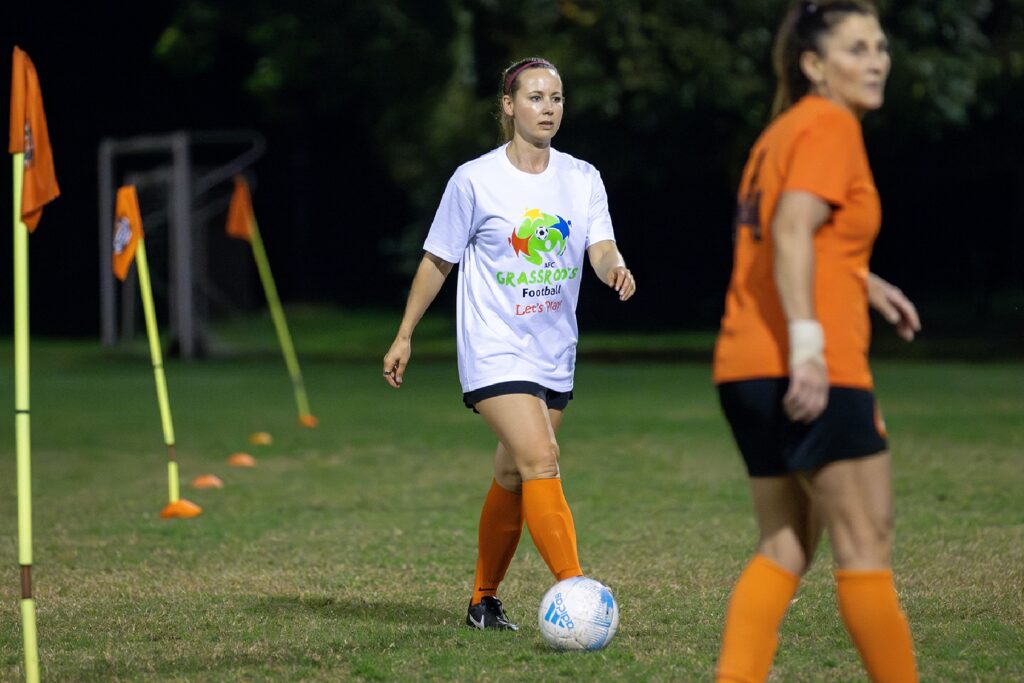
Community Spirit Shines on AFC Grassroots Football Day 2026

This week, Football Australia (FA) celebrated AFC Grassroots Football Day 2026, championing the people and communities who continue to hold up a safe, inclusive and supportive environment in the football landscape.

‘For all, for life’

In collaboration with Football NSW, Canterbury Football Association and community club, Balmain & District Football Club, the day reflected the very best of what football provides.

The event brought in participants of all ages – from 4-74 years-old – and reached a total of 400 people. Girls-only programs, all-abilities sessions and over-age football ensured all were catered for.

Such a diverse range of participants builds on a wider drive during FIFA World Football Week, which seeks to promote the sport not just as the dazzling lights of 100,000-seater stadiums, but as a way to foster community spirit and social development.

Furthermore, FA support through its Club Changer program was a welcome addition to the action, emphasising the organisation’s commitment to nurture a real love for the game across communities in Australia.

“Through Club Changer we support our clubs to provide a safe, fun and enjoyable environment where everyone is welcome; whether that be as a player, volunteer, referee or supporter,” explained National Program Manager Club Development at FA, Grace Lambourne.

“Everyone should feel they belong and are welcome to play, stay, and love the game.”


A welcome celebration

While the upcoming FIFA World Cup will no doubt inspire millions of future Socceroos and Matildas, events like the AFC Grassroots Football Day represent something beyond just inspiration.

It is a platform. An opportunity to express a love for football and to connect with others while doing so.

And connections between the professional and grassroots game is more important than ever if Australia is to nurture the next generation of talent.

This is particularly clear in the rise of women’s football across the nation. Since the FIFA Women’s World Cup, female participation rose by 32%, and registrations for the MiniTillies Program skyrocketed from 264 in 2023, to 1223 in 2024.

The professionals spark passion. But communities turn that passion into playing time.

That is why celebrating grassroots football – and the volunteers and families who sustain it – is a vital part of Australia’s football future. Together, FA and the AFC are creating strong foundations built on positivity, engagement, and inclusivity for all with a love for the beautiful game.

Most Popular Topics

Editor Picks

Send this to a friend