


When Danny Townsend was appointed CEO of Sydney FC in August, 2017, he could never have envisaged the pressures which Australian football would be confronted with in 2020
A national competition in the A-league which has its very survival threatened had been losing public support for the last few years.
Now a major dispute with the P.F.A over players’ wages, conditions and entitlements, the diminution of television and commercial backing and an uncertain starting date for the next season, have made this year the worst in the fifteen year history of the competition
Danny Townsend is a creative thinker but he will have to apply all the know – how gleaned in the formation and growth of his brainchild international company, Repucom, to combat the forces at work against the prosperity of the A-League and his own club.
In this interview with Roger Sleeman, Danny Townsend discusses the hurdles the game is facing and attempts to provide the answers to overcome them.
ROGER SLEEMAN
You completed the double on August 30. What is the aftermath for Sydney FC?
DANNY TOWNSEND
It was a fantastic achievement in surpassing Sydney City, South Melbourne, Marconi and Melbourne Victory as the club with the greatest number of titles in national competition so it’s something we can all look back on with pride.
ROGER SLEEMAN
What were the pros and cons of finishing the season?
DANNY TOWNSEND
For the game it was important to resume the season after the COVID-19 interruption.
Particularly for our club, so the players could complete the mission to secure the Double and go back to back Champions.
Also, continuity was important because the wider community and football supporters needed something to inspire them given the difficult times brought about by the pandemic.
Certainly, it was a positive winning the Double in these difficult times.
ROGER SLEEMAN
At the moment, coverage for the game on tv, radio and print media is next to nothing.
Your thoughts?
DANNY TOWNSEND
This is disappointing but COVID-19 has created an inflexion point for the game to rebuild and examine media and many other issues.
We have a strategy and all stakeholders in the code from the FFA, the Professional Leagues and down to the grassroots must play an important collaborative role in rebuilding the game .
We’ve always talked about high participation rates and interest in football – we have the numbers and enough support to justify having coverage on the front and back pages every day.
However, this has never been capitalised on and it’s a clear failing in the game to date.
Now is the time to do something about it – we have no choice.
ROGER SLEEMAN
Do we have the right people on the Board of FFA and executive talent in the organisation to take the game forward?
DANNY TOWNSEND
The people are there and in James Johnson we have a CEO with the right credentials who unfortunately has taken up his position at a particularly difficult time. It’s not just up to the FFA but we must separate the Professional Leagues.
These organisations need to be entrepreneurial and hire the most talented and innovative people.
There are plenty of good people in football but we need to be bold and take some risks.
There should be a mixture of competencies which allows the game to move forward as a collective.
It isn’t about one single board member or executive but about senior figures in the game working together to achieve the necessary outcomes to take the game forward.
Fortunately, Sydney FC Board members provide me with the support to do the job I want and critically, I have the best people around me to make it happen.
ROGER SLEEMAN
How much longer will it be before the A-League clubs become independent from the FFA and will the current incumbents led by Greg O’Rourke still administer the competition?
DANNY TOWNSEND
The FFA has indicated to the clubs they support the process of an independent League.
However, there are processes to be followed which will ensure the separation is carried out in a professional and orderly manner.
I can’t really comment about how the unbundling will take place and what it will finally look like.
Nonetheless, Greg O’Rourke demonstrated great initiative in getting the competition back and running again after the COVID-19 layoff. Many people on the periphery have no appreciation for the operational and commercial challenges the League faced and to finish the season was a significant achievement by Greg, his team and all the clubs.

ROGER SLEEMAN
You ran a multinational success story in Repucom for twelve years. What can the game learn from your business experience?
DANNY TOWNSEND
You need the best people to execute your strategy like you require the best players on the pitch to win trophies. We’re in a competitive marketplace vying for recognition with other sports and entertainment mediums.
Therefore, we have to work harder and become more creative and innovative in our work. At Repucom we had a good solution but we had the best people to bring it to life. In Football we have the best game and we just need talented people to capitalise on the opportunity.
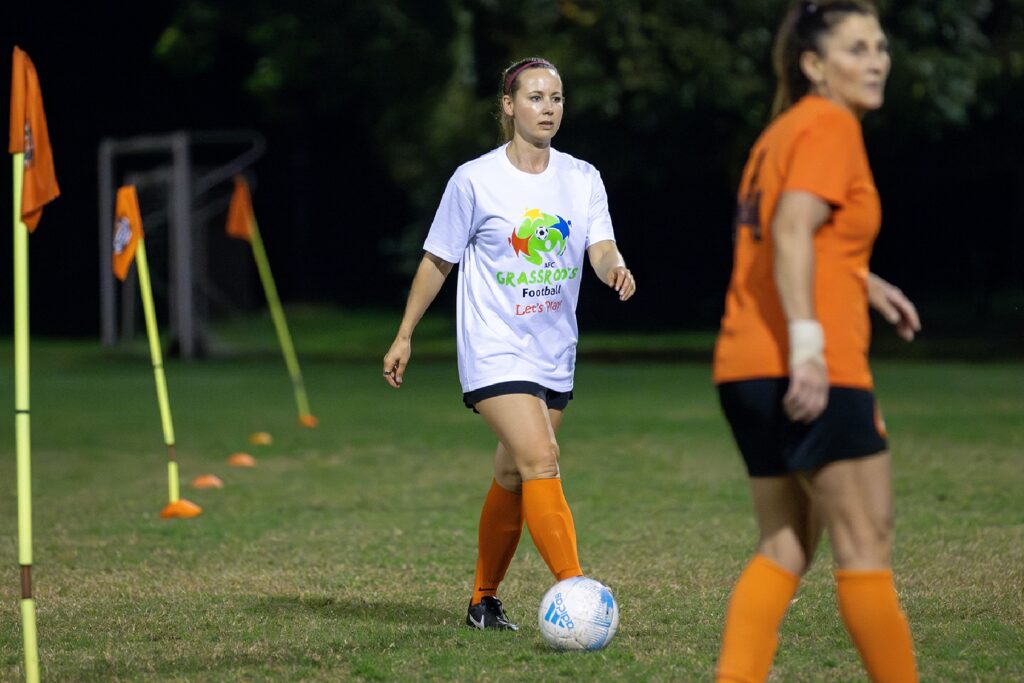
In the past the game has probably been guilty of complacency, particularly in our failure to link grassroots with senior football.
The grass roots really need to be tapped into because it’s a huge marketplace which is already aligned with the sport. We are in the entertainment business and we need to think like that when we think about the Professional Leagues.
ROGER SLEEMAN
How can the game attract more funding from business and government?
DANNY TOWNSEND
Once again, it’s about creating value and the private and public sector will respond.
By selling the health and wellness benefits of the sport, we should have access to more government grants. Our sport is comparatively poorly supported by state and federal government compared to our counterparts, so we need to set that straight.
Also, the success in winning the Women’s World Cup should be leveraged to unlock the scale of our game to the community and in turn the private sector. In the past 3-4 seasons, Sydney FC has made giant strides, but we can only do so much. Being a big club in an ordinary competition isn’t going to help our club grow further.
Being a great club in a great competition is really going to set the pathway so we must work as shareholders in the game to grow a better competition. For the League to prosper, it’s a must for other clubs to perform better on and off the pitch.
ROGER SLEEMAN
Steve Corica brought a number of young players through the ranks last season.
Will this be the continuing trend or will marquee and overseas players still be sort after?
DANNY TOWNSEND
The rationalisation of the competition and the current CBA negotiations are affecting our cost base so naturally there’ll be more of a reliance on domestic talent to drive results on the pitch. The club has invested in a five-year program for the Academy and a few players have already gone overseas to ply their trade.
Nevertheless, foreigners have a place in the game eg: Cameron Devlin who trained next to Brandon O’Neill and Milos Ninkovic every day became a much better player before moving to Wellington and Trent Buhagiar has learnt a lot from Adam Le Fondre in the past two seasons.
However, young players shouldn’t believe they have a sense of entitlement to make the grade because nobody gets a guaranteed starting place at this club or any other club. The foreign player market has shifted so I still think you will see quality and high profile foreign football talent in the A-League and W-League into the future.
ROGER SLEEMAN
Do you agree the media concentrates too much on off the park events, rather than what is happening on it?
DANNY TOWNSEND
I agree with this statement, so the game has to do a better job of controlling the narrative.
In the absence of reliable communications, the game suffers so information flow is essential to prevent the media from filling in the blanks.
All stakeholders in the game must communicate clearly and more often to achieve a fair balance in reporting.
Currently, only one side of a story is being publicised so let’s assist the media in producing more accurate stories based on better quality transparency whether the news is good, bad or ugly.
ROGER SLEEMAN
Where do the CBA negotiations currently sit?
DANNY TOWNSEND
The CBA is currently on pause as clubs are working with their respective playing groups. The cuts mentioned in the media aren’t correct as individual club contracts and situations are all different with the mix of contracted and uncontracted player’s conditions varying widely.
Critically, all clubs want to look after their players but they also have a fiscal responsibility to ensure the club’s survival. This is not a burden that lies solely with the players as cuts need to be unilateral across all functions of football which will recalibrate the game’s cost base.
ROGER SLEEMAN
Is it true that James Johnson will intervene if the current stalemate is not resolved?
DANNY TOWNSEND
The FFA and James Johnson have offered support to help the situation if necessary.
However, there are two parties involved in these negotiations. The clubs who employ and pay the players and the players themselves via the PFA.
The FFA as the regulator can get involved but James Johnson is doing the right thing by letting the parties work through the process as adults to try and find a suitable outcome. I remain very confident that will be the result.