
Angel City FC: Uplifting women and strengthening communities

Los Angeles is a city that produces pioneers and cultural influencers across various industries, including entertainment, technology, and sports. The Angel City FC epitomises LA’s ambition and innovative essence more than any other organisation.

Alexis Ohanian, Co-founder of Reddit, Initialised Capital and Seven Seven Six, is the largest shareholder as an individual investor for the club, however, he does not hold a majority of the equity or control of the board, instead sharing authority with co-owners Julie Uhrman, entrepreneur with a talent for community building and ranks among the most influential figures in the sports business industry as well as being President of the club. Joining in the ranks as founders are Kara Nortman, a visionary venture capitalist and , the acclaimed Academy Award winning actress and passionate advocate for women’s rights.

Angel City FC’s journey started following the US Women’s National Team’s 2019 World Cup victory. The triumph, which garnered record viewership, alongside movements for gender and pay equity, propelled the creation of the club has obtained attention since it was awarded expansion license for the 2022 season back in 2020.

Capitalising on the World Cup momentum and data indicating strong fan interest in women’s sports, the group established Angel City FC, confident in the increasing value and growth potential.

Angel City FC’s business strategy in sports is truly pioneering. By implementing creative revenue models, including distinctive sponsorship arrangements and a dedication to community investment, the club has shown that supporting women’s sports holds significant, untapped commercial potential. It is important to highlight that the club’s sponsorship model, which allocates 10% of sponsorship dollars back into the community.

Rocky Rodriguez headers the ball
Image credit: NWSL website

This approach has redirected over $4.5 million into the community, forging partnerships with Hollywood A-listers and influential activists like Uzo Aduba, Jessica Chastain, Jennifer Garner, and Eva Longoria, are amongst an ownership group over 100 strong, most of whom are women.

Through a new partnership with HubSpot, Angel City FC will support women athletes via a fund dedicated to post-retirement education and entrepreneurship endeavours. Emphasising revenue sharing and community reinvestment, Angel City FC persistently adopts a groundbreaking approach to achieve commercial success while advancing its broader mission.

Central to Angel City’s mission is the community it serves and builds. In its brief existence, the club has successfully cultivated a diverse and inclusive fan base, resulting in unprecedented support and engagement.

Angel City’s impressive 90% season ticket holder retention rate and strategic, values-aligned sponsorships further attest to the club’s success in community building. “How do we leave the community better than when we started?” Uhrman emphasises as a key question the club seriously contemplates with each partnership opportunity.

Consider the partnership with Sprouts Farmers Market. Through this collaboration, the club focuses on nutrition and education, partnering with two local schools to create gardens and host free monthly farmers markets benefiting the community. Additionally, an education program teaches children about nutrition and the importance of developing strong bodies, further enhancing the impact of the Sprouts partnership.

While Sportico reported that for the clubs first season in 2022, the new entity had already been valued at more than $150m approximately, Angel City’s average crowd attendance for the 2022 and 2023 seasons at BMO stadium had surpassed Sydney FC’s attendance during the 2022/23 A-League Men season by approximately 3000, which led the competition.

With at least four more expansion franchises planned in the coming years, perhaps the question is why the A-Leagues can’t strive to establish their own Angel City FC, or at the very least, embrace the concept of standalone women’s teams in the A-League Women?

However, Uhrman, on her end, recognises that the Angel City model isn’t universally applicable and cannot simply be replicated everywhere around the world.

The NWSL was established in 2012, the following year was when matches were played, ever since then NWSL is being praised for reaching a stage where there is ongoing work needed to address sustainability and player safety concerns (the league has faced a series of abuse scandals in recent years).

With new investments and ambitions, such as relocating its headquarters from Chicago to New York, aligning with the MLS and America’s major sports leagues like the NFL, NBA, MLB, and NHL – the league is poised to strengthen its foundations and sustainability as it enters a new phase of existence.

In this phase, the NWSL not only aims to solidify its position in the American sports hierarchy but also seeks to distinguish itself within the rapidly expanding women’s football ecosystem worldwide.

The club’s website has a dedicated category for their six unique supporter groups, with each of them having social media platform and a website, with a brief description about each group. Looking at this from an Australian footballing perspective, it all sounds too good to be true, how Angel City FC has excelled the marketing area for its club efficiently in a short period of time, whereas compared to the clubs here in the country, it needs to take learnings from America on how they implement the marketing strategies in different area of a football club and apply it for their respected clubs.

Previous ArticleNext Article

Weekly update: NPL partnership announcements

Read here for the latest news and updates on NPL partnerships across each state in Australia.

NPL VIC

Dandenong Thunder

BBQ-K Glen Waverley – Popular Korean restaurant located in Monash, Victoria. The team offers delicious Korean BBQ food options alongside an excellent dining experience.

Senix Australia – Specialists in premium, innovative and durable power tools and outdoor power equipment. For years, Senix has delivered quality results at exceptional value.

Preston Lions 

Kennards Hire – Australian-owned equipment hire company, prioritising safety, reliability, and industry knowledge to help clients across construction, DIY and more.

Fettayleh Foods – A family business which provides premium halal meat, continuing to offer an extensive range of meat product items in stores like Coles, Woolworths and IGA.

Kabina Distilling – Based on a 100-year old recipe, Kabina Distilling’s products are leaders in the rakija scene in Australia. The drinks make the perfect addition to gatherings with family or friends.

Hume City 

Senol – For nearly thirty years, Senol has delivered exceptional commercial and residential developments across Melbourne. They combine excellence, innovation and a customer-first approach for consistent results.

St Albans Dinamo FC

A.I.M Steel & Fabrication – Delivering professional and reliable services based on over forty years of fabrication experience. A.I.M use quality steel and specialist coatings for every project.

NPL SA

Playford Patriots

Angle Vale Tavern – Offering an exceptional dining experience for customers, the Angle Vale Tavern is the go-to location for all occasions and celebrations.

NPL NSW

Marconi Stallions 

Total Concept Signs – Helping businesses across Sydney, Total Concept Signs specialise in providing quality custom signage.

NPL QLD

Wynnum Wolves

Legacy Fencing – Brisbane-based contractor which provides commercial and residential fencing of exceptional quality. The team at Legacy Fencing also delivered the fencing at Carmichael Park, home to Wynnum Wolves.

Moreton City 

Inside Out Active Recovery – With an expert team and state of the art facilities, Inside Out Active Recovery can help clients achieve their physical and health goals.

Lions FC

Value Dental Centres – A patient-focused clinic operating across Brisbane, Gold Coast, Melbourne and Sydney. They are dedicated to providing customers with affordable, personal and stress-free dental care.

NPL WA

Western Knights

Matic Transport – A market leader in transport services, with a committed focus to delivering exceptional customer service in the transport sphere.

Marine and Construction Services – Providing businesses with qualified personnel, specialising in vessel and offshore platform maintenance and repair, as well as vessel mobilisation.

Dianella White Eagles

Perth Mahindra – Specialists in new and used car sales in WA, Perth Mahindra is a trusted car dealership which offers expert advice on a range of car brands, whatever the client’s needs.

Future Aim – A leading digital, engineering and consulting services company, specialising in industries including mining, oil & gas and infrastructure.

SRB Automotive – A family-owned auto repair shop, providing customers with car servicing, maintenance, performance upgrades and more.

DM1 Steel – A trusted provider of high-quality steel fabrication and construction solutions. DM1 Steel focuses on precision, safety and professionalism for all customers.

Twinside Retaining – Designers and constructors of high-quality retaining walls for residential, commercial and industrial projects. They pride themselves on durability, precision and expert workmanship.

Yes Loans – Trusted finance broker providing solutions for personal loans, car loans, motorbike finance and more for clients across Australia.

Total Stone – Specialists in the fabrication and installation of high quality marble, granite and stone surfaces. They are committed to reliability and attention to detail.

Spex Design Optometrist – Expert eye care services, providing comprehensive eye exams, high quality eyewear and personalised solutions since 2005.

Olympic Kingsway SC

Daniel Pastorelli – Parliamentary Secretary to the Premier and Member for Landsdale, Daniel Pastorelli is a proud supporter of Olympic Kingsway and its community programs.


NPL NT

Garuda FC

Darwin Catering Company – Offering an extensive selection of catering options for any event, party or fucntion, Darwin Catering Company are a go-to for anyone looking for delicious spreads and a personalised touch.

Atlas Property Services – Local property services based in Darwin, the team specialises in electrical and air-conditioning services, property maintenance and more.

Community Bank Nightcliff – As well as managing funds and helping clients with personal or business needs, Community Bank Nightcliff also invest in local community through various sponsorships, grants and partnerships.

Azzurri United 

Access Hire – With Australia’s largest privately owned fleet of specialised access equipment, Access Hire are industry leaders in providing, selling, servicing and transporting equipment to leading brands.

Casuarina FC

The Foreshore Restaurant & Cafe – The perfect spot for great food and beautiful sunset views. Among family and friends, The Foreshore Restaurant & Cafe is a local favourite.

The Participation Boom Councils Didn’t Plan For Is Hitting Football Hard

Football in Australia isn’t being held back by passion, participation, or community support. It’s being held back by local government failure. From a CEO perspective, the warning signs are no longer subtle — they’re screaming. Confidence towards councils is collapsing, clubs are done believing the rhetoric, and the people carrying the game every weekend are telling us the same thing: councils don’t understand football, don’t consult properly, and don’t plan for growth. This isn’t opinion anymore. It’s measurable. And it should embarrass every policymaker in the country.

Football in Australia isn’t struggling because of a lack of passion. It isn’t struggling because communities don’t care. And it certainly isn’t struggling because participation is declining.

Football is struggling because, at the local government level, confidence is collapsing. What is more, the people closest to the game can feel it.

Soccerscene’s latest survey on council readiness and football planning shows something deeply confronting: trust in councils is at its lowest point, and clubs no longer believe the rhetoric. Councils frequently speak about “supporting the world game” and “investing in community sport,” but the data tells a different story.

The people building the game every weekend, people such as presidents, coaches, volunteers and administrators, are telling us councils do not understand football demand, do not consult effectively, and do not plan for long-term growth. And that’s not an emotional opinion. It’s now measurable.

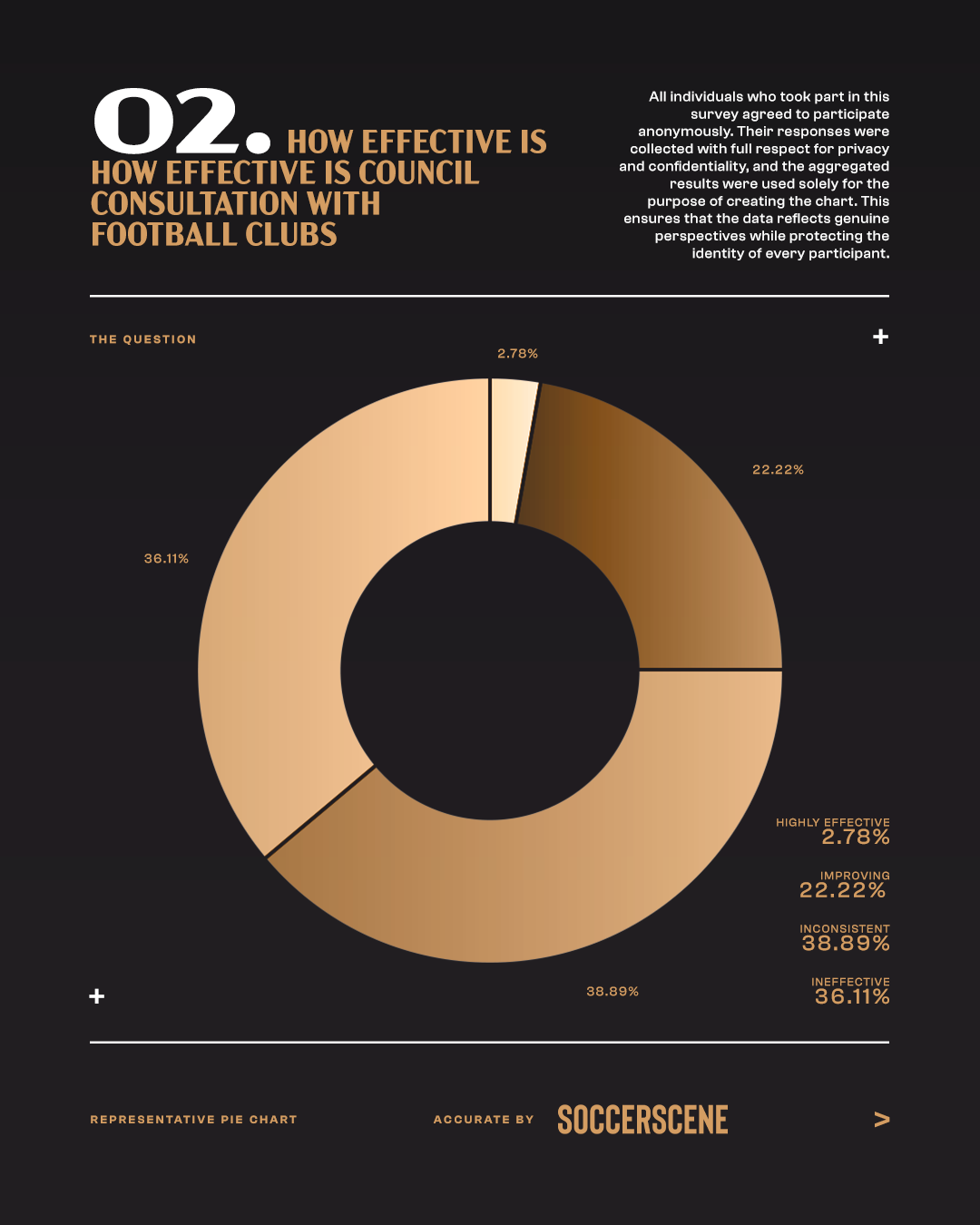
In our survey, over 61% of respondents said their council has limited or no understanding of football participation demand. Consultation outcomes were even worse: 74% said council consultation is inconsistent or ineffective. And when asked if facilities are being planned with long-term growth in mind, the answer should stop every policymaker in their tracks: more than 71% said planning is short-term or non-existent.

Results graphic from Soccerscene’s January industry survey:

This is not a small problem. This is a national warning sign.

Football is not a niche sport. It’s the world’s sport

Councils across Australia are making decisions as if football is still an emerging code, competing for scraps. That thinking is decades out of date.

Football is not only Australia’s largest participation sport in many communities – it is also part of the global economy of sport, the largest sport market on earth, and a cultural engine that connects Australia to Asia, Europe, Africa and the Americas.

When councils underinvest in football infrastructure, they’re not just failing local clubs. They’re failing an entire economic pipeline: participation growth, player development, coaching pathways, community engagement, multicultural integration, women’s sport, health outcomes, events, tourism, and commercial opportunity.

And yet, football is still treated as the code that should “make do”.

The Glenferrie Oval case: a perfect example of the imbalance.

Take the redevelopment of Glenferrie Oval and the historic Michael Tuck Stand in Hawthorn.

This is a major project with a total estimated investment of approximately $30 million, with the City of Boroondara allocating $29.47 million over four years to transform the site into a premier hub for women’s and junior AFL.

Let’s be clear: there is nothing wrong with investing in women’s sport. In fact, it’s essential.

But this investment is also a symbol of something football people have been saying quietly for years: councils understand AFL. Councils prioritise AFL. Councils know how to justify AFL.

They don’t do the same for football, despite its participation scale, multicultural reach, and global relevance.

Across the country, football clubs are being told there is “no funding,” that “planning takes time,” or that facilities “can’t be upgraded yet.” Meanwhile, we see multi-million-dollar grandstands, boutique ovals, and legacy infrastructure funded and delivered for other codes.

Football isn’t asking for special treatment.

Football is asking for fair treatment based on reality.

Councils are stuck in a domestic mindset – while football is global.

Here is the core issue: local councils are making decisions through a domestic sporting lens, while football operates in a global one.

Football isn’t just a Saturday sport. It’s a worldwide industry with elite pathways, commercial frameworks, international investment, and an ecosystem that Australia must compete within.

If councils don’t understand this, they will keep making decisions that shrink our competitiveness.

And this is where the stakes become real.

Australia is not only competing against itself. We are competing against countries like Japan and South Korea, who treat football as a national asset. They don’t leave football infrastructure to fragmented local decision-making without a clear national framework. They invest strategically, align education with delivery, and build systems that create long-term advantage.

We cannot keep pretending we are in the same conversation globally while our local facilities remain stuck in the past.

Clubs are carrying the burden – and it’s breaking the system.

The survey results point to a harsh reality: football clubs feel like they are carrying the weight of growth alone.

When asked what the biggest council-related challenge is, nearly 49% said funding is not prioritised, while others pointed to poor facility design, limited engagement, and slow planning processes.

This isn’t just an inconvenience.

It is creating volunteer burnout, club debt, stagnation in women’s participation, and barriers to junior growth. It is forcing clubs into survival mode – patching up grounds, sharing overcrowded facilities, and trying to grow in spaces that were never designed for modern football demand.

And when planning is short-term, the problem compounds. Councils aren’t just falling behind- they’re building the wrong solutions.

So what do we do? We stop reacting and start leading.

Football cannot keep waiting for councils to “get it” organically. That approach has failed.

What we need now is a national strategic response that is structured, intelligent, and relentless.

This is where football must learn from high-performing football nations  not just on the pitch, but in governance, philosophy, and decision-making.

A powerful example is Korea’s “Made in Korea” project, which was built to identify structural gaps, align stakeholders, and create a unified development philosophy. It wasn’t just a technical framework, it was a national alignment strategy.

Australia needs the off-field equivalent.

A National Football Facilities & Readiness Taskforce.

I believe the time has come to establish a National Football Facilities & Readiness Taskforce, made up of the most capable minds across the game and beyond it.

Not another committee. Not another meeting group.

A taskforce.

It should include leaders from football, infrastructure, urban planning, commercial strategy, government relations, and corporate Australia. We should be selecting the most intelligent and effective people in the country, not based on titles, but based on outcomes.

This taskforce should have one clear mission:

Educate, influence, and reshape how councils plan, consult, and invest in football infrastructure.

Alongside a taskforce, we need long-term strategic working groups embedded across the states, designed to:

educate councils on football participation demand and growth forecasting

standardise best-practice facility design and future-proofing

create consistent consultation frameworks

align football investment with economic, health and multicultural outcomes

build a national narrative that football is an asset rather than a cost

Because right now, the survey shows councils aren’t prioritising football for economic reasons. In fact, only 2.56% of respondents said councils should prioritise football due to economic benefits. This is not because it isn’t true, but because councils haven’t been educated to see football that way.

That is a failure of strategy, not a failure of the game.

This is bigger than facilities – it’s about Australia’s place in the world game.

If we want to be taken seriously as a football nation, we must build a country that treats football seriously.

Not just at elite level.

At local level – where the entire pyramid begins.

The message from the survey is blunt: football’s confidence in councils is collapsing. But within that truth is also an opportunity.

Because when trust hits its lowest point, change becomes possible.

The next step is ours.

We either continue accepting a system that doesn’t understand the world game – or we build one that does.

Most Popular Topics

Editor Picks

Send this to a friend