




Football Tasmania CEO Matt Bulkeley: “It isn’t a national competition without a Tasmanian team in it”

Football Tasmania CEO Matt Bulkeley has been in the job since August 2018, and has had plenty of work cut out for him during a turbulent time in Australian football. He spoke to Soccerscene about his involvement in football, Tasmania’s A-League ambitions, and the future of the game in Australia’s smallest state.

Q. How did you become involved in football?

Bulkeley: I’ve been involved in football all my life, I started playing when I was about six or seven in the Hills district in Sydney. I played football probably until I was about 35, and was involved as a volunteer coaching juniors and seniors. I studied a sports management degree when I finished school and worked for about 10 years in cricket. The opportunity came up for an opportunity with Football Federation Australia in around 2005, and I took that role on and was with the national body for almost eight years. I had some other roles in between before coming back into football in this role. 

Q. What challenges has Football Tasmania faced in recent years?

Bulkeley: We’ve had similar challenges to everyone else in relation to COVID, The interruption of the season, and the need to reconfigure what we had planned to do. We were able to get away a season that was roughly two-thirds of a normal season, we didn’t play all of the normal games. We did get most of our players who ended up playing after the break, which was a good thing. When we did return it was a pretty good season. What our clubs found was that they had good interest, good attendance on game days. People enjoyed themselves, and after that lockdown, it was in a sense even more important people had football to forward to and bring themselves together again. What it did impact was that the National Boy’s Championship didn’t go ahead, so that cohort of players didn’t have that opportunity last year, which was disappointing for them with a bit of gap in their development.

In terms of other challenges, one of our challenges that has been fairly well documented is around facilities. We are the biggest participation sport in Tasmania in terms of team sports, but our facilities have not kept up with that demand. They are dated, they are all a similar age and until recent times that haven’t provided suitable amenities for females in particular, both in terms of the number of change rooms as well as their design. We’ve spent a lot of time in the last couple of years working with all levels of government and our stakeholders to try and unlock more funding in football and had good success with that. There have been commitments of $30 million-plus, maybe closer to $40 million after this last state election, and we are starting to see the fruit from that – better facilities, and more across the state.

Q. Has engaging with state government and politicians been a challenge?

Bulkeley: It has been a challenge, and I think that is because we haven’t been as coordinated as we could have been in our approach, and being able to put forward a needs-based business case on why football needs better and more facilities. We are the biggest sport, we are bursting at the seams, and have facilities that aren’t fit for purpose. On one hand, it was challenging, but on the other the case sort of speaks for itself in terms of outcomes in recent years.

Q. Is a boutique rectangular stadium an aim for Football Tasmania?

Bulkeley: Absolutely, as far as I know, we are the only state capital that doesn’t have a rectangular stadium of any kind. When we have high-level games, including the Western United games, they’ve been played on ovals which as you know isn’t as good of a spectator experience for everyone. It’s really important for our ambitions for having our own A-League and W-League teams, which we are confident will happen. The Liberal state government has been very supportive in recent times under the leadership of premier Gutwein, in terms of supporting those ambitions, and has been very positive around a rectangular stadium. We know that would be very important in terms of that missing link for sport in this state. 

Q. How important would it be to become the first football code to launch a professional team in Tasmania?

Bulkeley: I think it’s just important full stop that we have that pathway opportunity. One of the big benefits we see having a team will provide for males and females in that opportunity locally to play at the highest level in this country without leaving the state. We’ve still got people as young as 14 and their families having to decide to relocate, with half of them staying and half of them going, so this provides a local opportunity for those more aspirational players. Then obviously being the biggest team participation sport it provides that local high-level football opportunity for people to go and watch to get behind. We think we have the football community to support it, but also think it adds value to our community by providing local heroes for our young people to look up to.

Q. What hurdles does Football Tasmania in launching an A-League team?

Bulkeley: It is tied to further expansion to the A-League, and from everything that has been communicated from the APL (Australian Professional Leagues), that will occur. Then it’s working on the infrastructure part of it, ensuring we have government support, and that we work with club owners and put the case for having a Tasmania team forward as a strong environment for a further team to be based. It would add a lot to the competition, and our view has always been that it isn’t a national competition if it doesn’t have a Tasmanian team in it. 

Q. What challenges does Football Tasmania face going forward?

Bulkeley: I think one thing we have worked hard on, in the last period of time, is collaboration. We have and are committed to working very closely with our clubs and associations on the aspirations of football. We know we can only do it together. We’ve made some really good inroads in the infrastructure area. We are working hard on other areas of the game, continuing to grow the game, the female side of the game. We have the highest proportion of female participation of anywhere in the country of almost 29%, which we are very proud of but want to keep building on that. We want to keep providing more opportunities around coach education and development, and similarly with refereeing. So there are lots of opportunities and challenges for us to embrace, but we know we need to work together with our clubs and associations to do that.

Previous ArticleNext Article

More Than One in Five Football Australia Staff to Lose Jobs Amid Growing Financial Losses

Australian football finds itself in a curious position.

From the outside, the game appears to be riding a wave of momentum. Attendances, visibility and public interest have all experienced significant uplift in recent years, while major international tournaments and growing discussion around football’s future continue to place the sport firmly within the national conversation.

Yet behind that momentum, Football Australia is now confronting a far more challenging internal reality.


A compounding deficit

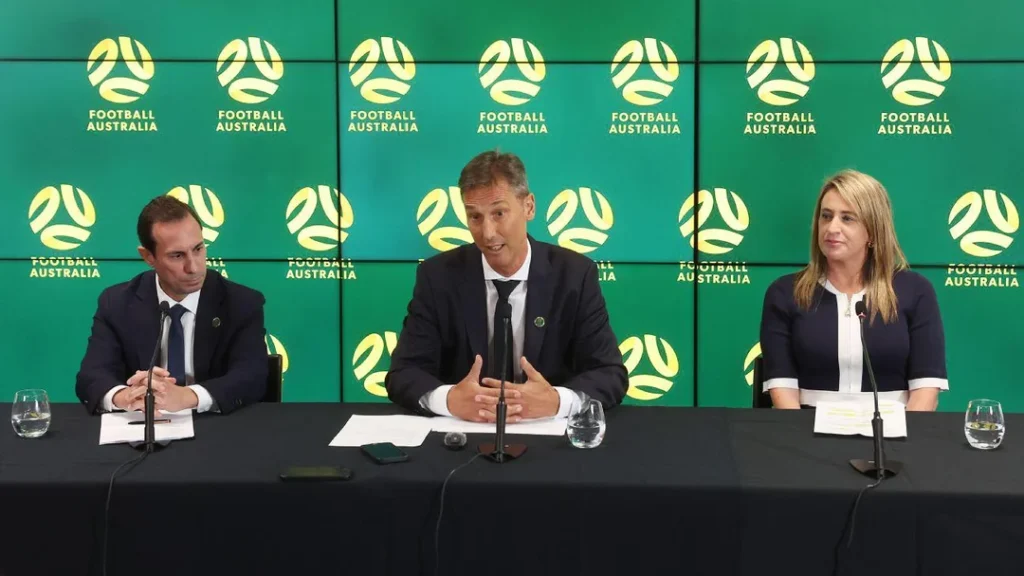
Chief Executive Martin Kugeler has reportedly indicated the governing body’s projected financial losses for 2025 are expected to exceed the organisation’s reported $8.5 million deficit from the previous year. Accompanying the financial outlook are substantial organisational changes, with reporting from Tracey Holmes indicating more than one in five Football Australia employees are expected to lose their positions through restructuring measures.

The figures represent more than a difficult balance sheet. They point toward a significant period of recalibration inside the organisation responsible for overseeing the sport nationally.


Losing the wisdom of existing staff members

For governing bodies, restructures are often framed as strategic necessities for future sustainability. However, workforce changes on this scale also raise broader questions around the challenges of such a transition.

People are often the carriers of knowledge, relationships and long-term strategic understanding. When organisations undergo significant structural change, the effects can extend beyond immediate financial outcomes.


Contradicting timing

The timing is what makes the developments particularly notable.

Football in Australia has spent recent years discussing expansion, growth and long-term opportunity. The conversation surrounding the game has increasingly centred on future potential. Often headlining stronger pathways, larger audiences, infrastructure development and greater visibility.

Against that backdrop, news of deep financial losses and substantial staffing reductions creates a different conversation: one focused not on where the game wants to go, but on what may be required to sustain that journey. Therefore, this announcement points toward stagnancy, rather than growth.

Further detail surrounding Football Australia’s strategy and long-term direction will likely emerge over coming months. For now, the developments serve as a reminder that growth stories are rarely straightforward.

Often, the periods that appear strongest from the outside can also be the moments organisations face their most significant internal tests.

Victorian State Budget delivers $750,000 to football facilities as governing body signals more to come

Two of Victoria’s most prominent football clubs have secured a combined $750,000 in facility funding from the 2026 Victorian State Budget, in what Football Victoria describes as the beginning of a broader set of announcements for the sport from this year’s budget cycle.

Avondale FC will receive $500,000 to install lighting at Avenger Park in Avondale Heights, while Hume City FC has secured $250,000 for major upgrades at Nasiol Stadium in Broadmeadows, including a new LED scoreboard and improved lighting infrastructure. Both clubs compete in the Victorian National Premier Leagues and serve large multicultural communities in Melbourne’s north and northwest.

The announcements are modest in scale relative to the infrastructure deficit facing community and semi-professional football across the state, but their political significance extends beyond the dollar figures. They represent a tangible return on Football Victoria’s sustained advocacy campaign, which includes the Level the Playing Field parliamentary petition calling for more equitable government funding for football relative to other codes.

Facilities as Equity Infrastructure

The Avondale funding addresses a problem that has constrained the club’s operations for years. Avenger Park currently cannot be used at night, forcing the club to play matches at neighbouring venues or arrange temporary lighting for significant fixtures, including last year’s Hahn Australia Cup tie. The $500,000 investment will allow the club to host evening matches and training sessions on its own ground for the first time, removing a structural disadvantage that has affected scheduling, participation and the overall experience for hundreds of players each week.

For Hume City, the implications carry a specific equity dimension. Club President Ersan Gulum noted that upgraded lighting and facilities would directly support the growth of the club’s girls’ and women’s programs by providing better access to training environments and creating more opportunities for female participation.

“We have hundreds of players across all age groups utilising these facilities each week, and these improvements will help create an even stronger environment for excellence, participation, and community engagement,” Gulum said.

The connection between lighting and women’s football access is not incidental. Inadequate or absent lighting at community grounds disproportionately affects female programs, which have expanded rapidly in recent years but frequently find themselves scheduled into daytime slots because evening use of the facility is not viable. Infrastructure that enables night training and matches does not merely improve conditions. It expands the hours during which the ground can be used, directly increasing the number of teams and players a facility can serve.

The Political Context

Both clubs are located in state electorates where local members played an active role in securing the funding. Avondale celebrated the announcement with Parliamentary Secretary Sheena Watt, while Hume City acknowledged the support of local members in its public statement.

The pattern is familiar in Australian sports funding. Facility grants flow through electorate-level political relationships as much as through any centralised allocation process. Football Victoria’s acknowledgement of both Merri-Bek and Hume City Councils, in addition to the state government, reflects the layered advocacy required to move funding from budget allocation to ground-level construction.

Football Victoria CEO Dan Birrell praised both clubs and pointed toward further announcements.

“Both Avondale and Hume City are pillars in the Victorian football landscape, building strong and supportive communities around their top level junior and senior football programs,” Birrell said. “Professional level facilities like Avenger Park and Nasiol Stadium are critical for the development of Victorian football.”

Football Victoria has indicated more budget-related football announcements are forthcoming and has urged supporters to sign the Level the Playing Field petition ahead of the next Victorian State Election.

Most Popular Topics

Editor Picks

Send this to a friend