

Making the decision to move countries in order to chase your dreams is one that befalls plenty of Australian footballers. However, such a contemplation also ensues for coaches, physiotherapists and sports scientists wishing to be challenged at the highest level of the game.
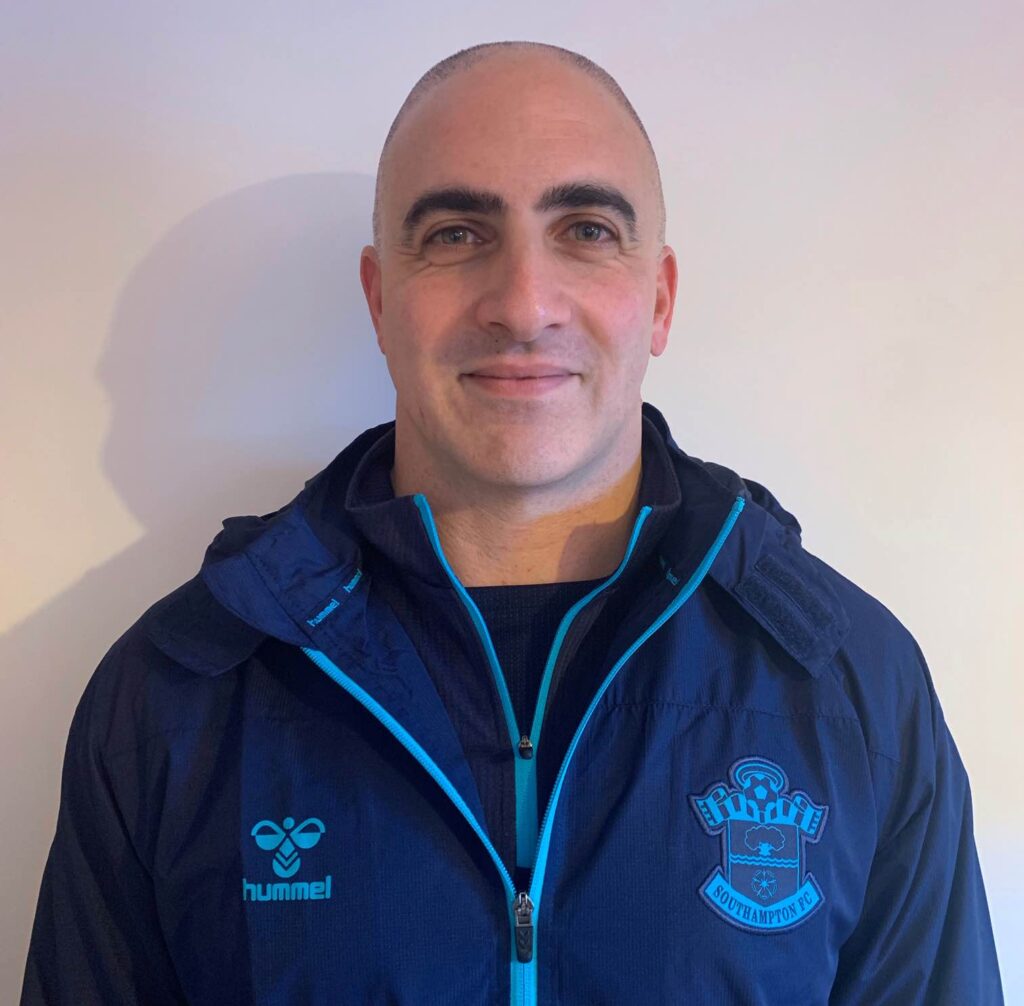
For Tass Amiridis, it was this exact decision to head overseas in pursuit of a fresh challenge that led him to first taking on a role at historic English side Crewe Alexandra FC, and now as a PDP Academy Physiotherapist for Southampton FC’s B Team.
Having honed his skills as a physiotherapist in the Victorian NPL with the likes of Heidelberg United and Pascoe Vale – and in the A-League with Western United – Tass is part of the impressive legion of Australian physios and sports scientists who are based in football clubs around the world.
Tass sat down with Soccerscene to chat through his experiences in England with Crewe and Southampton, his self-belief in acquiring his dream job overseas, the differences in sports science between Australia and the UK, and what life is like at a Premier League club.
You’ve had an extensive career as a physiotherapist in the Victorian NPL, A-League and now as the Academy Physiotherapist at Southampton FC. Can you tell us a bit about your journey to this point?
Tass Amiridis: My background is also as a chiropractor, so I had worked for NPL teams with that. And then I embarked on becoming a physiotherapist because I wanted to work full-time in football in the Premier League – and this is something that I’ve always wanted to do.
When I went through university initially, I thought I’d maybe be able to do it as a chiropractor but as time went on, I realised that wasn’t the case especially when teams advertise for a physiotherapist. They’re looking for a physio as opposed to a chiro, even though the two fields are similar.
I then went and studied physiotherapy as a mature age graduate, and while I was doing that, I was also working at NPL. I graduated in December of 2019 and started in January with Western United’s first team as one of the physios there. I worked up with them until August when I left in 2020 and came over to England.
In that January to August period, I also worked with Heidelberg United and Pascoe Vale in the NPL, and did some consultancy work for North Sunshine Eagles as well, so I was quite busy during that eight-month period. But I was doing what I wanted to do so it was great.
I also worked in a clinic and had that as a back-up. But because I hadn’t worked in sports with a club for a period of time when I started – even though I was seeing a lot of athletes in the clinic – I just wanted to get my hands on as many players and get across as many things as possible in a short space of time. I felt like I wanted to make up for lost time.
When an opportunity arose, I felt like I could do it and was able to. It also gave me the ability to help other students and physios wanting to come through in similar roles, and give them opportunities to work, and assist, and cover for when I physically couldn’t be there. I felt like I was able to give back to people wanting to come through, and having been where they were, I knew how hard it would be to get a foot in the door, even at the NPL level.
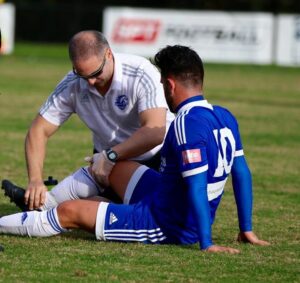
Why was it always an aspiration of yours to conduct your work at a high level in football?
Tass Amiridis: It was wanting to work with sportspeople, having played football myself up until first team level from the academy system, and wanting to work in a full-time environment – you look at the Premier League and it’s the best league in the world. ‘Challenge yourself, strive for your best and see how far you go’ is the way that I’ve always looked at things.
Wanting to work at that top level is not so much for the status of it, but about challenging yourself against the best. Networking with other practitioners, connecting with people and helping athletes at the top level it where I always wanted to be.
I suppose that’s how I carried myself even when I worked in the NPL. My motto has always been whether I’m seeing a nine-year-old in the academy or a first team player, they get the same level of care. All too often I did see, that because they were nine or 10, they were thought about with the mentality of ‘they’re kids, they’ll get back, they’ll be fine, they don’t need anything’. But that’s not the way I see things. That’s why I always had the mentality of treating them like they’re elite players and that’s the standard you set for yourself, and for them as an athlete and as a person.
What was the transition like from the Victorian NPL to the A-League and then to English football?
Tass Amiridis: It was harder than I thought to get work as there’s a few things that you need to do to get qualified over here. Not only registered as a physiotherapist but then also advanced medical training that you need to do to work in the academies and football clubs over here. That process takes time, and I came over in the year of COVID. I didn’t have a job lined up but I knew that I would find work. I was never worried about that in that sense – I was prepared to do anything even if it wasn’t physio work.
I started applying for jobs literally when I was still working in Australia once I had formalised everything and booked flights. I applied for about 40 jobs and got three interviews. I had two of those interviews via zoom when in Cyprus on holiday before heading to the UK and did a second interview face-to-face with Crewe. It all happened relatively quickly once I got the interview but just getting it was tough.

What was it like transitioning from Crewe Alexandra to Southampton? How did that come about?
Tass Amiridis: Southampton advertised the role and I applied for it – I know that sounds pretty daft and pretty simple but sometimes roles do get advertised but they’re filled already because they’ve selected someone that they know. It was a three-stage interview process, with a zoom interview, and then a practical interview, and finally a HR zoom interview to finish. I felt good after each interview and felt like I was going to progress. I felt I was what they were looking for and that they were what I was looking for – I was very impressed with the whole process.
The big differences going from one to the other were obviously the facilities. You’ve gone from a category 2 club to a category 1 and obviously Premier League, so the step up was massive. And it’s essentially what I thought it would be. It’s like when you tour other clubs’ facilities and you see that it’s exactly what you thought it would be.
Obviously, the biggest changes were also resources and staff, but the ability to be accountable and be challenged was the big thing. I felt like at Crewe I had lost that towards the end, like I wasn’t getting challenged enough and that the environment wasn’t challenging enough for me. It was just time to move on.
I’m forever indebted to Crewe and they’re a great club and great people to work for, and I’ve still got a lot of close friends and people that I speak to from over there. They’ve had a tough year being relegated but they’ll get back for sure.
At Southampton, what does your day-to-day involve?
Tass Amiridis: Day-to-day we start with a morning meeting and that’s usually with the first team, and we relay our information and updates to them. We then have our B Team meeting to plan the day and see if any players need any modifications or changes. You have your breakfast and then you’re getting players ready for training and rehab.
When the training session starts, we also have players in the background who are undergoing rehab starting their day. From there your day just bounces around – you could be with your rehab players, running a pitch session and we’re always on radio in case something happens on pitch. It can vary because there’s lots of different moving parts, particularly with the B Team. But the days go super quick and you feel like you’ve done what you need to, but it’s always like ‘wow that flew fast’.
After lunch sometimes the guys will have a second session or a gym session. Typically rehabs will go all day depending on how you’ve periodised it for the week. At the end of the day, you’re planning for the next day and reviewing how things went.

How modern are football’s physiotherapy standards when compared to other sports? Do you feel football is a leader in this space?
Tass Amiridis: I think in some instances we are leading and in some instances we’re not. I think sports that are field sports have similar injury profiles of players – hamstring, groin and knee injuries. But it seems to almost go in waves where you have more hamstring injuries and then you might have more groin injuries, or more knee injuries. So it does vary over time.
There’s a lot of good people doing good things in football and they’re world leaders in their field. I think collectively as a group of practitioners and professionals there’s good collaboration between sports, so you’ll often see people from football going over to the States to study and learn from them and vice-versa. I know they do it with AFL sometimes as well.
As physiotherapists from Australia our reputation is world-renowned, and so are sports scientists from Australia. I feel in football generally you probably find your strength and conditioning and your sports science isn’t as big as your other codes, but they do play a significant and important part in the game – especially with the speed of the game, tactics and data measurement changing. I wouldn’t say that we are leaders in everything, but we all learn off each other.
What do you think are the key differences in approaches to physiotherapy and sports science between the Premier League and the A-League?
Tass Amiridis: I was lucky at Western United as I had a fantastic team around me – my line manager Shane Carr was phenomenal as a boss and a person. Daniel Hanna and the sports science guys were all great and we had really good collaboration as a team.
Facilities wise is probably one thing, Western United had not bad facilities considering they were sharing space with Caroline Springs. You had everything you needed essentially and they made use of a gym locally which worked quite well.
The biggest thing I would say – and I wasn’t there long enough to know if things had changed – but during my time there you often didn’t get other companies wanting to give you some CPD around particular products and technology that they might have. Obviously being Premier League, companies want to be affiliated with that, so the exposure to various bits of technology and rehab equipment that you’ve never seen before – because it’s only over here and it’s not a massive market in Australia – is a big difference I’ve noticed.
Sometimes they’re the things that give you that 1-2% difference, because we’re all doing the same thing. Everyone’s squatting and everyone’s deadlifting effectively in the gym but other technologies to improve your hand-eye coordination and your reactive speed is where the cutting-edge stuff comes in. And that’s probably the Premier League level where they just have that in abundance.