

The FIFA Women’s World Cup has got off to a great start, where it is fantastic to see the Australian and New Zealand communities get behind their teams.
It’s exciting to follow the journey of the Matildas, who with Tony Gustavsson at the helm are sure to do the nation proud.
A tournament such as the World Cup does of course throw up some challenges, where the mental and physical wellbeing of players and coaches is of upmost importance.
In this article, I will explore the key talking points from the tournament so far and how to create a positive mindset.
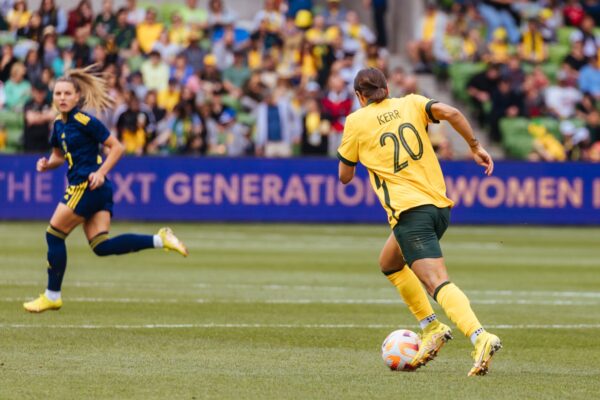
Sam Kerr’s injury situation and teammate impact
It is very easy for an individual to be really impacted negatively by an injury, particularly on the eve of a competition or event. You can also be disheartened and very frustrated – affecting an individual’s mental health and causing the individual to ruminate about negative matters and issues – many of which are often outside of our control.
It will be very important for an individual such as Sam to to apply mental skills to overcome the setback of her injury and to maintain her dedication to her rehabilitation, whilst continuing to be a leader amongst the team and not become inwardly focused.
As a squad, Sam’s teammates can also incorporate helpful mental skills and strategies to overcome worry and avoid disruption. Helpful mental skills include being able to purposefully maintain the positive culture and mood within the team by applying techniques such as mindfulness sessions, and positive psychology activities, including gratitude and savouring.
Teammates may also use cognitive reframing to overcome negative thoughts, feelings, and emotions – to foster positivity and to regain their focus upon the important things they need to do to be successful.
It’s key for them to draw upon the inner support network of coaches, staff, family, partners, their teammates, and others within the Matildas to really foster positivity and to overcome negative rumination.
Other helpful techniques players could use are using affirming sounds, music, images and comforting statements. I’m also quite confident in surmising that the Australian team most likely has some group messages and themes to draw upon that they have devised in their camps leading up to this event. Having these ways to foster positivity will go a long way to overcoming the setback of injuries.
Pressure to perform as the tournament progresses
There’s pressure not only on the players, yet also the head coach, other coaches and staff, particularly because it’s a home event co-hosted with New Zealand and it can be overwhelming at times, especially as we saw in the lead up to the opening group stage game against Ireland with the focus on the expectations of the home fans that Australia that will do well.
The fact that Sam wasn’t playing at the last moment would have caused enormous pressure on everybody. However, helpful techniques that individuals in the group can use are relaxation techniques, which might include meditation, and mindfulness – which is what I particularly recommend for a group – which helps players focus their attention on what’s important and to let go and diminish distractions and non-essential matters. Other helpful techniques to create calm and relaxation might also include breath control, and imagery.
Mindfulness has been demonstrated by research to be especially good at diminishing and interrupting distractions and help individuals focus. For example, in my previous work with the Western Bulldogs AFLW team as their performance psychologist, we would always undertake mindfulness pre-game as a group.

Goalkeepers bouncing back when they make a crucial error
As technical specialists who have their own coaches, goalkeepers train away from the main group, so it is very helpful for goalkeepers to have a unique set of mental techniques to apply when things inevitably go wrong.
I’ve done a lot of work in AFL and AFLW football with the forwards when taking set shots, and it’s the same concept with goalkeepers to be able to regain and switch their focus rapidly back to those skills that help them be very successful and not to become mired or to be lost in negative thoughts, feelings and emotions when things go wrong in a match.
Thought stoppage techniques are particularly helpful, and an example of that is where at training and before a game, players practise a technique where they’re able to stop unhelpful thoughts and focus on important one, which is called anchoring.
This is a mental exercise which helps individuals cope with stressful events such as a goal being scored against them. At training and pre-game, what a player does is recalls the times where they’ve played successfully when they felt hopeful, optimistic, and positive. At the peak of that experience, they undertake a particular gesture such as clenching their preferred hand into a fist, or it might be touching their right boots.
Whatever that gesture or action is, they develop an operant conditioning association between that action, and the feeling of being positive, optimistic, confident, and hopeful. We build an association / connection between a particular experience, and a triggering stimuli.
There was a very famous Russian psychologist Ivan Pavlov, who conducted experiments with his dogs. Every time he fed his dogs, he’d ring a little bell, and then feed the dogs. Very rapidly, his dogs learned that if you rang the bell, that food was forthcoming and they’d start to salivate. We can deliberately create the same phenomenon by this technique of anchoring, which like a ship’s anchor, connects a triggering stimuli, that can help us recall a helpful psychological and physical state.
For example, if a player in the World Cup uses the gesture of clenching her/their preferred hand into a fist whenever they practise their helpful mental state – in the game when something goes wrong, and they recognise that they’re starting to get upset, what they can do is they clench her/their preferred hand into that fist. And that triggers the previously established helpful psychological state, which helps her/them refocus and diminish negative thoughts.
Being composed and thinking clearly during a match
Another tool that I find works successfully with the Men’s professional football players I assist is time managing worries. That’s where we tell ourselves that when a game starts, we’re going to defer any concerns or worries to before or after the game. During the game, if inevitably a worry comes into his head, what we do is we tell ourselves, “I’m going to worry about this before or after the game.”
This is a thought stopping technique, which allows us to stop negative thoughts, and defer them to a helpful and convenient time.
This is where focus and resilience skills become very important. One of the helpful skills that I use with players and sportspeople is being able to master their self-talk. At times, they may start becoming worried or panic, or even becoming disheartened, and outraged. Whatever the unhelpful emotion is, and unhelpful thoughts are, it’s helpful to master their self-talk and focus. That’s where cognitive reframing questions can be particularly helpful, where players ask themselves helpful questions to diminish negativity and refocus.
Here are some example questions below:
- How can I face this current difficulty in a way that’s helpful for myself and my teammates?
- How can I interpret this setback as merely being temporary?
- How can I become a better player into the future by facing this current worrying concern?
- What’s within my control and influence?
- How can I draw upon the expertise of my teammates, my coaches and others?
What this reframing technique does is it helps stop and interrupt unhelpful thoughts, emotions, and behaviours, – replacing them with helpful thoughts, emotions, and behaviours through focusing on:
- Our control and influence,
- How we can help ourselves, our teammates and others through our actions,
- Recognising that we can become better and more knowledgeable by facing this worry, and
- Most importantly, the difficult worries that we’re facing will often pass and then we’ll get through them.
My general tips for anyone competing in sport
Here are my five main tips to overcome setbacks and boost your resilience.
- Mentally prepare for training and competition rather than merely just waking up on the day of the game.
- Set goals for yourself. Research consistently demonstrates when we set motivating and challenging goals to help, motivate and inspire us, it really helps us focus and perform.
- Build your resilience and mental toughness to face whatever challenge comes your way, for example using positive and affirming self-talk and having belief in yourself.
- Practise an activity to create calmness, relaxation, and focus – such as meditation, mindfulness, deep breathing or yoga – whatever your preference is to diminish stress.
- Create positivity and savour it. Surround yourself with positive and beloved people, undertake enjoyable hobbies, listen to music, be around animals, enjoy nature – anything and everything that creates positivity, and then really immerse and savour that positive thought, feeling and emotion to bolster your morale and mental health.

Christopher Shen is a Psychologist based in Melbourne, Australia. He can be contacted at: www.christophershen.com.au