


Newcastle Jets CEO Shane Mattiske on Maverick Sports Partners ownership: “It is exciting to see so many people lean forward and now want to get involved”

To the relief of Newcastle Jets fans and those of the A-Leagues alike, Maverick Sports Partners were unveiled as the Club’s new owners.

The June announcement ended months of speculation, with questions being asked about whether the Jets would even survive financially.

Now under fresh leadership, Maverick Sports Partners will support the Club’s future and build on the tight-knit community that Newcastle represents.

Speaking to Soccerscene after the deal was confirmed and ahead of the Round of 32 Australia Cup tie with Rockdale Ilinden, Jets CEO Shane Mattiske describes the feeling of elation, the challenges it presented, upcoming business plans and how the A-Leagues will still thrive.

How has everything been since the confirmed announcement?

Shane Mattiske: It’s the end point of one big stage of the Club’s history.

We’ve been working hard in the background to build a strong foundation for growth in a real transitional period.

The critical thing was to find a new permanent ownership group – we are really pleased to launch into that new era alongside Maverick Sports Partners.

It’s great for the players, community and stakeholders because it sets up our future and puts us in a position where we can focus on growth and makes everyone happy.

What have you seen in the Newcastle community with their support?

Shane Mattiske: We are seeing strong engagement from the corporate sector and our members.

Our memberships went on sale and our target of 10,000 members is ideal but we of course aim for more. We’ve already had a great response from our membership base, with early renewals and quite a few new members coming in despite being away from the formal part of the season; this is really encouraging.

We’re looking forward to the team getting back on field and seeing the fans come out and we’re confident that the work’s been done to support that through good crowd growth and build on the successes of the women’s and men’s teams.

It is exciting to see so many people lean forward and now want to get involved in the Club, with the comfort of the new era that also celebrates our 20th year coming up, highlighting the heritage and history of the Jets.

Mattiske has been instrumental in securing the services of Maverick Sports Partners, among existing sponsors of the Newcastle Jets.

Do you have any plans in mind with Maverick Sports Partners at this stage?

Shane Mattiske: We are already making changes. Jason Hoffman is the first big example where he has come in from being an elite player to the corporate side of the Club.

He’s creating a connection between the men’s playing squad and our community team. Jason is one of those people that has got a big presence and has an identity.

Through his efforts, we are already seeing some great engagement at corporate level.

In addition, we are launching a new product called ‘Jets in Business’, where the broader business community come together and network with other organisations that has got an interest in football through this community and the success of our men’s and women’s teams.

We’ve also added Ken Schembri as General Manager of Football and Ben Hawes as General Manager of Commercial, Digital and Marketing.

We do have some big ambitions in terms of our growth. We are focusing very hard on our corporate revenue growth and membership numbers, with some big targets for our community engagement going forward.

From a personal point of view, how were the challenges in your role?

Shane Mattiske: For the past three and a half years, this has been a period where we’ve seen the game come together, particularly representatives from clubs in the game who recognised the importance of Newcastle and this region.

We’ve received great support and without it, we couldn’t progress to this stage.

There has been a lot of work on creating a strong platform to grow from, when further resources came under a new ownership structure.

A lot of people here, such as our playing group, have worked hard and performed really well despite the uncertainty that was going on.

All our people inside the Club and our corporate partners believed that this club did have a strong future here, with dedication and commitment that we would realise.

It’s really rewarding to get to this point where we’ve set ourselves up to grow and got a good collective within the Maverick Sports Partners ownership, with interesting dimensions that will help us for business skills and great experience in the football space.

What do you make of the state of the game and the A-Leagues?

Shane Mattiske: The last 12 months have been an incredible period for the game, featuring the Women’s World Cup. That has unlocked a connection to the whole Australian population – there would be very few families, adults or children that wouldn’t have been inspired and engaged by the success of the Matildas.

The diversity that exists for the tournament proved to be a watershed moment for football in this country.

At the elite level, you’re seeing people engage in football and you can see how that’s driven growth.

From a Newcastle perspective, we more than doubled our average crowd for women’s football, ending with 7,000 to set a new record for the semi-final.

We’ve seen huge growth across the board in participation; football is the one sport that’s booming and there’s incredible numbers in female participation, so we have some really bright signs for the game’s future.

You can’t get away from the fact that the APL have had to work through some challenges as they refine their economic model. Being close to it, we think they are short-term challenges and there’s confidence around the way they intend to work through them.

You look to those indications around the strength of the base that sits behind football and that gives everyone comfort that in the medium-longer term, there is a strong future for football.

The economic model just needs some slight refinement, and that’s what it being worked through at the moment.


Previous ArticleNext Article

Tasmania’s State Budget Commits $350,000 to Football Facility Planning as $80 million Home of Football Moves Closer to Reality

The Tasmanian State Government has committed $350,000 in seed funding for the next stage of planning for Football Tasmania‘s proposed Home of Football, moving the state’s most significant football infrastructure project closer to construction and signalling political recognition that demand for rectangular facilities in Tasmania has outgrown what currently exists.

The funding, confirmed in the 2026-27 State Budget handed down last week, sits within an almost $200 million investment in sport and recreation across the budget and forward estimates: a package the government describes as designed to improve access and participation for Tasmanians of all ages. The football allocation is listed alongside a $25 million community sporting infrastructure commitment at Kingborough, $12.5 million for new multipurpose indoor sporting courts at New Town Bay, and $8 million for the Domain Tennis Centre redevelopment.

Football Tasmania CEO Tony Pignata OAM welcomed the commitment as an acknowledgement of the structural gap between participation numbers and available infrastructure, particularly in the state’s south.

“The State Government’s delivery on this commitment shows us that they understand that demand outstrips supply for rectangular facilities in the state,” Pignata said. “If we are to continue to grow and develop future Matildas and Socceroos, we need to invest in the infrastructure our game so desperately needs.”

The proposed $80 million facility would include six full-sized pitches, three synthetic and three turf, alongside four five-a-side pitches, modern changerooms for both men and women, and dedicated training facilities. The design is intended to serve every level of the game simultaneously, from grassroots junior competitions through to national-level tournaments.

From grassroots to A-League ambitions

Football Tasmania has framed the facility’s purpose across a deliberately wide range of uses. At the community end, it would provide a permanent home for junior games and regional tournaments that currently compete for limited rectangular ground availability across the state. At the elite end, it would create the capacity to host national competitions including the Emerging Matildas and Emerging Socceroos Championships, flagship state competitions such as the Statewide Cup finals, and potentially, in time, an A-League team.

That last ambition is the most significant and the most distant. Pignata was measured but direct in raising it, situating a Tasmanian A-League club alongside the NBL’s Jackjumpers, the WNBL’s Jewels and the AFL’s Devils as part of the state’s emerging identity as a home for national sporting competition.

“One day down the track, we anticipate this would become home to our very own A-League team, so that we take our rightful place in the nation’s elite competition,” he said.

The pathway from planning funding to A-League admission is long and would require sustained political and commercial support well beyond the current commitment. But the logic is consistent with how football infrastructure investment has worked elsewhere in Australia. The facility comes first, and the competitive pathway follows. Without a purpose-built ground that meets the standards required for elite competition, the conversation about an A-League team cannot begin in earnest.

The equity dimension

The inclusion of modern women’s and men’s changerooms in the facility’s design carries more weight than it might appear. Community and semi-professional football facilities across Australia have historically been built to male standards, with women’s changerooms added as afterthoughts or not included at all. That inadequacy has been consistently identified as a barrier to female participation and to the hosting of women’s competitions at venues that cannot accommodate them properly.

A purpose-built facility that treats women’s infrastructure as a design requirement rather than a retrofit positions the Home of Football to serve the growth of women’s football in Tasmania in a way that existing facilities cannot. The state recorded 41,395 registered football participants in 2025, a number that has been growing and that the current rectangular facility stock was not built to support at this scale.

Additionally, the government’s Ticket to Play program, which provides eligible children with two vouchers worth up to $100 each for sporting participation, and the Ticket to Wellbeing program offering $100 vouchers to eligible seniors, represent indirect but meaningful support for football participation across the state’s communities.

Pignata also acknowledged outgoing Football Tasmania President Bob Gordon, who he said had dedicated almost a decade to the organisation and had been instrumental in lobbying for this and other facilities across the state.

The $350,000 planning commitment is a beginning. The $80 million facility it is intended to progress remains subject to further government investment and development approval.

Aussie partners with two A-League clubs in cross-state alliance

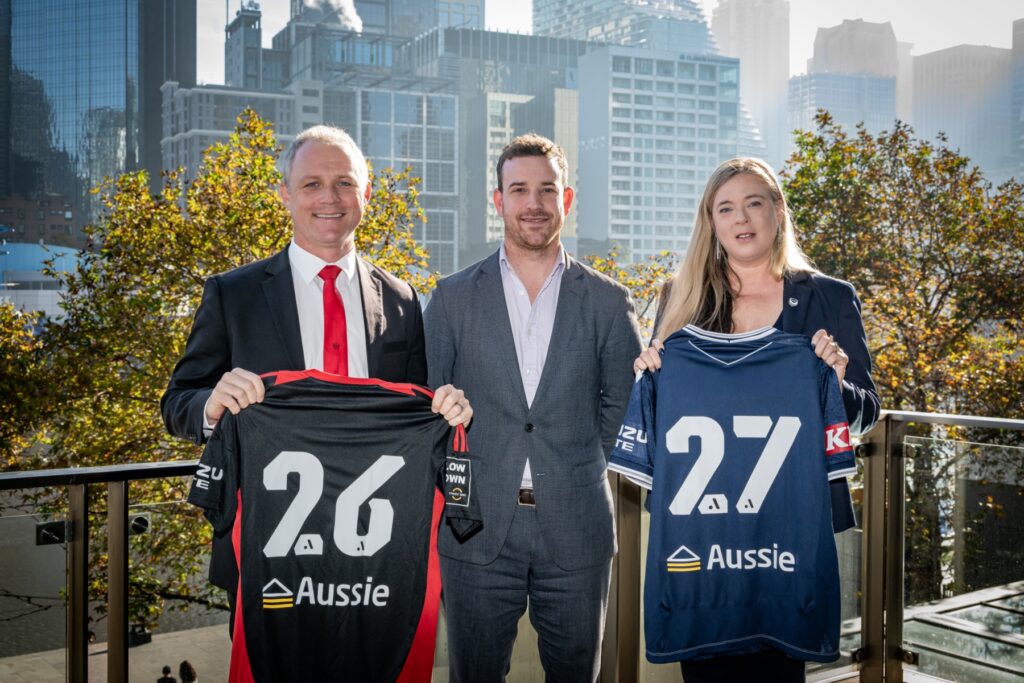
Australia’s largest retail mortgage broker will team up with Melbourne Victory and Western Sydney Wanderers, representing Aussie’s commitment to supporting and connecting people through football.


Opposing teams, United partners

The alliance between Aussie, Melbourne Victory and Western Sydney Wanderers reflects a unique approach to investing in Australia’s football landscape.

It encompasses both communities and supporters across Melbourne and Sydney, with Aussie’s presence in both cities now firmly embedded into local, grassroots networks.

“We’re excited about this partnership because it represents much more than a traditional sponsorship,” explained Aussie National Manager, Strategic Partnerships, Ryan Ferguson via press release.

“It’s about connection, community, and being part of something that reaches people in a meaningful and authentic way.”

Both Melbourne Victory and Western Sydney Wanderers also commented on the unique nature of the partnership.

“The joint venture is a game-changer in how brands and sports teams can collaborate beyond the traditional instruments of a partnership and stands apart from the existing relationships in our sporting landscape for the betterment of our stakeholders,” said Melbourne Victory Managing Director, Caroline Carnegie.

“For the first time, two iconic clubs are coming together in a joint-venture sponsorship that delivers unmatched reach, community impact and business innovation,” added Western Sydney Wanderers CEO, Scott Hudson.


National stage, local commitment

As Australians grapple with soaring property prices and financial uncertainty, having access to a platform like Aussie is immensely valuable.

So now that Aussie will begins its venture alongside Melbourne Victory and Western Sydney Wanderers – two clubs with extensive fanbases – it now has the means to make real, local impact.

Two major cities. Two footballing identities. All aligned under the same vision for community reach, growth and innovation.

“Aussie is a national brand, but at our heart, we are built on local relationships,” continued Ferguson.

“Every day, our brokers are working with customers in their communities, helping them navigate the journey of finding, buying and owning their own home. That’s why this partnership feels like such a natural fit.”

Ultimately, while the alliance will build on the business and community networks of the two A-League outfits, the impact will extend far beyond the boundaries of the pitch.

Most Popular Topics

Editor Picks

Send this to a friend