





MLS NEXT Pro continues to expand with Connecticut United addition

Connecticut United FC joins MLS Next Pro

Connecticut (CT) United FC will join the ever-growing MLS NEXT Pro League in 2025, in a move that promises to reinvigorate the US state through investment in football infrastructure.

CT United becomes the fifth independent team to join US football’s third-tier national competition, which serves as a valuable development tool for young players at the 27 existing Major League Soccer (MLS) clubs.

It joins teams from Jacksonville, Florida and Chattanooga – who were recently announced by the MLS NEXT organisation.

Chattanooga FC have been competing at state-level for 15 years, allowing it to join the competition in 2024 alongside fellow independent club, Carolina Core FC.

Jacksonville Armada are expected to enter alongside CT United and a team from Cleveland, Ohio, in 2025.

The nucleus of CT United’s football operation will be based in Connecticut’s capital city, Bridgeport, after its Planning and Zoning Commission approved a project for a waterfront football-specific stadium.

The stadia will be a part of a larger infrastructure plan to create a mixed-use destination for retail, residential, and community zones. Bridgeport’s Mayor, Joseph Ganim, says the city is ready to drive the project.

“Bridgeport is in the midst of a renaissance, rebranding from an industrial city to now the capital of arts and entertainment of Connecticut,” he said via media release.

“I am proud to announce that MLS NEXT Pro will join that landscape in providing entertainment opportunities for Bridgeport residents and the region at large.”

The club’s formation represents the first foray into sports ownership for the Connecticut Sports Group (CTSG), an organisation founded and led by Connecticut local and technology entrepreneur, André Swanston.

Though in its infant stages, the organisation relies primarily upon its partnership with the University of Connecticut, and minor investors within the state.

Swanston, 42, becomes not just one of the youngest principal owners of a football club in the country, but also making a difference as one of the few Black sports owners in US sport overall.

“As CT United FC embarks on its MLS NEXT Pro journey, I want to extend deep gratitude to the incredible fans, community leaders and government officials who have embraced our vision – I am confident that, united, Connecticut can compete against anyone,” he proclaimed via press release.

“We are committed to building the infrastructure – from a free youth academy to a state-of-the-art stadium – needed to propel Connecticut to the highest levels of soccer.”

The formation of CT United represents an exciting prospect for the people of Connecticut, who will be eager to see CTSG deliver on its vision to ‘create unforgettable experiences that inspire communities.’

It also showcases Major League Soccer’s continuing expansion, and intent to re-invigorate communities across North America.

Previous ArticleNext Article

Tasmania’s State Budget Commits $350,000 to Football Facility Planning as $80 million Home of Football Moves Closer to Reality

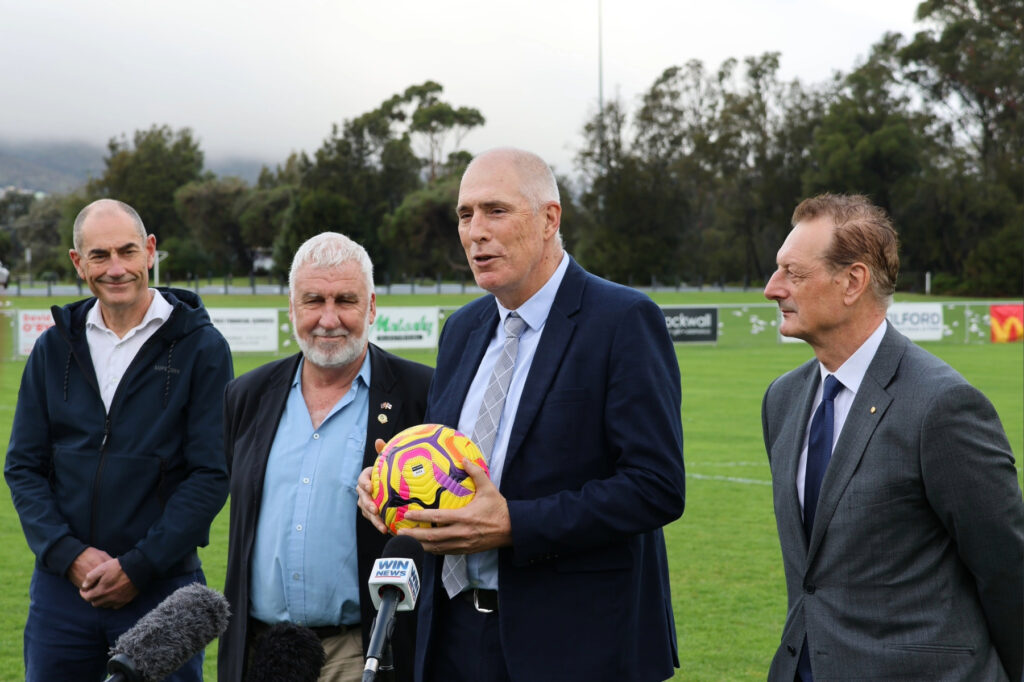
The Tasmanian State Government has committed $350,000 in seed funding for the next stage of planning for Football Tasmania‘s proposed Home of Football, moving the state’s most significant football infrastructure project closer to construction and signalling political recognition that demand for rectangular facilities in Tasmania has outgrown what currently exists.

The funding, confirmed in the 2026-27 State Budget handed down last week, sits within an almost $200 million investment in sport and recreation across the budget and forward estimates: a package the government describes as designed to improve access and participation for Tasmanians of all ages. The football allocation is listed alongside a $25 million community sporting infrastructure commitment at Kingborough, $12.5 million for new multipurpose indoor sporting courts at New Town Bay, and $8 million for the Domain Tennis Centre redevelopment.

Football Tasmania CEO Tony Pignata OAM welcomed the commitment as an acknowledgement of the structural gap between participation numbers and available infrastructure, particularly in the state’s south.

“The State Government’s delivery on this commitment shows us that they understand that demand outstrips supply for rectangular facilities in the state,” Pignata said. “If we are to continue to grow and develop future Matildas and Socceroos, we need to invest in the infrastructure our game so desperately needs.”

The proposed $80 million facility would include six full-sized pitches, three synthetic and three turf, alongside four five-a-side pitches, modern changerooms for both men and women, and dedicated training facilities. The design is intended to serve every level of the game simultaneously, from grassroots junior competitions through to national-level tournaments.

From grassroots to A-League ambitions

Football Tasmania has framed the facility’s purpose across a deliberately wide range of uses. At the community end, it would provide a permanent home for junior games and regional tournaments that currently compete for limited rectangular ground availability across the state. At the elite end, it would create the capacity to host national competitions including the Emerging Matildas and Emerging Socceroos Championships, flagship state competitions such as the Statewide Cup finals, and potentially, in time, an A-League team.

That last ambition is the most significant and the most distant. Pignata was measured but direct in raising it, situating a Tasmanian A-League club alongside the NBL’s Jackjumpers, the WNBL’s Jewels and the AFL’s Devils as part of the state’s emerging identity as a home for national sporting competition.

“One day down the track, we anticipate this would become home to our very own A-League team, so that we take our rightful place in the nation’s elite competition,” he said.

The pathway from planning funding to A-League admission is long and would require sustained political and commercial support well beyond the current commitment. But the logic is consistent with how football infrastructure investment has worked elsewhere in Australia. The facility comes first, and the competitive pathway follows. Without a purpose-built ground that meets the standards required for elite competition, the conversation about an A-League team cannot begin in earnest.

The equity dimension

The inclusion of modern women’s and men’s changerooms in the facility’s design carries more weight than it might appear. Community and semi-professional football facilities across Australia have historically been built to male standards, with women’s changerooms added as afterthoughts or not included at all. That inadequacy has been consistently identified as a barrier to female participation and to the hosting of women’s competitions at venues that cannot accommodate them properly.

A purpose-built facility that treats women’s infrastructure as a design requirement rather than a retrofit positions the Home of Football to serve the growth of women’s football in Tasmania in a way that existing facilities cannot. The state recorded 41,395 registered football participants in 2025, a number that has been growing and that the current rectangular facility stock was not built to support at this scale.

Additionally, the government’s Ticket to Play program, which provides eligible children with two vouchers worth up to $100 each for sporting participation, and the Ticket to Wellbeing program offering $100 vouchers to eligible seniors, represent indirect but meaningful support for football participation across the state’s communities.

Pignata also acknowledged outgoing Football Tasmania President Bob Gordon, who he said had dedicated almost a decade to the organisation and had been instrumental in lobbying for this and other facilities across the state.

The $350,000 planning commitment is a beginning. The $80 million facility it is intended to progress remains subject to further government investment and development approval.

Football NSW calls on clubs to Make It Red for Heart Health Round

Football NSW is calling on clubs and associations across the state to register for the 2026 Make It Red campaign, joining a national awareness movement aimed at reducing heart-related deaths on sporting grounds ahead of Heart Health Round on the weekend of June 5 to 7.

The campaign, developed by the Heartbeat of Football Foundation, asks sporting clubs to wear red, raise funds and build awareness around heart disease and sudden cardiac arrest, which is the leading single cause of disease burden and death in Australia for both men and women, and one that health authorities say is largely preventable through modifiable risk factors.

The call to action comes as the Foundation continues its work to map and register Automated External Defibrillators across NSW sporting facilities, a project that has already engaged twelve football associations and fed data into both the NSW Ambulance GoodSAM registry and NSW Health’s public AED map. The availability of a functioning, registered AED on site is among the most significant determinants of survival following sudden cardiac arrest, with survival rates declining sharply for every minute without defibrillation.

Football NSW is encouraging clubs to engage with the campaign across three areas. Clubs can register for the Make It Red campaign to help fund research, education and prevention programs. Participants, particularly those aged over 35, are encouraged to seek a free heart health screening test from their local GP or enquire about hosting a Heartbeat of Football testing day. Clubs are also urged to ensure their grounds have active, accessible AEDs in place, with guidance available through Football NSW’s Rescue Ready Guide.

The Make It Red campaign runs from June 5 to July 12, with Heart Health Round taking place across the opening weekend. Clubs can register and access participation resources at makeitred.org.

Most Popular Topics

Editor Picks

Send this to a friend