


Joe Mirabella: Melbourne Victory on my mind

Melbourne Victory shareholder, Joe Mirabella, was introduced to football at an early age when he was taken by his father to watch his beloved Juventus in the Victorian State League.

Following a playing career where he reached reserve grade status, Mirabella became president of the club in 1990, served on the board of Football Victoria in 1991 and 1992 and became a shareholder of Melbourne Victory when the A-League commenced in 2005.

He is one person who puts his money where his mouth is, through his highly successful trading company, Mirabella International, which currently has a 12.5% shareholding in Melbourne Victory after it was diluted from 19% when 777 acquired its majority interest in the club.

Mirabella’s motivation to see football succeed in Australia is clear for all to see but he is also realistic there are many challenges facing the game.

In this interview with Roger Sleeman, Mirabella discusses all things A-League, the proposed National Second Tier competition, the future of Melbourne Victory and his hopes for the progress of the game.

ROGER SLEEMAN

What motivated you to seek a financial stake in the A-League?

JOE MIRABELLA

There’s a family connection here as we put our money into the State League and N.S.L. and it was my late father who encouraged  us to buy shares in Victory at the start of the A-League.

He was a true believer in Frank Lowy who was tough but craved success for the game so it was a natural process for me to be involved at Victory when Lowy came back to the game at the start of the A- League.

Personally, I have a love affair with the game and it’s my dream the game will reach its true potential in the not too distant future.

R.S.

The A-League experienced many years of success.

In hindsight, was it a wise move to unbundle the League from the F.A.?

J.M.

It was a big mistake by the owners of the A-League clubs and the removal of Steven Lowy was catastrophic.

The Lowy family had the ability to negotiate with government and keep the League on a good financial footing so they should never have been removed from power.

My statements supporting  this view are recorded in the Melbourne Victory records.

R.S.

What was your reaction to the removal of over forty employees from the APL in January?

J.M.

It had to happen because the league was bleeding money with clubs facing insolvency.

Critically, there should never have been so many employed in the first place.

R.S.

Are you confident in the current executive management overseeing the APL?

J.M.

Not impressed at all and they’re doing nothing except talking since Stephen Conroy came to power as Independent Chairman.

When Conroy took up his position, he had three tasks to perform.

(1) Advise the clubs that none of them could be directors  of the APL and an independent board would be installed for the benefit of the game.

(2) An enquiry be undertaken to account how the $140 million from Silver Lake was spent, e.g.$40 million to Keepup and subsidies for Perth Glory to stave off bankruptcy.

(3) A comprehensive review of the television deal with Ten and Paramount.

None of these tasks have been achieved.

R.S.

What was your take on the reduction of funding to the A-League clubs from $2 million to $530,000 per season announced in May?

J.M.

I knew it was coming and told Stephen Conroy he should go back to basics like the NSL model.

I suggested no levy or licence fee should be charged even if it meant the $530,000 contribution to the clubs was reduced.

Also, that prize money should be allocated for the minor premiership and end of season playoffs and the salary cap removed.

There should also be an increase in the League to sixteen teams to create economies of scale  and the clubs should be encouraged to build their asset base to provide income streams and consequent financial stability.

Joe Mirabella with his two sons & Keisuke Honda, at Melbourne Victory’s Round 14 match with Wellington Phoenix on January 20, 2019.

R.S.

What is your opinion of the proposed National Second Tier competition?

J.M.

I can’t see it going ahead and believe the FA always knew this under the current plan.

If it goes ahead, they’ll send the clubs bankrupt.

Without promotion and relegation it’s not sustainable because without this carrot there’s no incentive for the clubs.

R.S.

What is your view of the current Paramount television deal?

J.M.

It’s not successful with subscriptions right down, and with revenue to the clubs only paid on pro rata subscriptions, it’s not an ideal situation.

R.S.

Melbourne Victory was always a flag bearer of Australian football.

Where do you see it now, and in the future?

J.M.

We have to look at the financial situation first because there’s no olive tree in the backyard.

The deal for 777 to buy out the club within five years doesn’t look promising because the club doesn’t have sufficient assets to make a wholesale purchase attractive.

The company also has the weight of the Bonza airline liquidation to contend with and recently their proposed purchase of Everton F.C. has failed.

Consequently, 777’s ability to buy the balance of Victory’s shares which will cost them $40 million seems remote.

Therefore, the only way Victory can stay afloat in the long term is for bank finance to be raised.

However, the question is without sufficient asset backing, who is going to guarantee the bank loans because the existing shareholders certainly won’t.

Jim Christo, Anthony Di Pietro & Joe Mirabella with his two sons at the A-League Men semi-final in Sydney on April 28, 2018.

R.S.

How do you see the future of the A-League?

J.M.

Most of the clubs, except for the Wanderers and Sydney FC, have financial constraints but with new ownership at Perth Glory and Newcastle there is hope on the horizon.

All clubs need is to increase their asset backing and diversify their revenue streams so they can live within their means.

Promotion of the league is also tantamount to its long term stability.
Previous ArticleNext Article

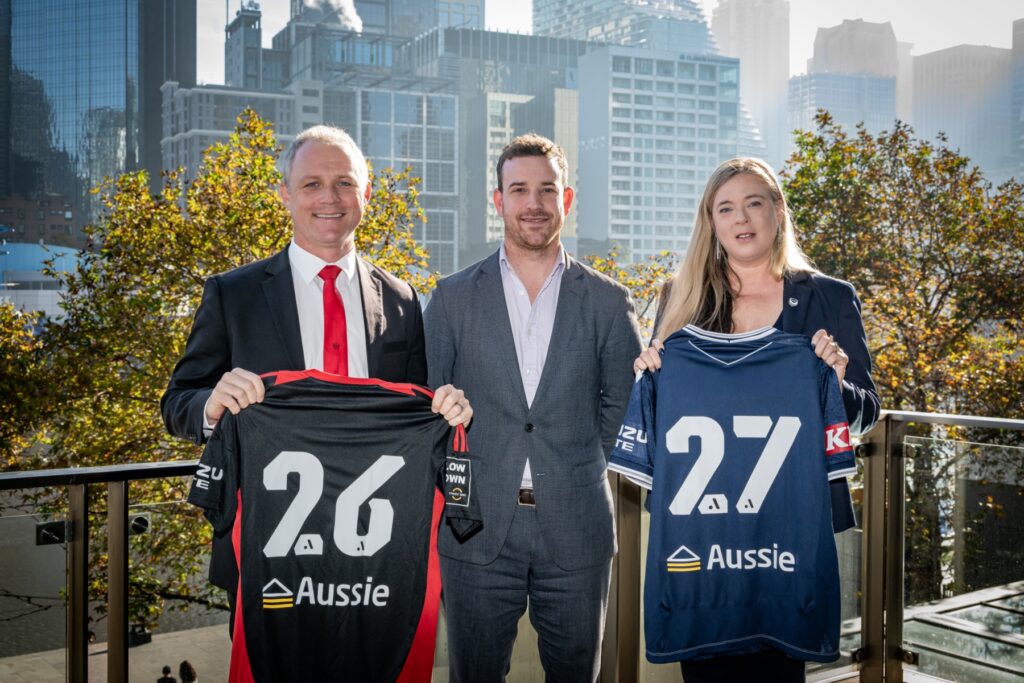
Aussie partners with two A-League clubs in cross-state alliance

Australia’s largest retail mortgage broker will team up with Melbourne Victory and Western Sydney Wanderers, representing Aussie’s commitment to supporting and connecting people through football.


Opposing teams, United partners

The alliance between Aussie, Melbourne Victory and Western Sydney Wanderers reflects a unique approach to investing in Australia’s football landscape.

It encompasses both communities and supporters across Melbourne and Sydney, with Aussie’s presence in both cities now firmly embedded into local, grassroots networks.

“We’re excited about this partnership because it represents much more than a traditional sponsorship,” explained Aussie National Manager, Strategic Partnerships, Ryan Ferguson via press release.

“It’s about connection, community, and being part of something that reaches people in a meaningful and authentic way.”

Both Melbourne Victory and Western Sydney Wanderers also commented on the unique nature of the partnership.

“The joint venture is a game-changer in how brands and sports teams can collaborate beyond the traditional instruments of a partnership and stands apart from the existing relationships in our sporting landscape for the betterment of our stakeholders,” said Melbourne Victory Managing Director, Caroline Carnegie.

“For the first time, two iconic clubs are coming together in a joint-venture sponsorship that delivers unmatched reach, community impact and business innovation,” added Western Sydney Wanderers CEO, Scott Hudson.


National stage, local commitment

As Australians grapple with soaring property prices and financial uncertainty, having access to a platform like Aussie is immensely valuable.

So now that Aussie will begins its venture alongside Melbourne Victory and Western Sydney Wanderers – two clubs with extensive fanbases – it now has the means to make real, local impact.

Two major cities. Two footballing identities. All aligned under the same vision for community reach, growth and innovation.

“Aussie is a national brand, but at our heart, we are built on local relationships,” continued Ferguson.

“Every day, our brokers are working with customers in their communities, helping them navigate the journey of finding, buying and owning their own home. That’s why this partnership feels like such a natural fit.”

Ultimately, while the alliance will build on the business and community networks of the two A-League outfits, the impact will extend far beyond the boundaries of the pitch.

More Than One in Five Football Australia Staff to Lose Jobs Amid Growing Financial Losses

Australian football finds itself in a curious position.

From the outside, the game appears to be riding a wave of momentum. Attendances, visibility and public interest have all experienced significant uplift in recent years, while major international tournaments and growing discussion around football’s future continue to place the sport firmly within the national conversation.

Yet behind that momentum, Football Australia is now confronting a far more challenging internal reality.


A compounding deficit

Chief Executive Martin Kugeler has reportedly indicated the governing body’s projected financial losses for 2025 are expected to exceed the organisation’s reported $8.5 million deficit from the previous year. Accompanying the financial outlook are substantial organisational changes, with reporting from Tracey Holmes indicating more than one in five Football Australia employees are expected to lose their positions through restructuring measures.

The figures represent more than a difficult balance sheet. They point toward a significant period of recalibration inside the organisation responsible for overseeing the sport nationally.


Losing the wisdom of existing staff members

For governing bodies, restructures are often framed as strategic necessities for future sustainability. However, workforce changes on this scale also raise broader questions around the challenges of such a transition.

People are often the carriers of knowledge, relationships and long-term strategic understanding. When organisations undergo significant structural change, the effects can extend beyond immediate financial outcomes.


Contradicting timing

The timing is what makes the developments particularly notable.

Football in Australia has spent recent years discussing expansion, growth and long-term opportunity. The conversation surrounding the game has increasingly centred on future potential. Often headlining stronger pathways, larger audiences, infrastructure development and greater visibility.

Against that backdrop, news of deep financial losses and substantial staffing reductions creates a different conversation: one focused not on where the game wants to go, but on what may be required to sustain that journey. Therefore, this announcement points toward stagnancy, rather than growth.

Further detail surrounding Football Australia’s strategy and long-term direction will likely emerge over coming months. For now, the developments serve as a reminder that growth stories are rarely straightforward.

Often, the periods that appear strongest from the outside can also be the moments organisations face their most significant internal tests.

Most Popular Topics

Editor Picks

Send this to a friend