



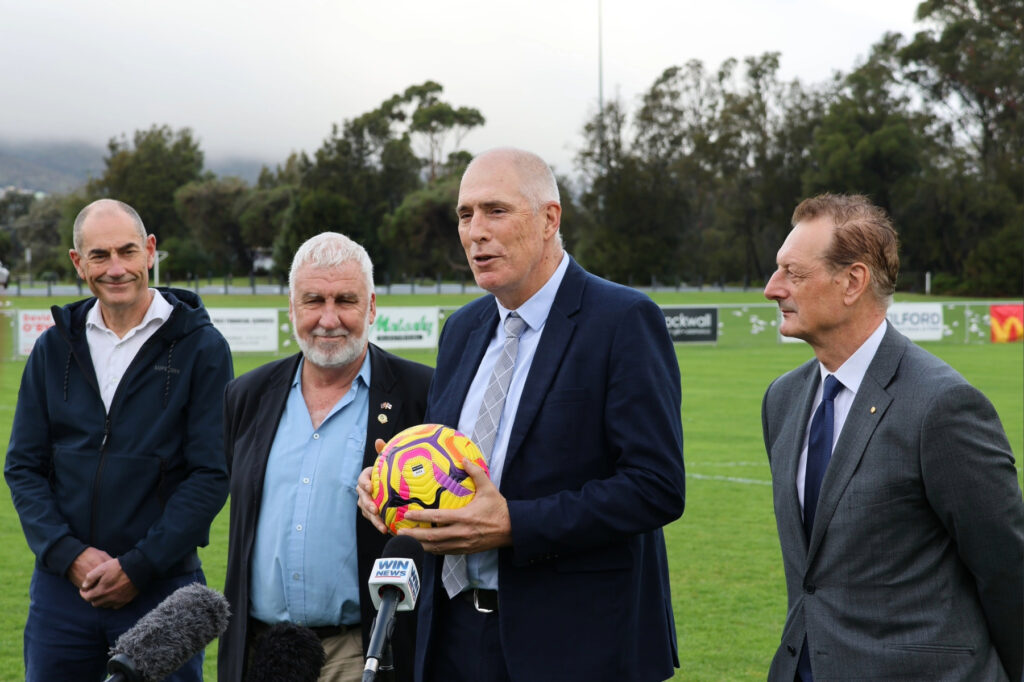
Football Tasmania CEO Matt Bulkeley: “It isn’t a national competition without a Tasmanian team in it”

Football Tasmania CEO Matt Bulkeley has been in the job since August 2018, and has had plenty of work cut out for him during a turbulent time in Australian football. He spoke to Soccerscene about his involvement in football, Tasmania’s A-League ambitions, and the future of the game in Australia’s smallest state.

Q. How did you become involved in football?

Bulkeley: I’ve been involved in football all my life, I started playing when I was about six or seven in the Hills district in Sydney. I played football probably until I was about 35, and was involved as a volunteer coaching juniors and seniors. I studied a sports management degree when I finished school and worked for about 10 years in cricket. The opportunity came up for an opportunity with Football Federation Australia in around 2005, and I took that role on and was with the national body for almost eight years. I had some other roles in between before coming back into football in this role. 

Q. What challenges has Football Tasmania faced in recent years?

Bulkeley: We’ve had similar challenges to everyone else in relation to COVID, The interruption of the season, and the need to reconfigure what we had planned to do. We were able to get away a season that was roughly two-thirds of a normal season, we didn’t play all of the normal games. We did get most of our players who ended up playing after the break, which was a good thing. When we did return it was a pretty good season. What our clubs found was that they had good interest, good attendance on game days. People enjoyed themselves, and after that lockdown, it was in a sense even more important people had football to forward to and bring themselves together again. What it did impact was that the National Boy’s Championship didn’t go ahead, so that cohort of players didn’t have that opportunity last year, which was disappointing for them with a bit of gap in their development.

In terms of other challenges, one of our challenges that has been fairly well documented is around facilities. We are the biggest participation sport in Tasmania in terms of team sports, but our facilities have not kept up with that demand. They are dated, they are all a similar age and until recent times that haven’t provided suitable amenities for females in particular, both in terms of the number of change rooms as well as their design. We’ve spent a lot of time in the last couple of years working with all levels of government and our stakeholders to try and unlock more funding in football and had good success with that. There have been commitments of $30 million-plus, maybe closer to $40 million after this last state election, and we are starting to see the fruit from that – better facilities, and more across the state.

Q. Has engaging with state government and politicians been a challenge?

Bulkeley: It has been a challenge, and I think that is because we haven’t been as coordinated as we could have been in our approach, and being able to put forward a needs-based business case on why football needs better and more facilities. We are the biggest sport, we are bursting at the seams, and have facilities that aren’t fit for purpose. On one hand, it was challenging, but on the other the case sort of speaks for itself in terms of outcomes in recent years.

Q. Is a boutique rectangular stadium an aim for Football Tasmania?

Bulkeley: Absolutely, as far as I know, we are the only state capital that doesn’t have a rectangular stadium of any kind. When we have high-level games, including the Western United games, they’ve been played on ovals which as you know isn’t as good of a spectator experience for everyone. It’s really important for our ambitions for having our own A-League and W-League teams, which we are confident will happen. The Liberal state government has been very supportive in recent times under the leadership of premier Gutwein, in terms of supporting those ambitions, and has been very positive around a rectangular stadium. We know that would be very important in terms of that missing link for sport in this state. 

Q. How important would it be to become the first football code to launch a professional team in Tasmania?

Bulkeley: I think it’s just important full stop that we have that pathway opportunity. One of the big benefits we see having a team will provide for males and females in that opportunity locally to play at the highest level in this country without leaving the state. We’ve still got people as young as 14 and their families having to decide to relocate, with half of them staying and half of them going, so this provides a local opportunity for those more aspirational players. Then obviously being the biggest team participation sport it provides that local high-level football opportunity for people to go and watch to get behind. We think we have the football community to support it, but also think it adds value to our community by providing local heroes for our young people to look up to.

Q. What hurdles does Football Tasmania in launching an A-League team?

Bulkeley: It is tied to further expansion to the A-League, and from everything that has been communicated from the APL (Australian Professional Leagues), that will occur. Then it’s working on the infrastructure part of it, ensuring we have government support, and that we work with club owners and put the case for having a Tasmania team forward as a strong environment for a further team to be based. It would add a lot to the competition, and our view has always been that it isn’t a national competition if it doesn’t have a Tasmanian team in it. 

Q. What challenges does Football Tasmania face going forward?

Bulkeley: I think one thing we have worked hard on, in the last period of time, is collaboration. We have and are committed to working very closely with our clubs and associations on the aspirations of football. We know we can only do it together. We’ve made some really good inroads in the infrastructure area. We are working hard on other areas of the game, continuing to grow the game, the female side of the game. We have the highest proportion of female participation of anywhere in the country of almost 29%, which we are very proud of but want to keep building on that. We want to keep providing more opportunities around coach education and development, and similarly with refereeing. So there are lots of opportunities and challenges for us to embrace, but we know we need to work together with our clubs and associations to do that.
Previous ArticleNext Article

New ‘Unfiltered’ Episode with Paul Klisaris and Oscar Yildiz

The ‘Unfiltered’ podcast by Soccerscene promises honest, thought-provoking conversations about football culture, identity and the stories fans don’t usually hear in mainstream coverage.

In the latest episode, Mihaila Kilibarda sits down with passionate councillors Paul Klisaris and Oscar Yildiz to debate the role of policy in shaping infrastructure, career opportunities and on-field success in the Australian football landscape.

From exposing flaws in policy making, to critiquing the A-League, Paul and Oscar discuss the future trajectory of football in Australia. With strong views on the disconnect between decision-makers and grassroots communities, this is an unfiltered look at the issues holding the sport back—and the urgent need for change.

“Bring back Preston, bring back South Melbourne, bring back that culture into the game. There was nothing wrong with that. Bring it back. Regulate it better, police it better, like they have in Europe. There is rivalry and that’s healthy!” says Paul Klisaris in this episode.

Oscar Yildiz agreed that “We might need to throw a bomb. There is no incentive for clubs to aspire to. You know, you can finish last and still stay in the league. They need to have people from state, from federal, people, again, who know the game, who genuinely know the game. And, it means understanding the politics around the game.”

Listeners can expect Unfiltered to go beyond match reports and transfers. Each episode will dive into the ideas, people and cultural forces that make football one of the world’s most compelling sports. Episode 2 is available now, hoping to challenge, entertain and inspire.

Listen now on Spotify: 

With Unfiltered, Soccerscene is giving fans a space to think, feel and debate about the game they love. Further, it is encouraging conversations that are as engaging as the football itself.

Stay tuned for future episodes, featuring more voices shaping the beautiful game.

The A-Leagues Final Series important status also a secret hinderance

The Isuzu A-League finals series is a huge event in the footballing calendar, though its contribution to stagnant attendance numbers in the league is something to be said.

If the 2025/26 finals series follows similar patterns to those before it, it will gather huge traction and strong ticket sales.

It is the largest event for the domestic league, bringing in massive amounts of viewership through media and gate receipts.

Finals series from years past have shown this, with the 2024/25 final, a Melbourne derby, being sold out within 48 hours and gathering significant viewership online.

The idea of a finals series lies within the Australian sporting ethos; the other sporting codes have had this tradition for most of their existence, especially in recent history.

Football, though, is different from the rest of the sporting codes in Australia, unique even. This has historically contributed to its inability to integrate into the same supported status as other codes.

Many in the Australian footballing community, supporter groups, players, coaches, and even the new Director of Football Australia, have voiced concerns over fan numbers in the league competition.

It wouldn’t be absurd to say that maybe, though profitable now, the finals series is actually taking away from the league itself.

Consider the media image: the league winner is called the “minor premiership,” and ticket sales and viewership figures reveal a huge disparity between the two parts of the A-League.

It must be said that an alternative that could work in unison with the league and possibly increase viewership of the league itself would be a great advantage.

It would allow the league to gain more jeopardy and drama, which could build greater interest in attending league games.

One alternative is already here.

No other sporting code in Australia has both a league competition and a cup competition. Football in Australia does.

The Hahn’s Australia Cup is our equivalent to the FA Cup in England or the Copa del Rey in Spain.

These are competitions that offer a finals option in a different competition entirely. They generate huge traction while never diminishing the importance of the league and, therefore, its popularity.

These cup competitions cannot be discussed without acknowledging some obvious differences.

They don’t face the same popularity issues that football does in Australia. It’s obvious the Hahn’s Australia Cup doesn’t yet gain the traction that the finals series does.

However, for a healthy footballing environment with increasing fan numbers, it should.

The idea of elevating the Hahn’s Australia Cup and scaling back the finals series is a complex question, one that is treated like a “no-go zone” by many in the Australian footballing community, and that is understandable.

Though big changes like this might, in the end, be credible options for the future of the sport in this country.

Larger plans must be set in motion, strategies that can be worked towards and refined along the way. It is the process by which all large organisations, business models and even national governments build their strategies.

Such a shift will be scrutinised and pushed back against.

Though with further fine-tuning and smart investment in development, not to mention the introduction of promotion and relegation and the possibility of changing the footballing calendar.

It could replicate the success that these two-competition models already enjoy in other leagues.

The added importance that the premiership would gain, the reality that every game matters, could alongside other strategies entice fans to more games, increase viewership and ticket sales, and create more dedicated fan bases. It works in other nations, very well in fact.

The possibility of two teams lifting a trophy, rather than one single event defining it all, sounds like a strategy that could deliver more engagement over longer periods of time.

Maybe Australian football doesn’t need to answer this question just yet. It is complex, difficult and it would require a great deal of work, including significant investment into the game, which is another issue entirely.

Yet as low attendance numbers persist in the A-League, even alongside increased media viewership, something needs to change for football in Australia.

The rise in popularity of this game and its dedicated community deserves bold ideas and forward thinking.

Ideas like this could eventually begin to change the landscape of the beautiful game in Australia for the better.

Most Popular Topics

Editor Picks

Send this to a friend