




Football streaming versus the national second division – where to next?

Online streaming continues to be a popular choice for football fans around the country, but have we been better off since these services have changed the landscape?

The EPL is exclusively on Optus Sport to stream for $15 a month whilst other Major European leagues, as well as the A-League, W-League and FFA Cup, is on Kayo Sports for $25 a month.

Telstra also offers a service for streaming Socceroos and Matildas games on the My Football Live App, as well as giving fans of the A-League, W-League and FFA Cup another alternative streaming option.

At a local NPL level, significant progress has also been made in this area.

A recent initiative was introduced this past season by NPL Victoria and other NPL associations around the country, with all senior NPL games live streamed on Facebook and YouTube. This in turn has increased the visibility of the local game and given fans the chance to stream games on familiar online platforms.

Football Victoria recently posted record audience numbers on their YouTube and Facebook streams for their Grand Final Triple Header broadcast on September 15. Some of these figures were up 32% on last year’s spectacle, highlighting the appetite for the local streaming coverage.

While the implementation has been successful, there are infinite possibilities for growth through these digital platforms.

I’m sure those who are in charge of the creation of the proposed national second division will be looking at various options to find viable streaming options which will grow the game.

Could that body invest heavily in producing a streaming service that will charge a subscription fee to fans?

Or is it more suitable to keep costs lower, give out the service for free and expand digital advertising across the board, with the associated revenue making it a viable solution?

It certainly is an interesting debate, without knowing the finer details.

Maybe NPL clubs such as South Melbourne or Heidelberg United can put the onus on themselves to find a partner to stream their games (or do it themselves), when the second division is up and running.

They may try to strike a deal similar to that of Los Angeles Football Club in the MLS. LAFC secured an agreement with YouTube TV in 2018, as not only a sponsor of the team but a streaming partner. 30 of LAFC’s 34 games are streamed on the paid subscription service in 2019, available to those in the Los Angeles area. Pre-existing media deals that have been secured by the MLS are not affected by LAFC’s deal with YouTube TV. The streaming partner does not produce the coverage of the game by itself, instead partnering with the MLS and LAFC. Content produced for the service includes pre and post-game shows and other LAFC related content.

Traditional NPL clubs could package archival footage in a similar type of setup, giving fans of the team more value for their dollar. Advertising revenue could then be generated for themselves or split with the streaming partner.

These are all possible alternatives, as it becomes increasingly hard for traditional media companies (such as FOX Sports) to shell out money for sports broadcasting rights.

If FOX Sports’ current attitude towards the A-League is any indicator, the chances of them investing in a national second division are not very high.

Sports such as Basketball have taken the hint and are seeking out other viable options.

Last week the NBL announced they are in a partnership with Facebook to live stream 52 NBL games into America. This was a significant announcement for the NBL as Facebook will pay a fee to stream the games, something that they have struggled to garner domestically from traditional media outlets.

The NBL will broadcast a number of games on ESPN and SBS VICELAND this season in Australia, sharing the advertising revenue with both of these partners.

Games will also be available to stream on SBS ON DEMAND, as well as the NBL TV streaming service which is a model the national second division will be considering.

The NBL TV model gives fans access to all games live streamed for $5 a month, with full game replays and NBL Classics on demand.

It’s time for those in charge of the national second division to find the right balance for football. The streaming waters have been tested this season with NPL associations around Australia, but the decision makers will have to do their due diligence and find the right model for the future of the game.

Previous ArticleNext Article

Football West’s Female Football Week draws record engagement from Metropolitan Perth to Remote Kunurra

Football West has wrapped up its 2026 Female Football Week with activations spanning metropolitan Perth, regional Western Australia and national online platforms, as participation data from the state’s most remote football association underlined the scale of demand for women’s and girls’ football beyond the city.

Kununurra Soccer Association, situated in the East Kimberley more than 3,000 kilometres from Perth, recorded 47 new female registrations aged 7 to 12 across the first two terms of 2026 through Football West’s Junior Girls United program, representing a 30 percent increase in female membership that coaches Hannah Grominsky and Evie Marchetti described as overwhelming.

“The support from the community has been simply awesome,” Grominsky said. “We’re up to nearly 50 registered girls now. The majority of them have never played before or aren’t part of our association, so it’s great to give them a positive football experience in a comfortable environment.”

The program, supported by the Federal Government’s Play Our Way grant, now runs every Wednesday and has extended football activity into the cooler months of the Kimberley calendar, a season when the association would not traditionally operate. The result is a cohort of players new to the game, in a region where access to organised sport has historically been constrained by geography, infrastructure and seasonality.

Recognition across the state

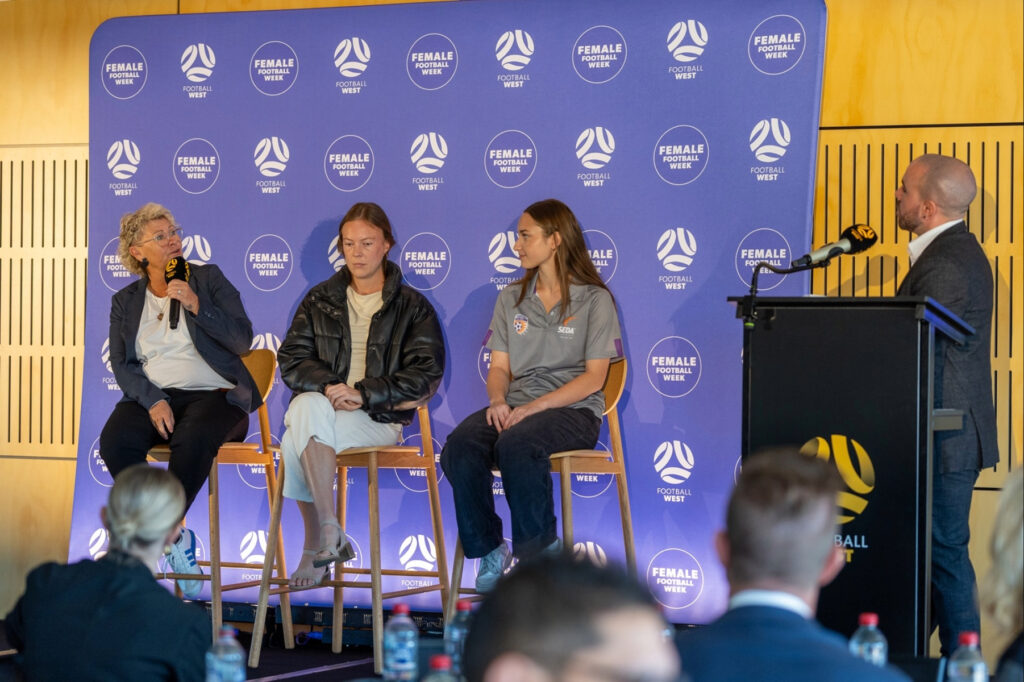
Back in Perth, Female Football Week’s centrepiece event was the Women in Football Celebrate You Breakfast at the Sam Kerr Football Centre, featuring two panel discussions covering officiating pathways, coaching development and advocacy for women in football.

Subiaco AFC NPL Women’s head coach Christine Coppin, who is one of few women coaching at her level in the region, said events like the breakfast were critical to making the pathway visible for others.

“I’d love to see more women coaches putting their hat in the ring, both at junior and senior levels, realising that there’s more to football than just playing,” Coppin said. “They can stay involved in the sport as they get older in different ways.”

A regional Women in Football Breakfast in Albany drew more than 30 attendees, while a Girls Day Out event in the same city attracted more than 50 participants aged 6 to 16 for a come-and-try introduction to the game, extending the week’s reach into the Great Southern and reinforcing Football West’s stated commitment to building women’s football outside metropolitan areas.

Recognising those who make it happen

The week’s awards, nominated by the WA public, recognised five individuals whose contributions to female football across the state were judged most significant over the past year. Cassandra Paxman of Albany Rovers FC was named Coach of the Year, Georgia Whitelaw of Great Southern JSA and Albany JSA took Referee of the Year, Karen Harris of Carramar Shamrock Rovers FC was named Volunteer of the Year, Georgia Aiesi of Mandurah City FC received the Player of the Year award, and Melissa Spillman of Football Futures Foundations was named Community Champion of the Year— a recognition she also received at the national level.

Football West Female Football and Advocacy Manager Sarah Carroll said the week had reinforced both the momentum and the responsibility facing the sport.

“Female Football Week continues to showcase the incredible passion and growing appetite for the women’s game,” Carroll said. “It’s a reminder of how important it is that we keep working together to drive the game forward.”

The contrast between a packed breakfast at the Sam Kerr Football Centre and a Wednesday afternoon program in Kununurra working around wet season schedules captures something essential about where women’s football in Western Australia actually lives. The growth is real, and it is happening in places the cameras do not always reach.

Tasmania’s State Budget Commits $350,000 to Football Facility Planning as $80 million Home of Football Moves Closer to Reality

The Tasmanian State Government has committed $350,000 in seed funding for the next stage of planning for Football Tasmania‘s proposed Home of Football, moving the state’s most significant football infrastructure project closer to construction and signalling political recognition that demand for rectangular facilities in Tasmania has outgrown what currently exists.

The funding, confirmed in the 2026-27 State Budget handed down last week, sits within an almost $200 million investment in sport and recreation across the budget and forward estimates: a package the government describes as designed to improve access and participation for Tasmanians of all ages. The football allocation is listed alongside a $25 million community sporting infrastructure commitment at Kingborough, $12.5 million for new multipurpose indoor sporting courts at New Town Bay, and $8 million for the Domain Tennis Centre redevelopment.

Football Tasmania CEO Tony Pignata OAM welcomed the commitment as an acknowledgement of the structural gap between participation numbers and available infrastructure, particularly in the state’s south.

“The State Government’s delivery on this commitment shows us that they understand that demand outstrips supply for rectangular facilities in the state,” Pignata said. “If we are to continue to grow and develop future Matildas and Socceroos, we need to invest in the infrastructure our game so desperately needs.”

The proposed $80 million facility would include six full-sized pitches, three synthetic and three turf, alongside four five-a-side pitches, modern changerooms for both men and women, and dedicated training facilities. The design is intended to serve every level of the game simultaneously, from grassroots junior competitions through to national-level tournaments.

From grassroots to A-League ambitions

Football Tasmania has framed the facility’s purpose across a deliberately wide range of uses. At the community end, it would provide a permanent home for junior games and regional tournaments that currently compete for limited rectangular ground availability across the state. At the elite end, it would create the capacity to host national competitions including the Emerging Matildas and Emerging Socceroos Championships, flagship state competitions such as the Statewide Cup finals, and potentially, in time, an A-League team.

That last ambition is the most significant and the most distant. Pignata was measured but direct in raising it, situating a Tasmanian A-League club alongside the NBL’s Jackjumpers, the WNBL’s Jewels and the AFL’s Devils as part of the state’s emerging identity as a home for national sporting competition.

“One day down the track, we anticipate this would become home to our very own A-League team, so that we take our rightful place in the nation’s elite competition,” he said.

The pathway from planning funding to A-League admission is long and would require sustained political and commercial support well beyond the current commitment. But the logic is consistent with how football infrastructure investment has worked elsewhere in Australia. The facility comes first, and the competitive pathway follows. Without a purpose-built ground that meets the standards required for elite competition, the conversation about an A-League team cannot begin in earnest.

The equity dimension

The inclusion of modern women’s and men’s changerooms in the facility’s design carries more weight than it might appear. Community and semi-professional football facilities across Australia have historically been built to male standards, with women’s changerooms added as afterthoughts or not included at all. That inadequacy has been consistently identified as a barrier to female participation and to the hosting of women’s competitions at venues that cannot accommodate them properly.

A purpose-built facility that treats women’s infrastructure as a design requirement rather than a retrofit positions the Home of Football to serve the growth of women’s football in Tasmania in a way that existing facilities cannot. The state recorded 41,395 registered football participants in 2025, a number that has been growing and that the current rectangular facility stock was not built to support at this scale.

Additionally, the government’s Ticket to Play program, which provides eligible children with two vouchers worth up to $100 each for sporting participation, and the Ticket to Wellbeing program offering $100 vouchers to eligible seniors, represent indirect but meaningful support for football participation across the state’s communities.

Pignata also acknowledged outgoing Football Tasmania President Bob Gordon, who he said had dedicated almost a decade to the organisation and had been instrumental in lobbying for this and other facilities across the state.

The $350,000 planning commitment is a beginning. The $80 million facility it is intended to progress remains subject to further government investment and development approval.

Most Popular Topics

Editor Picks

Send this to a friend