




FA Wales takes action with Facility & Investment Vision

The Football Association of Wales (FAW), in collaboration with the Cymru Football Foundation (CFF), released the Facility and Investment Vision to improve the national football experience.

In a report published on its website, FAW and the CFF provide a detailed, statistical overview of Wales’ current football facilities, demonstrating the need for more investment, and the positive impact this could have on Welsh communities.

Football is the largest participation team sport in Wales, reporting over 87,000 active players across 811 registered clubs.

Moreover, football participation is a huge driver within the Welsh economy. FAW reports that the current overall return from football participation is over £550 million ($1.07 billion AUD), split across social, economic, and health sectors.

The association believes that further investment into the sport will generate an additional £1 million ($1.9 million AUD).

At the elite level, the Welsh men’s national team has progressed significantly in the last 10 years, performing well in the past two European Championships, and qualifying for the FIFA World Cup for the first time since 1958.

These achievements place a microscope on how the association maintains this success, but more importantly, how it can elevate pathways for juniors and women’s football.

The current situation

The statistics regarding current facilities in the FAW’s report illustrate a dire situation for Welsh football.

Pitch demand continually exceeds supply in Wales with a reported average number of five teams sharing one pitch, despite 60% of clubs advising a need for at least two pitches to operate effectively.

Pitch overuse explains why just 21% of Welsh football pitches are reported to be in “good” condition, whilst 1 in 5 games are cancelled due to wet weather and localised flooding. FAW believes these figures will increase if action is not taken now.

The delivery of artificial surfaces in the United Kingdom is the primary solution to combatting natural elements, yet, 54% of participants in a Welsh national survey state that access to those pitches is difficult.

Off the pitch, changerooms facilities are subject to similar negative feedback, with only 23% of participants saying their changerooms are in “good” condition.

This feedback takes on greater significance given the increased popularity of women’s football, and the subsequent need for more female-friendly changerooms.

A combination of poor pitch quality and changeroom facilities reduces an individual’s enjoyment in football, and this threatens participation and sustainability at all levels of the game.

Addressing the current situation

The purpose of the Facility and Investment Vision report is to show investors exactly what is required for football in Wales to move forward.

In particular, FAW has created a club model that uses the size of football clubs to determine the quantity of facilities required for them to run effectively.

To use an Australian comparison, an NPL club like Sydney Olympic would be considered large because it has over 20 teams at senior and junior level. Whereas a community club, that competes at amateur level (e.g Melbourne State Leagues), would be considered small.


The club model plan represents a smart and effective way to show potential investors what they can do for Welsh football.


Regarding current investment, the CFF has contributed over £9 million ($17.4 million AUD) as part of its mission to strengthen Welsh communities through football.

It is succeeding in its mission, with 98% of people reporting an improved experience when using facilities supported by the CFF.

FAW wants to improve its relationships with county councils and schools so that action plans can be drawn. This will help secure investment for better football facilities and smoother community access.

Objectives for the facilities vision

The overarching objective for FAW and CFF is to deliver a wider range of high-quality football facilities that stakeholders can access year-round.

The economic impact of future investment has been mentioned here already, but environmental sustainability is also at the forefront of the organisation’s plans.

FAW recognises the importance of future-proofing facilities to avoid early re-construction, thereby reducing its carbon footprint.

From an elite pathway perspective, FAW wants to build world-leading facilities to better support future generations of international players and coaches.

This goes beyond the provision of high-quality pitches and changerooms, with FAW insisting that technology, media, and commercial sectors must be improved.

FAW Chief Executive Noel Mooney explained the honest appraisal of football facilities in Wales is motivation for delivering a high-quality football experience.

“We know that facilities in Wales are not where they need to be, and this vision gives us a clear plan to bring facilities across Wales at all levels into the present day,” he told the FAW website.

Mooney elaborated further on the yearly target figure for investment, set by FAW and the CFF.

“We want to be able to invest at least £10 million a year into improving facilities in communities across Wales to bring them up to standard. This investment will continue to support the work that the Cymru Football Foundation is already doing and allow us to grow football in Wales on and off the pitch.

The Facility and Investment Vision demonstrates a commitment to Welsh football stakeholders by FAW and the CFF, and signifies an important moment in the future development of football in the country.

Previous ArticleNext Article

Tasmania’s State Budget Commits $350,000 to Football Facility Planning as $80 million Home of Football Moves Closer to Reality

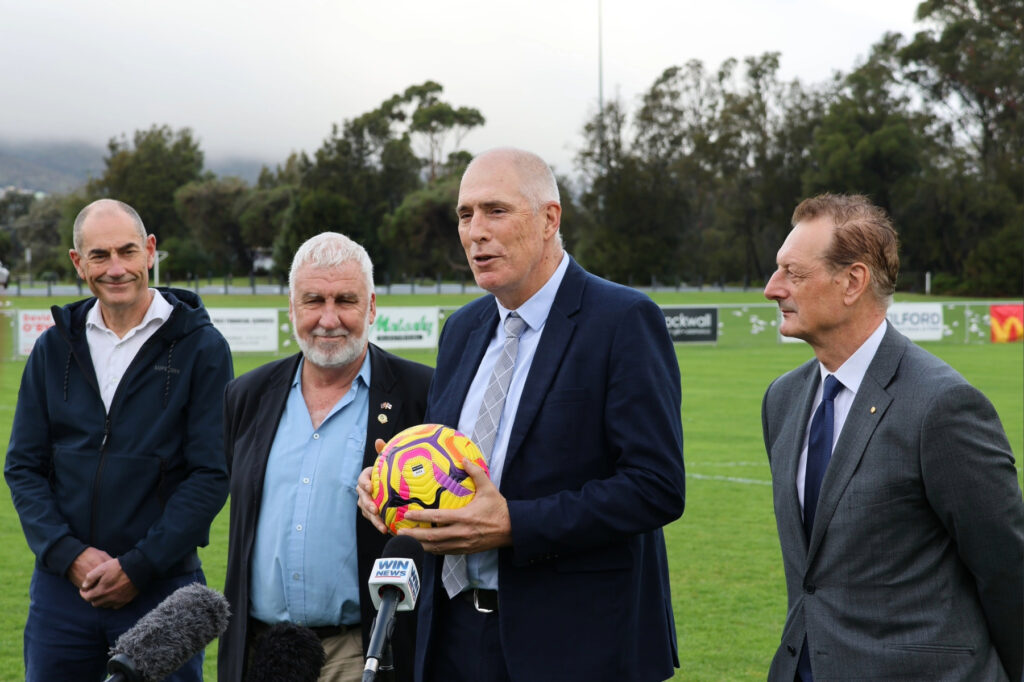
The Tasmanian State Government has committed $350,000 in seed funding for the next stage of planning for Football Tasmania‘s proposed Home of Football, moving the state’s most significant football infrastructure project closer to construction and signalling political recognition that demand for rectangular facilities in Tasmania has outgrown what currently exists.

The funding, confirmed in the 2026-27 State Budget handed down last week, sits within an almost $200 million investment in sport and recreation across the budget and forward estimates: a package the government describes as designed to improve access and participation for Tasmanians of all ages. The football allocation is listed alongside a $25 million community sporting infrastructure commitment at Kingborough, $12.5 million for new multipurpose indoor sporting courts at New Town Bay, and $8 million for the Domain Tennis Centre redevelopment.

Football Tasmania CEO Tony Pignata OAM welcomed the commitment as an acknowledgement of the structural gap between participation numbers and available infrastructure, particularly in the state’s south.

“The State Government’s delivery on this commitment shows us that they understand that demand outstrips supply for rectangular facilities in the state,” Pignata said. “If we are to continue to grow and develop future Matildas and Socceroos, we need to invest in the infrastructure our game so desperately needs.”

The proposed $80 million facility would include six full-sized pitches, three synthetic and three turf, alongside four five-a-side pitches, modern changerooms for both men and women, and dedicated training facilities. The design is intended to serve every level of the game simultaneously, from grassroots junior competitions through to national-level tournaments.

From grassroots to A-League ambitions

Football Tasmania has framed the facility’s purpose across a deliberately wide range of uses. At the community end, it would provide a permanent home for junior games and regional tournaments that currently compete for limited rectangular ground availability across the state. At the elite end, it would create the capacity to host national competitions including the Emerging Matildas and Emerging Socceroos Championships, flagship state competitions such as the Statewide Cup finals, and potentially, in time, an A-League team.

That last ambition is the most significant and the most distant. Pignata was measured but direct in raising it, situating a Tasmanian A-League club alongside the NBL’s Jackjumpers, the WNBL’s Jewels and the AFL’s Devils as part of the state’s emerging identity as a home for national sporting competition.

“One day down the track, we anticipate this would become home to our very own A-League team, so that we take our rightful place in the nation’s elite competition,” he said.

The pathway from planning funding to A-League admission is long and would require sustained political and commercial support well beyond the current commitment. But the logic is consistent with how football infrastructure investment has worked elsewhere in Australia. The facility comes first, and the competitive pathway follows. Without a purpose-built ground that meets the standards required for elite competition, the conversation about an A-League team cannot begin in earnest.

The equity dimension

The inclusion of modern women’s and men’s changerooms in the facility’s design carries more weight than it might appear. Community and semi-professional football facilities across Australia have historically been built to male standards, with women’s changerooms added as afterthoughts or not included at all. That inadequacy has been consistently identified as a barrier to female participation and to the hosting of women’s competitions at venues that cannot accommodate them properly.

A purpose-built facility that treats women’s infrastructure as a design requirement rather than a retrofit positions the Home of Football to serve the growth of women’s football in Tasmania in a way that existing facilities cannot. The state recorded 41,395 registered football participants in 2025, a number that has been growing and that the current rectangular facility stock was not built to support at this scale.

Additionally, the government’s Ticket to Play program, which provides eligible children with two vouchers worth up to $100 each for sporting participation, and the Ticket to Wellbeing program offering $100 vouchers to eligible seniors, represent indirect but meaningful support for football participation across the state’s communities.

Pignata also acknowledged outgoing Football Tasmania President Bob Gordon, who he said had dedicated almost a decade to the organisation and had been instrumental in lobbying for this and other facilities across the state.

The $350,000 planning commitment is a beginning. The $80 million facility it is intended to progress remains subject to further government investment and development approval.

Football NSW calls on clubs to Make It Red for Heart Health Round

Football NSW is calling on clubs and associations across the state to register for the 2026 Make It Red campaign, joining a national awareness movement aimed at reducing heart-related deaths on sporting grounds ahead of Heart Health Round on the weekend of June 5 to 7.

The campaign, developed by the Heartbeat of Football Foundation, asks sporting clubs to wear red, raise funds and build awareness around heart disease and sudden cardiac arrest, which is the leading single cause of disease burden and death in Australia for both men and women, and one that health authorities say is largely preventable through modifiable risk factors.

The call to action comes as the Foundation continues its work to map and register Automated External Defibrillators across NSW sporting facilities, a project that has already engaged twelve football associations and fed data into both the NSW Ambulance GoodSAM registry and NSW Health’s public AED map. The availability of a functioning, registered AED on site is among the most significant determinants of survival following sudden cardiac arrest, with survival rates declining sharply for every minute without defibrillation.

Football NSW is encouraging clubs to engage with the campaign across three areas. Clubs can register for the Make It Red campaign to help fund research, education and prevention programs. Participants, particularly those aged over 35, are encouraged to seek a free heart health screening test from their local GP or enquire about hosting a Heartbeat of Football testing day. Clubs are also urged to ensure their grounds have active, accessible AEDs in place, with guidance available through Football NSW’s Rescue Ready Guide.

The Make It Red campaign runs from June 5 to July 12, with Heart Health Round taking place across the opening weekend. Clubs can register and access participation resources at makeitred.org.

Most Popular Topics

Editor Picks

Send this to a friend