


Cavallucci spearheads reform for football in Queensland

Football Queensland (FQ) have made it their mission to work through a wide range of reforms for the game in the sunshine state, with CEO Robert Cavallucci a central figure overseeing the governing body’s progress.

In a wide-ranging interview with Soccerscene, Cavallucci emphasised the importance of delivering important objectives for the game, which include executing crucial competition reforms for overall player development, encouraging and providing appropriate support strategies for coaches and referees, lifting the profile of futsal in the state and taking the women’s game to the next level.

The FQ CEO explained some of the changes they are implementing to competition structures across Queensland and how critical it is to link the state’s football pyramid.

“Strategically, it’s very important, Football Queensland takes all possible steps in regards to connecting and linking the football pyramid where it can to benefit the game,” he said.

“In the advanced pathway, we need to make sure there’s a clear, transparent and accessible opportunity for aspirational clubs and players to find the right place for them in the football ecosystem.

“What we’ve done is divided the state up into three competition conferences – South East Queensland, Central Coast and North Queensland.

“In South East Queensland obviously it’s a lot more mature in terms of the advanced pathway, the NPL itself has been around for some time. But it’s now about linking it with the other elements of the advanced pathway, so there’s a clear passage for clubs to transition to the right framework for them that aligns with their strategic objectives. That’s what we are doing in South East Queensland and from a football point of view, having a connected pyramid with promotion and relegation is the most preferred position to be in.”

The South East Queensland competition reforms are set to have as many as 6 divisions of the Football Queensland Premier League (FQPL), with clubs in those leagues able to strive to reach the top tier in the National Premier Leagues (NPL) Queensland.

In the Central Coast and North Queensland conferences, the system will be similar, however some adjustments will need to be made.

“We will be transitioning the Premier League clubs in those environments into the FQPL environment (which is the same licensing and competition framework as South East Queensland).

“We will then work those clubs over the next 3 years or so to build their capacity and help them transition from a community club environment into the advanced pathways.”

The idea is that over the next few years the FQPL in Cairns for example, will be as close to the same thing as the FQPL in Brisbane.

“It’s a 3-5 year journey, but it’s something we are ambitious in doing because we have a firm belief that kids in regional Queensland should have the same opportunity as kids in South East Queensland,” Cavallucci said.

Alongside the focus on the development of players through these revamped competition structures, improving coaching and referee standards have been two major pillars that are an integral part of FQ’s overall growth strategy.

“We’ve had a massive investment in coaching education in Queensland, significantly growing the number of coach educators and significantly growing the amount of courses being delivered,” he said.

“We’ve been able to substantially grow the number of registered coaches across the state; we are up nearly 35% this year, which is huge.

“That reflects investment in the key parts of our game that have been neglected from a coach education point of view.

“Equally in referees, we have conducted significant reform in that space and have worked to fix the culture across the state.

“Under the number of strategies and programs we’ve implemented, referee numbers are also up over 20% this year. After 7 years of decline we’ve been able to turn it around, so these are really good outcomes for the game.”

Futsal referee courses have also been delivered by the governing body, which in the past were never prevalent.

A strategy for the small-sided game in the state was released late last year, which has gone a long way to uniting the Queensland futsal community.

“We released our futsal strategy not that long ago, and now we are quite ambitious in our efforts to promote and grow the game,” Cavallucci said.

“We are absolutely investing in the right places to try and bring futsal to life and intend to heavily promote it as much as we can. It’s that fast, active, intense social product of our game, where there is a whole market for it in itself.”

Another market which continues to grow at a rapid pace is women’s football and with games to be played in Queensland at a home Women’s World Cup in 2023, Cavallucci sees huge potential for the tournament to instigate generational change.

“It’s the ultimate opportunity,” he said.

“There’s strong ambitions to have 50/50 participation by 2025. It’s an incredible ambition and target to get to, but that’s ultimately where we want to be and we will strive to deliver that.

“The opportunity for our game with having more women involved, more women in leadership positions, more women as referees and coaches, our game is ready to embrace these changes and the direction we are heading in.”

Cavallucci believes the game in Queensland will reap the rewards of the World Cup in the future, through a tangible lasting legacy.

“We will certainly benefit from it,” he said.

We launched our women’s football strategy a couple months ago at parliament, which was all about unlocking the infrastructure legacy of the Women’s World Cup.

“Whether it’s a centre of women’s football, whether it’s female friendly facilities or changerooms, it’s critical for accommodating the growth we are experiencing as a game overall.

“It’s incumbent on all of us in leadership positions to ensure we deliver what’s best for our game.”


Previous ArticleNext Article

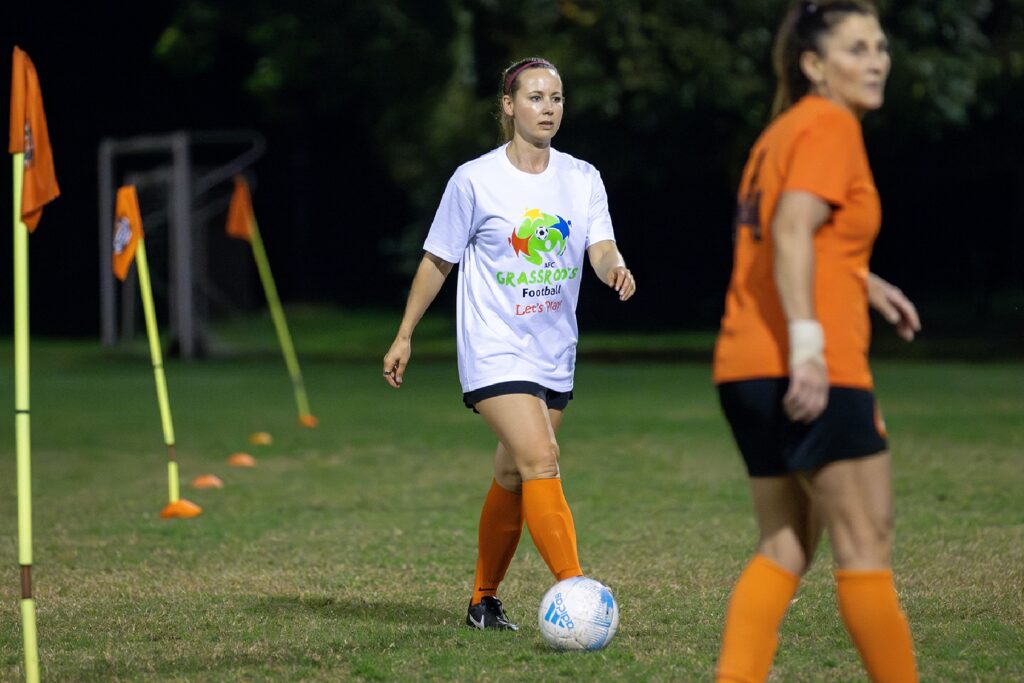
Community Spirit Shines on AFC Grassroots Football Day 2026

This week, Football Australia (FA) celebrated AFC Grassroots Football Day 2026, championing the people and communities who continue to hold up a safe, inclusive and supportive environment in the football landscape.

‘For all, for life’

In collaboration with Football NSW, Canterbury Football Association and community club, Balmain & District Football Club, the day reflected the very best of what football provides.

The event brought in participants of all ages – from 4-74 years-old – and reached a total of 400 people. Girls-only programs, all-abilities sessions and over-age football ensured all were catered for.

Such a diverse range of participants builds on a wider drive during FIFA World Football Week, which seeks to promote the sport not just as the dazzling lights of 100,000-seater stadiums, but as a way to foster community spirit and social development.

Furthermore, FA support through its Club Changer program was a welcome addition to the action, emphasising the organisation’s commitment to nurture a real love for the game across communities in Australia.

“Through Club Changer we support our clubs to provide a safe, fun and enjoyable environment where everyone is welcome; whether that be as a player, volunteer, referee or supporter,” explained National Program Manager Club Development at FA, Grace Lambourne.

“Everyone should feel they belong and are welcome to play, stay, and love the game.”


A welcome celebration

While the upcoming FIFA World Cup will no doubt inspire millions of future Socceroos and Matildas, events like the AFC Grassroots Football Day represent something beyond just inspiration.

It is a platform. An opportunity to express a love for football and to connect with others while doing so.

And connections between the professional and grassroots game is more important than ever if Australia is to nurture the next generation of talent.

This is particularly clear in the rise of women’s football across the nation. Since the FIFA Women’s World Cup, female participation rose by 32%, and registrations for the MiniTillies Program skyrocketed from 264 in 2023, to 1223 in 2024.

The professionals spark passion. But communities turn that passion into playing time.

That is why celebrating grassroots football – and the volunteers and families who sustain it – is a vital part of Australia’s football future. Together, FA and the AFC are creating strong foundations built on positivity, engagement, and inclusivity for all with a love for the beautiful game.

What do Football Queensland’s Annual Numbers mean for Australian Football?

Football Queensland has released its 2025 Annual Report, revealing record total revenue of $25.3 million, participation exceeding 296,000 and more than 94,000 female participants across the state, as the organisation positions itself for a decade of growth leading into the Brisbane 2032 Olympic and Paralympic Games.

The report, released following the Annual General Meeting on Friday May 22, documents a year in which Football Queensland recorded a pre-depreciation surplus of $306,599 while maintaining participant registration fees at their lowest level among all Australian member federations for the fifth consecutive year. A statutory deficit of $269,860 after depreciation was recorded following the recognition of a $295,953 impairment against a long-outstanding debt owed by Football Australia, a matter the board and executive indicated they would continue to pursue.

Total revenue grew from $23.9 million in 2024 to $25.3 million in 2025, driven by increases across registration income, community and advanced football programs, and other income streams. Commercial revenue declined slightly from $3.66 million to $3.36 million across the same period.

Growth on and off the field

The participation figures embedded in the report underscore the scale of the challenge and opportunity facing Queensland football. Women’s and girls’ participation reached 94,165 across all programs, with club-based women’s and girls’ participation growing to 37,946. Coles MiniRoos participation climbed seven percent to 46,448, with female MiniRoos participation up ten percent.

Girls United programs welcomed more than 3,500 participants across leagues, social sessions and carnivals statewide, while the Q-League Schools Competition has now delivered playing opportunities to close to 1,000 students since its inception. Walking Football continued to expand, with the 7th Annual QUT Walking Football Cup attracting 39 teams and more than 300 participants.

Digital engagement also reached new heights, with FQTV livestream views climbing to 2.47 million and women’s viewership surging 67 percent across the year, a figure that reflects the growing audience for female football at state competition level and points to the commercial opportunity the women’s game represents for Queensland football governance.

Coach registrations grew 22.9 percent, with Football Queensland delivering courses to close to 3,000 participants across the state including dedicated all-female Foundation of Football, C Diploma and B Diploma programs. Referee registrations grew 6.3 percent, supported by 170 courses delivered to more than 2,100 attendees and a landmark Memorandum of Understanding with three of Queensland’s leading school sport associations to strengthen referee development pathways.

The 2032 dimension

Perhaps the most consequential element of the 2025 report is Football Queensland’s progress on the Brisbane 2032 infrastructure agenda. The organisation submitted a comprehensive proposal to the Queensland Government’s 100-Day Olympic Infrastructure Review, advocating for a purpose-built Tier 2 rectangular stadium, upgrades to Perry Park and the establishment of a Queensland State Home of Community Football at Meakin Park.

The submission secured meaningful outcomes, with Queensland Government contributions toward Perry Park and a State Home of Community Football included in the government’s 2032 Delivery Plan. The infrastructure foundations being laid now will determine whether the Games leave a lasting legacy for football in Queensland or a missed opportunity.

CEO Robert Cavallucci said the year had been defined by investment in the structures that make participation possible.

“Our priority remained the delivery of accessible and inclusive participation opportunities for all Queenslanders as our community and social programs reached thousands of players in every corner of the state,” Cavallucci said.

Most Popular Topics

Editor Picks

Send this to a friend