




Brisbane Roar’s stagnation has dragged on for too long

Australian football experienced a shock to the system on Tuesday evening when A-Leagues side Brisbane Roar announced the abrupt dismissal of its junior academy sides.

Earning league-wide discontent and now the involvement of Football Australia in the matter, the situation has added to the club’s woes in a tumultuous season that has also seen the termination of Corey Brown’s contract for alleged drug use and subsequent judicial hearings with Professional Footballers Australia (PFA) in regards to the incident.

The announcement, released by the Roar unexpectedly on Tuesday, saw the club state the following via a press release:

“As the only Isuzu UTE A-League team in Queensland, Brisbane Roar are proud to support a pathway for the junior players in the state to have professional football opportunities,” the statement read.

“Brisbane Roar also recognise that Football Queensland works with NPL clubs and players, across the state, and that these clubs are the backbone for development, particularly for junior players.

“Therefore, Brisbane Roar have made the difficult decision to focus on the development of players from the age of 16 and up that are eligible for the Under 23’s and NPL men’s squad.

“As a result, the Brisbane Roar Football Club Academy Under 14 to Under 18 programs will cease to operate. The Under 13’s has been removed under the new Football Queensland model.”

The Roar went on to cite an ambition to provide a “direct pathway to professional football with our Under 23 and Men’s teams” as the ultimate reasoning behind the decision – this is in spite of the fact that the club’s under-15 and under-23 sides won their respective Grand Finals.

An already deteriorating relationship with its fan base has been further solidified with fan malaise at an all-time high at the club. Despite returning to Suncorp Stadium amidst growing fan discontent towards having to travel to Redcliffe for home games, the Roar currently sit 10th on the Isuzu Ute A-League Men’s ladder following a draw against Macarthur and loss against Melbourne City both at home.

The Bakrie Group, the Indonesia-based conglomerate who has owned a 70 percent share in the A-Leagues sole Queensland representative, has reduced their investment into the club through the years, and despite early success under Ange Postecoglou and Mike Mulvey, has been largely at fault for the club’s unfortunate decline and has only been a source of ire for their loyal supporters recently. With funding into the club clearly an issue, it is no doubt time for Brisbane Roar to move on from their relationship with the Bakrie Group – something which is undeniably no easy feat.

The intention to stick with only an expanded Under-23 side for the foreseeable future has generated obvious furore for a reason, especially with Queensland being home to the second largest contingent of football participants in Australia. Adding to the club’s ill decision-making is the fact that Football Queensland, the governing body in charge of the state’s footballing endeavours, issued a statement of their own which made it clear that the result of the Roar’s decision is solely their making:

“This decision was made exclusively by the Brisbane Roar and by Brisbane Roar alone,” the statement read.

“Football Queensland accepts the position of Brisbane Roar who will now focus on their U23 and First team squads.

“Football Queensland will ensure the advanced junior development pathway continues to be strong and accessible to Queensland talent.”

Football Queensland went on to back up their initial statement with a commitment to the implementation of a full-time state development program for boys that aligns with the FQ Academy QAS girls’ program ahead of the upcoming 2024 National Premier Leagues Queensland season.

The fallout of Brisbane Roar’s decision will invariably leave elite junior players looking elsewhere for opportunities and also reduce coaching opportunities for aspiring local coaches. In addition, it will arguably result in the Roar potentially alienating NPL sides who develop these players that they poach or worse, it will leave generational gaps in Australian football – something which is irrefutably detrimental to the growth of Australian football.

Football Australia immediately released a statement of their own on the issue, further reflecting the implications behind the Roar’s decision and the foreseeable damage the club and the Bakrie Group may cause in the future.

“Football Australia, in its regulatory capacity, has some concerns with Brisbane Roar Football Club’s announcement regarding proposed changes to its Academy and have scheduled a meeting with the Club to gather information and discuss their decision in more detail. Only once this meeting has taken place will Football Australia be able to provide further comment.”

Regardless of the Roar’s justification behind the end to its junior sides, it can no longer remain behind the rest of the A-Leagues on or off the field, especially in a state where football is so deeply-entrenched at a grassroots level. The time is now overdue for the club to depart with the Bakrie Group in search of something greater or at minimum stabler. As daunting as that may appear, it will be nothing but holistically positive for Queensland and Australian football.

Previous ArticleNext Article

What do Football Queensland’s Annual Numbers mean for Australian Football?

Football Queensland has released its 2025 Annual Report, revealing record total revenue of $25.3 million, participation exceeding 296,000 and more than 94,000 female participants across the state, as the organisation positions itself for a decade of growth leading into the Brisbane 2032 Olympic and Paralympic Games.

The report, released following the Annual General Meeting on Friday May 22, documents a year in which Football Queensland recorded a pre-depreciation surplus of $306,599 while maintaining participant registration fees at their lowest level among all Australian member federations for the fifth consecutive year. A statutory deficit of $269,860 after depreciation was recorded following the recognition of a $295,953 impairment against a long-outstanding debt owed by Football Australia, a matter the board and executive indicated they would continue to pursue.

Total revenue grew from $23.9 million in 2024 to $25.3 million in 2025, driven by increases across registration income, community and advanced football programs, and other income streams. Commercial revenue declined slightly from $3.66 million to $3.36 million across the same period.

Growth on and off the field

The participation figures embedded in the report underscore the scale of the challenge and opportunity facing Queensland football. Women’s and girls’ participation reached 94,165 across all programs, with club-based women’s and girls’ participation growing to 37,946. Coles MiniRoos participation climbed seven percent to 46,448, with female MiniRoos participation up ten percent.

Girls United programs welcomed more than 3,500 participants across leagues, social sessions and carnivals statewide, while the Q-League Schools Competition has now delivered playing opportunities to close to 1,000 students since its inception. Walking Football continued to expand, with the 7th Annual QUT Walking Football Cup attracting 39 teams and more than 300 participants.

Digital engagement also reached new heights, with FQTV livestream views climbing to 2.47 million and women’s viewership surging 67 percent across the year, a figure that reflects the growing audience for female football at state competition level and points to the commercial opportunity the women’s game represents for Queensland football governance.

Coach registrations grew 22.9 percent, with Football Queensland delivering courses to close to 3,000 participants across the state including dedicated all-female Foundation of Football, C Diploma and B Diploma programs. Referee registrations grew 6.3 percent, supported by 170 courses delivered to more than 2,100 attendees and a landmark Memorandum of Understanding with three of Queensland’s leading school sport associations to strengthen referee development pathways.

The 2032 dimension

Perhaps the most consequential element of the 2025 report is Football Queensland’s progress on the Brisbane 2032 infrastructure agenda. The organisation submitted a comprehensive proposal to the Queensland Government’s 100-Day Olympic Infrastructure Review, advocating for a purpose-built Tier 2 rectangular stadium, upgrades to Perry Park and the establishment of a Queensland State Home of Community Football at Meakin Park.

The submission secured meaningful outcomes, with Queensland Government contributions toward Perry Park and a State Home of Community Football included in the government’s 2032 Delivery Plan. The infrastructure foundations being laid now will determine whether the Games leave a lasting legacy for football in Queensland or a missed opportunity.

CEO Robert Cavallucci said the year had been defined by investment in the structures that make participation possible.

“Our priority remained the delivery of accessible and inclusive participation opportunities for all Queenslanders as our community and social programs reached thousands of players in every corner of the state,” Cavallucci said.

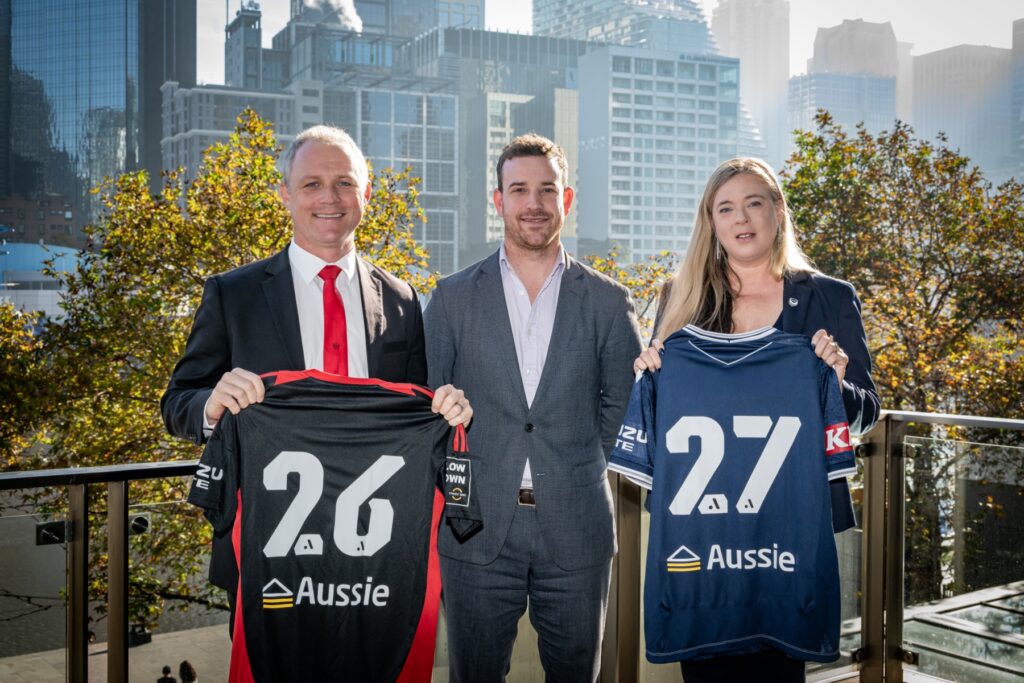
Aussie partners with two A-League clubs in cross-state alliance

Australia’s largest retail mortgage broker will team up with Melbourne Victory and Western Sydney Wanderers, representing Aussie’s commitment to supporting and connecting people through football.


Opposing teams, United partners

The alliance between Aussie, Melbourne Victory and Western Sydney Wanderers reflects a unique approach to investing in Australia’s football landscape.

It encompasses both communities and supporters across Melbourne and Sydney, with Aussie’s presence in both cities now firmly embedded into local, grassroots networks.

“We’re excited about this partnership because it represents much more than a traditional sponsorship,” explained Aussie National Manager, Strategic Partnerships, Ryan Ferguson via press release.

“It’s about connection, community, and being part of something that reaches people in a meaningful and authentic way.”

Both Melbourne Victory and Western Sydney Wanderers also commented on the unique nature of the partnership.

“The joint venture is a game-changer in how brands and sports teams can collaborate beyond the traditional instruments of a partnership and stands apart from the existing relationships in our sporting landscape for the betterment of our stakeholders,” said Melbourne Victory Managing Director, Caroline Carnegie.

“For the first time, two iconic clubs are coming together in a joint-venture sponsorship that delivers unmatched reach, community impact and business innovation,” added Western Sydney Wanderers CEO, Scott Hudson.


National stage, local commitment

As Australians grapple with soaring property prices and financial uncertainty, having access to a platform like Aussie is immensely valuable.

So now that Aussie will begins its venture alongside Melbourne Victory and Western Sydney Wanderers – two clubs with extensive fanbases – it now has the means to make real, local impact.

Two major cities. Two footballing identities. All aligned under the same vision for community reach, growth and innovation.

“Aussie is a national brand, but at our heart, we are built on local relationships,” continued Ferguson.

“Every day, our brokers are working with customers in their communities, helping them navigate the journey of finding, buying and owning their own home. That’s why this partnership feels like such a natural fit.”

Ultimately, while the alliance will build on the business and community networks of the two A-League outfits, the impact will extend far beyond the boundaries of the pitch.

Most Popular Topics

Editor Picks

Send this to a friend