
DFL outlines possible return of fans to Bundesliga

DFL Deutsche Fußball Liga, the governing body for the Bundesliga and Bundesliga 2, has released a guideline to assist clubs with the possible return of fans to matches.

The DFL said that the guideline provides a basic structure of what must be taken into account in the process for allowing crowds at matches once again.

Clubs must develop concepts about the prevention of infections, such as how they will calculate spectator capacity for their respective stadiums. These concepts must be approved by the local health authority of each club.

The DFL believes that major events may be allowed to occur from September 2020, with contract tracing and hygiene practices in place.

If there is more than 35 new cases of COVID-19 a week per 100,000 people in the local area of a club, spectators would not be allowed to attend. If there is less than five new cases, then clubs would be able to work with local health authorities to have fans attend the match.

The DFL is working on defining the conditions about whether fans could attend if the new cases range between five and 35.

“The outbreak of the COVID-19 pandemic in March 2020 has [affected] the global economy, social life and entire states,” the DFL Deutsche Fußball Liga said in the release.

“Even … with the resumption of gaming operations, media revenues are the most important source of income [that] could be secured, there is broad agreement that footballs lives strongly from the emotions and the spectators in the stadium and without a stadium audience appears very reduced.

“The Bundesliga, with an average of more than 42,000 sold tickets per game (season 2018/2019) [is] the world’s leading football league in terms of appreciation from the audience [and] owes its international recognition to the committed audience.”

The German Federal Ministry of Health said that in order for fans to be allowed to return, there must be systemic compliance to the highest standards of infection protection.

An Extraordinary Members Assembly will be held before the 2020-2021 season starts to discuss the details of whether crowds will be attending matches.

The Bundesliga restarted on May 16 without crowds in attendance.

Previous ArticleNext Article

Football Victoria and VicHealth partner on anti-racism program as community sport data reveals systemic problem

Football Victoria has partnered with the Victorian Health Promotion Foundation to roll out the Set The Standard initiative across the state’s football clubs, in a collaboration that signals a significant shift in how Australia’s most popular club-based sport is approaching racism and cultural exclusion at the grassroots level.

The partnership brings together the state’s peak football governing body and its primary health promotion agency around a shared finding that can no longer be treated as incidental. According to the 2025 report Enhancing the Capacity of Victorian Community Sport to Tackle Racism, 56 per cent of surveyed participants had experienced or witnessed racism in community sport. In a state where football draws participants from some of the most culturally diverse communities in the country, that figure represents a systemic failure the sport can no longer address through conduct policies alone.

Clubs that subscribe to the Set The Standard newsletter will be entered into a draw to win one of three $1,000 vouchers, available for equipment, facility improvements, events or other community initiatives. The incentive is designed to drive early engagement with a program whose ambitions extend well beyond a newsletter subscription.

What the Partnership Signals

Racism in sport has historically been treated as a conduct and governance issue, managed through complaints mechanisms that require incidents to be formally reported and tend to significantly undercount the actual prevalence of harm. VicHealth’s framing of racism as a public health problem repositions the entire conversation.

Experiences of racism are associated with measurable negative health outcomes including anxiety, depression and social withdrawal. When community sport, which governments and health agencies actively promote as a vehicle for physical and mental wellbeing, becomes a source of those same harms, the public health cost is direct and quantifiable.

Resources, not Rhetoric

For Football Victoria, the partnership brings something the governing body cannot provide on its own. VicHealth’s credibility, resources and public health framework give the initiative a foundation that a sporting organisation working alone would struggle to establish. Set The Standard offers clubs practical tools and guidance built around progress rather than perfection, which reflects a realistic understanding of how cultural change works inside volunteer-run community organisations.

The $1,000 vouchers are not a side note. Most community clubs operate on tight margins, depend on volunteer administrators and are already stretched managing growing participation demands. Finding room to invest in cultural development programs on top of everything else is difficult. Providing tangible resources directly addresses that constraint at the point where clubs are most likely to disengage.

The program also arrives at a consequential moment. Football in Victoria is absorbing significant participation growth following the AFC Women’s Asian Cup and sustained increases in junior registrations, bringing new communities into the game in large numbers. The 2025 data suggests the environments those communities are entering are not consistently safe or welcoming. Participation growth and cultural safety work need to move together. A sport that grows larger without becoming more inclusive has not actually improved the experience of the people playing it.

The Man Who Built a Women’s Football Program from Nothing is now an Award-Winning Gender Equity Leader

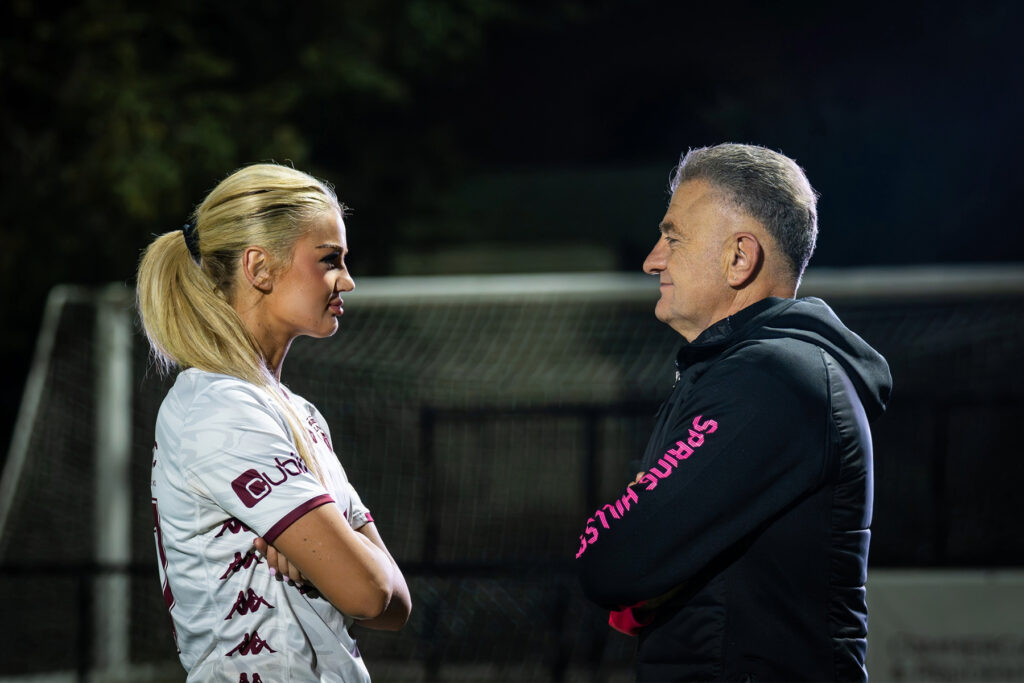
Eight years ago, Spring Hills Football Club did not have a girls’ team. Today it has one of the most recognised women’s programs in Melbourne’s west, a senior NPLW side, and a head coach who has just been named Gender Equity Leader of the Year at the Melton City Council Volunteer Achievement Awards.

Tom Markovski, Spring Hills’ NPLW Head Coach, received the award at a ceremony coinciding with National Volunteer Week, recognised for his community leadership, promotion of gender equality and commitment to advancing the status of women and people of all genders in sport. The recognition comes from outside the football community entirely, awarded by a local council celebrating volunteers across every sector of civic life in one of Melbourne’s fastest-growing regions.

Building from scratch

When Markovski arrived at Spring Hills, women’s football at the club did not exist. His first act was to champion the establishment of the club’s first all-girls team, a process that required persuading a club culture built around men’s football that the investment was worth making.

Women’s football in community clubs has historically struggled to access the same facilities, scheduling priority, coaching resources and institutional support as the men’s game. Clubs have been slow to invest in programs whose return is less immediately visible than a senior men’s premiership, and in a growing outer-suburban community like Melton, where volunteer capacity is finite and demand across every program is high, the case for building something new always has to compete with the urgency of maintaining what already exists.

Markovski made the case anyway, and kept making it across eight years of coaching senior and junior NPL teams while simultaneously building the structural foundations of a women’s program designed to outlast any individual’s involvement. The club’s first all-girls team became multiple junior girls teams. Those junior teams created the pipeline for a senior women’s side. The senior women’s side created visible pathways for younger players to see where the game could take them within their own club.

The outcome is a program that Spring Hills now holds up as central to its identity rather than supplementary to it. The club has become a leader in female participation in Melbourne’s west, and recently made history within the NPLW Victoria structure by fielding junior teams coached entirely by female coaches, a milestone that reflects the depth of the program Markovski helped build.

What the Award Recognises

The Melton City Council’s decision to name Markovski its Gender Equity Leader of the Year places his work in a frame that extends beyond football. Melton is one of the fastest-growing local government areas in Australia, a diverse and rapidly expanding community where the institutions that bring people together, like schools, councils, sporting clubs, carry an outsized responsibility for social cohesion.

Mayor Cr. Lara Carli, speaking at the awards ceremony, reflected on the role volunteers play in communities like Melton’s. “Volunteering creates friendships, strengthens communities and builds a sense of belonging,” she said. “It helps people feel connected, supported and valued, and those things are more important than ever in a growing and diverse community like ours.”

For the girls now playing football at Spring Hills who were not playing anywhere eight years ago, Markovski’s contribution is not abstract. It is the specific and concrete fact of having somewhere to play, someone to coach them, and a pathway that leads somewhere.

Most Popular Topics

Editor Picks

Send this to a friend