


From Sideline Frustration to Field Innovation: Interview with the team behind Alpha Skins

From Sideline Frustration to Field Innovation: Interview with the team behind Alpha Skins

Alpha Skins is a family-run brand founded by young soccer player Jax, who set out to solve a problem many kids face on the field—shin guards that slip, stink, and distract from the game.

Designed for “Sigma Kids” who live for every tackle, goal, and team huddle, Alpha Skins are comfy, all-in-one shin guards that don’t slip, can be tossed in the wash, and won’t leave your soccer bag smelling bad.

Inspired by Jax’s love for soccer and his desire to make the game better for kids like him, Alpha Skins helps players concentrate on playing their best—and makes life easier for parents.

Speaking to Soccerscene, Alpha Skins founders Alyce and her son Jax share how a simple idea sparked by Jax’s frustration with traditional shin guards quickly grew into a thriving family-run business.

What was the reason for creating Alpha Skins?

Alyce: The idea for Alpha Skins came to life at the beginning of 2025. It started as a simple observation — there was a clear gap in the market for comfortable, stylish, and innovative shin guards. Jax, a naturally creative and entrepreneurial young mind, was constantly thinking up new ideas and sketching designs. What began as a quick concept soon developed into a business that launched online in March. After rigorous quality control, product refinement, and sizing trials, Alpha Skins officially began.

We noticed how often children were adjusting their shin guards during training, trying to keep them in place. Another frustration was that Jax’s additional sock or sleeve for his shin pads would frequently go missing. Alpha Skins was created to simplify the process for families getting ready for training, reduce stress, and ultimately make the soccer experience smoother, and a little less noisy, for everyone involved.

Can you tell us a bit about how has the company evolved and progressed since its founding

Alyce: We really hit the ground running when we launched Alpha Skins online in March. What began as a small idea to fill a gap in the market has quickly evolved into a growing online brand, with Jax as the face of the company. We’re constantly developing new ideas and expanding our vision.

The concept stemmed from Jax’s own frustration with traditional shin guards, the hard plastic ones or those with Velcro straps that often shifted during training and matches. We set out to create a more comfortable, kid-friendly alternative that wouldn’t cause irritation or move out of place. As an added bonus, our shin guards are machine washable, making them even more convenient for busy families.

Were there any initial challenges you faced when creating Alpha Skins and if so how did you overcome them?

Alyce: In terms of setup and operations, we’ve been fortunate not to encounter any major challenges so far. Thanks to thorough quality control, product testing, and sizing adjustments early on, things have run quite smoothly.

The business has grown rapidly, and we’re grateful for the momentum it’s gained. Probably Jax’s confidence on the screen, on Instagram, that’s probably been his biggest challenge but it’s all going really well.

Is Alpha Skins involved in any partnerships or sponsorships with local soccer clubs and if not is that something you’re looking at doing?

Alyce: We’re aiming to officially launch our team-focused initiatives in time for the 2026 soccer season. With the business growing so quickly, we’re having to adapt and evolve our ideas at a rapid pace. Jax plays in the development squad at Palm Beach Soccer Club here on the Gold Coast, so they’ll be our first point of contact. From there, we hope to expand and connect with other local clubs in the region.

We’re also preparing to launch a new team order system on our website, allowing entire teams to place bulk orders efficiently. This next step will make it easier for clubs to access our products and help us build stronger partnerships within the local soccer community as we head into 2026.

What feedback have you received regarding the use and impact of the shin guards?

Alyce: Absolutely, Jax, what do you love most about them?

Jax: That they don’t annoy me when I wear them or play in them.

Alyce: Exactly, they don’t bother him, especially around the socks, which was a big issue with traditional shin guards. We’ve been thrilled to receive consistent five-star reviews from our online customers. The feedback has been overwhelmingly positive, with many parents sharing that their children genuinely enjoy wearing them.

The guards are comfortable, and one of the biggest wins for parents is that they’re machine washable, a simple but highly appreciated feature. Jax’s own soccer team has said they’re both comfortable and “cool,” and the name Alpha Skins definitely resonates with younger players. “Alpha” is a term that’s really popular with kids right now, and Jax came up with the name himself, it was something he really wanted to be part of.

They’re easy to put on, and our reviews highlight how much smoother the pre-training routine has become for families. Kids aren’t complaining during sessions, and parents love how hassle-free the whole experience is. The support through those five-star reviews has been incredible.

How is Alpha Skins currently tracking and what does the future hold for the company?

Alyce: We’re really excited about the future, what started as a small idea to support Jax’s journey in soccer has quickly evolved into something much bigger. We’ve already got new concepts in the pipeline, including a soccer-inspired apparel range, what do I always say to you?

Jax: Mum always says, “Do you really have to wear a soccer jersey to dinner?”

Alyce: [Laughs] Jax is constantly wearing his soccer jerseys, even to family dinners. So we’re working on creating stylish, soccer-inspired apparel that keeps the sporty vibe but is also versatile enough to wear out to a nice dinner. The goal is to design something that blends comfort, function, and style — without Messi or Ronaldo jerseys at the table!

Looking ahead, we’re also exploring other products like boot covers and accessories. The ideas are flowing, and we’re excited to keep growing and expanding what Alpha Skins has to offer.

Why should we buy Alpha Skins shin guards?

Alyce: What do you think, Jax? Why do your friends want to wear them? Why should people choose Alpha Skins?

Jax: Because they’re really comfy.

Alyce: That’s right,  comfort is key. We believe people should choose Alpha Skins because our products are designed with young players in mind. We’re a small, family-run business based on the Gold Coast, and everything we do is driven by a genuine passion for helping kids feel comfortable, confident, and excited about playing the sport they love.

Previous ArticleNext Article

Tasmania’s State Budget Commits $350,000 to Football Facility Planning as $80 million Home of Football Moves Closer to Reality

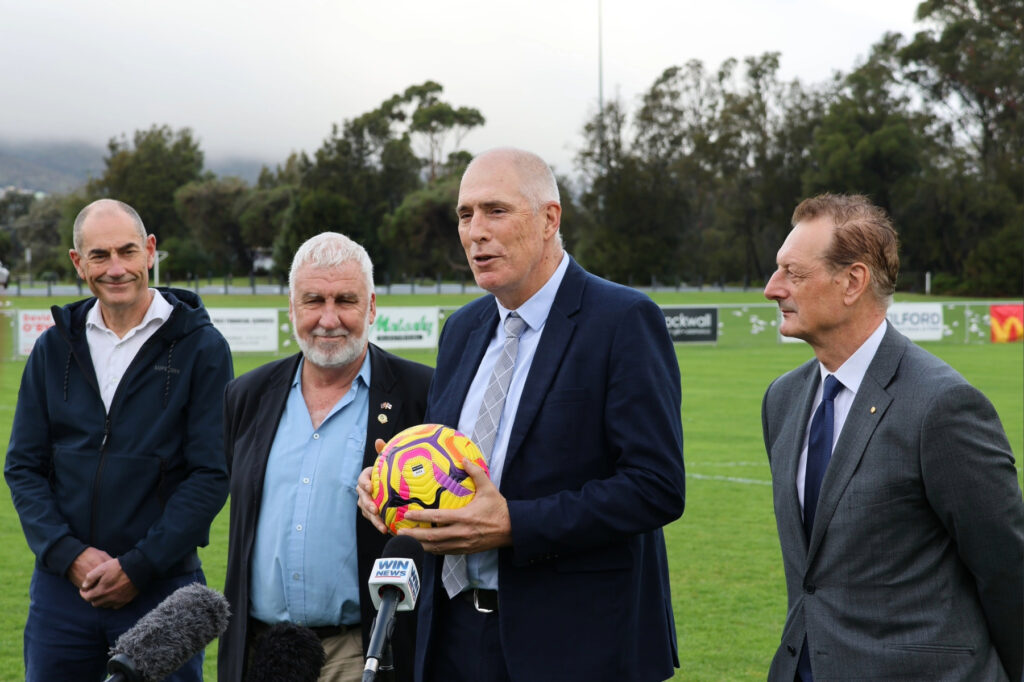
The Tasmanian State Government has committed $350,000 in seed funding for the next stage of planning for Football Tasmania‘s proposed Home of Football, moving the state’s most significant football infrastructure project closer to construction and signalling political recognition that demand for rectangular facilities in Tasmania has outgrown what currently exists.

The funding, confirmed in the 2026-27 State Budget handed down last week, sits within an almost $200 million investment in sport and recreation across the budget and forward estimates: a package the government describes as designed to improve access and participation for Tasmanians of all ages. The football allocation is listed alongside a $25 million community sporting infrastructure commitment at Kingborough, $12.5 million for new multipurpose indoor sporting courts at New Town Bay, and $8 million for the Domain Tennis Centre redevelopment.

Football Tasmania CEO Tony Pignata OAM welcomed the commitment as an acknowledgement of the structural gap between participation numbers and available infrastructure, particularly in the state’s south.

“The State Government’s delivery on this commitment shows us that they understand that demand outstrips supply for rectangular facilities in the state,” Pignata said. “If we are to continue to grow and develop future Matildas and Socceroos, we need to invest in the infrastructure our game so desperately needs.”

The proposed $80 million facility would include six full-sized pitches, three synthetic and three turf, alongside four five-a-side pitches, modern changerooms for both men and women, and dedicated training facilities. The design is intended to serve every level of the game simultaneously, from grassroots junior competitions through to national-level tournaments.

From grassroots to A-League ambitions

Football Tasmania has framed the facility’s purpose across a deliberately wide range of uses. At the community end, it would provide a permanent home for junior games and regional tournaments that currently compete for limited rectangular ground availability across the state. At the elite end, it would create the capacity to host national competitions including the Emerging Matildas and Emerging Socceroos Championships, flagship state competitions such as the Statewide Cup finals, and potentially, in time, an A-League team.

That last ambition is the most significant and the most distant. Pignata was measured but direct in raising it, situating a Tasmanian A-League club alongside the NBL’s Jackjumpers, the WNBL’s Jewels and the AFL’s Devils as part of the state’s emerging identity as a home for national sporting competition.

“One day down the track, we anticipate this would become home to our very own A-League team, so that we take our rightful place in the nation’s elite competition,” he said.

The pathway from planning funding to A-League admission is long and would require sustained political and commercial support well beyond the current commitment. But the logic is consistent with how football infrastructure investment has worked elsewhere in Australia. The facility comes first, and the competitive pathway follows. Without a purpose-built ground that meets the standards required for elite competition, the conversation about an A-League team cannot begin in earnest.

The equity dimension

The inclusion of modern women’s and men’s changerooms in the facility’s design carries more weight than it might appear. Community and semi-professional football facilities across Australia have historically been built to male standards, with women’s changerooms added as afterthoughts or not included at all. That inadequacy has been consistently identified as a barrier to female participation and to the hosting of women’s competitions at venues that cannot accommodate them properly.

A purpose-built facility that treats women’s infrastructure as a design requirement rather than a retrofit positions the Home of Football to serve the growth of women’s football in Tasmania in a way that existing facilities cannot. The state recorded 41,395 registered football participants in 2025, a number that has been growing and that the current rectangular facility stock was not built to support at this scale.

Additionally, the government’s Ticket to Play program, which provides eligible children with two vouchers worth up to $100 each for sporting participation, and the Ticket to Wellbeing program offering $100 vouchers to eligible seniors, represent indirect but meaningful support for football participation across the state’s communities.

Pignata also acknowledged outgoing Football Tasmania President Bob Gordon, who he said had dedicated almost a decade to the organisation and had been instrumental in lobbying for this and other facilities across the state.

The $350,000 planning commitment is a beginning. The $80 million facility it is intended to progress remains subject to further government investment and development approval.

FCA to Host Exclusive Two-Part Goalscoring Workshop Series with Dr Ron Smith

One of Australian football’s most respected coaching minds shares decades of research ahead of the FIFA Men’s World Cup.

Football Coaches Australia (FCA) has announced an exclusive two-part coach education series featuring renowned coach educator and football analyst Dr Ron Smith, offering coaches a rare opportunity to explore the evolving science of goalscoring through the lens of one of Australia’s most influential football thinkers.

The online workshops, scheduled for June 1 and June 8, will examine the historical development, modern trends and future direction of goalscoring in football, drawing on extensive research that formed the foundation of Dr Smith’s doctoral studies.

For FCA, the sessions represent the culmination of more than a year of planning and provide a timely opportunity for coaches to deepen their understanding of attacking play ahead of the FIFA Men’s World Cup.

“Ron’s work on goalscoring has been years in the making and continues to evolve,” FCA President Ian Greener said.

“We felt there was no better time to bring this knowledge to the coaching community than in the lead-up to the World Cup, when coaches around the world will be analysing the game’s best teams and players.”

Across the two sessions, Dr Smith will present findings from his extensive research into goalscoring patterns and trends, examining how the game has changed over time and what coaches can learn from football’s biggest tournaments.

Topics covered throughout the series will include:

  • Historical analysis of goalscoring trends
  • How goalscoring has evolved in the modern game
  • Key patterns identified through Dr Smith’s research
  • Scoring trends across the last six FIFA Men’s World Cups
  • Comparisons between men’s and women’s World Cup tournaments
  • The role of pressing, transition moments and direct play in creating goals
  • Practical coaching implications for improving attacking performance

The two-part structure has been intentionally designed to build upon itself. Session One will focus on the evidence, data and research underpinning Dr Smith’s findings, while Session Two will explore the practical applications and coaching interventions that can emerge from that analysis.

Football Australia has accredited both workshops with one Continuing Professional Development (CPD) hour each, allowing coaches to earn two CPD hours by attending both sessions.

Dr Smith’s coaching and coach education credentials span decades. He has worked extensively with Football Australia, the Australian Institute of Sport and the Socceroos, while also holding coaching roles internationally in Iceland and Malaysia, as well as within the A-League.

His contributions to coach development have helped shape generations of Australian coaches, making this series a valuable opportunity for coaches across all levels of the game.

Event Details

History and Future of Goalscoring – Session One
Date: Monday, June 1, 2026
Time: 7:30pm AEST
Format: Online
CPD: 1 Football Australia-accredited CPD hour

Following the completion of the FIFA Men’s World Cup, FCA is also planning a special panel discussion featuring leading Australian and international coaching voices to analyse the key tactical developments, trends and lessons emerging from the tournament.

Further details regarding that event are expected to be released later this year.

FCA members can attend the workshops free of charge, while guest registrations are available through Eventbrite.

Most Popular Topics

Editor Picks

Send this to a friend