


APIA Leichhardt FC: 70 years on & still counting

On 18th April, APIA Leichhardt FC – one of the most successful football clubs in Australia – will be celebrating its 70th year with a glamorous gala event at La Montage Function Centre.

The names of the former players who wore the maroon and sky blue colours of the club just roll off the tongue – including Stan Ackerley, Leo Baumgartner, Col Bennett, Arno Bertogna, Archie Blue, George Blues, Fillipo Bottalico, Mark Brown, Rod Brown, Alex Bundalo, Terry Butler, Ricard Campana, Ernie Campbell, Paul Carter, John Doyle, Stan Foster, Johnny Giacometti, Sebastian Giampolo, Joey Gibbs, Terry Greedy, Pat Hughes, Audauto Iglesias, Karl Jaros, Peter Katholos, George Keith, Billy Kerklaan, Lawrie McKinna, Danny McKinnon, Graham McKinnon, David McQuire, Ross Maiorana, Brad Maloney, Jean-Paul de Marigny, Joe Marston, Bruce Morrow, Tony Morsello, David Muir, George Nuttall, Phil O’Connor, Peter Ollerton, Franco Parisi, Tony Pezzano, Mark Pullen, Nick Rizzo, John Roberts, Billy Rogers, Jim Rooney, Bill Rorke, John Russell, Jim Sambrook, Marshall Soper, Darren Stewart, Brian Taylor, Cliff Van Blerk, Jason Van Blerk, Walter Valeri, Willie Wallace, John Watkiss,  Vernon Wentzel, Peter Wilson, Johnny Wong and Charlie Yankos.

The significance of this milestone is not lost on long serving President, Tony Raciti, who has been associated with the club since 1977 and is leading the charge for  APIA’s participation in the National Second Tier Competition commencing in March, 2025.

Although there is a lot of work to be done before next March, Raciti goes about his work with his usual determination to ensure the club is fully prepared for the task ahead.

In this interview with Roger Sleeman, Tony Raciti discusses the significance of APIA’s longevity in Australian football, the state of play for the Club’s National Second Tier effort and conveys his thoughts about all things football in Australia.


ROGER SLEEMAN

On the 70th anniversary of the club, what feelings are evoked?

TONY RACITI

The club has shown incredible stability in this time and we’re on target to enjoy another 70 years of prosperity.

The function on 18th April will be recognition of the club’s achievements over the 70 years and the large assembly of former and current players, supporters and sponsors will be a testimony to the continuing success and ambition of the club, particularly with the start of the National Second Tier.

R.S.

Is the original reason for the club’s formation still relevant today?

T.R.

It was originally formed as a sporting social club but obviously football was centre stage.

Today, the social aspect is not so evident as we’re a football club first and foremost providing a focus for the sport in the inner west for thousands of people, including players and supporters.

It’s now a firm fabric in local society.

Although the club has a strong Italian heritage, especially dating back to the 50’s and 60’s, there was also a strong Scottish and English influence which is still prevalent today.

Interestingly, if you examine the data base of registered players at the club, there are roughly 75% of Anglo Saxon and others of non Italian background which confirms we’ve fully integrated into the local community.

R.S.

You’ve been with the club since 1977.

What changes have you seen in this period?

T.R.

The fact we were incurring substantial losses in previous years, despite always meeting our debt, was not ideal. However, we are no longer incurring annual losses but breaking even or making small surpluses.

Lambert Park had never been subsidized by the local council until 2014 when the club was granted a $2.4 million government grant to upgrade the facility, the clubrooms and playing surface.

The club currently has an asset register which exceeds $6 million dollars and fortunately the local council is to provide funds to upgrade our synthetic surface and drainage. They will contribute $1.8 million dollars with the club funding  $500,000.

Fortunately, we’ll be playing at Leichhardt Oval next year in the N.S.T. and we have seven other grounds available in the area as registrations are growing rapidly.

To  meet the demand, we’re hiring school grounds for training  , including Concord High School four nights a week which has been funded by  the junior and women’s section of the club  who have banded together to raise $45,000 for lighting at the school.

R.S

Does Football NSW do enough to support your club and NPL Clubs in general?

T.R.

Unfortunately, the landscape has changed in the last decade or two and the makeup of the board requires more people with a football background.

Currently, there are a number who don’t have the knowledge of football history and club operations.

Nevertheless, Football NSW are a governing body with a strong management structure in a game which is bursting at the seams in N.S.W.

R.S.

Can the National Second Tier be a natural progression from the NPL?

T.R.

Absolutely.

It will support and underpin the A-League and provide advancement for clubs who want to grow further on a national stage.

In recent years, there’s been a deterioration in criteria observed for the NPL so the NST will provide an opportunity for clubs with ambition to achieve a higher position in the game and to evolve further in a much stronger competition with better training and playing facilities.

R.S.

Can the clubs raise sufficient capital to fund their place in the N.S.T.?

T.R.

I’ve been personally impressed with the clubs involved in the process and have no doubt the clubs will be financially stable, particularly with their fund raising activities.

From an APIA standpoint, we’ll be the first sporting club in Australia to be owned by the community via public shareholding.

This process hasn’t been launched yet because we haven’t finalised our prospectus which has to be approved by ASIC.

Initially, we are limited by law to twenty shareholders who have committed $500,000 so we can submit our bank guarantee to the F.A. to play in the N.S.T.

Beyond the approval of the prospectus, we’re confident we can increase our shareholding to 1000 by the end of 2024.

We also have strong corporate sponsorship to the tune of $800,000 per annum and with the move to Leichhardt Oval next year, the 2,500 under cover seats will be sold by end of January, 2025 which will give the club an injection of $1,000,000, adding to other revenue streams.

R.S.

Are all your supporters and sponsors fully behind the N.S.T. ?

T.R.

Very much so and they see the club is well managed with a strong board.

For the past decade, the club has been a powerhouse in first grade as well as juniors, SAP, women’s and girls.

Currently, there are twelve other clubs knocking on the door to be included beyond the initial eight accepted, so this speaks volumes for the interest in the N.S.T.

Obviously, only four of those clubs will be accepted in  the 2025 competition because there can’t be a 20-team League in the first season.

The FA  have been totally co-operative as a governing body which will guarantee the League has direction, stability, and good management, providing better marketing opportunities for the clubs, especially blanket television broadcasting.

Regrettably, in the initial stages there will be no money for the N.S.T. flowing from the broadcast deal.

R.S.

In view of the troubled A-League, will the football public warm to the NST?

T.R.

I believe they will and when promotion and relegation is introduced both Leagues will boom.

With the cost of licences in the A-League, it was premature to introduce promotion and relegation immediately.

Critically, there will be a higher level of competition on view in the NST.

R.S.

Can the A-League overcome its current problems to ensure there is no delay in the start of the NST?

T.R.

The NST will definitely commence next year.

It should be remembered there are thriving clubs like Sydney FC, Wanderers and Melbourne Victory and the remainder are working hard to improve their lot.

I wish I had $15 million to purchase Newcastle Jets because it’s a strong football area.

The purchase of Perth Glory by the Pellegra Group is also a perfect example of the willingness of substantial investors to support the game.

R.S.

Currently NPL playing times vary greatly.

Do you expect there will be uniformity in the NST whereby all games start at 3pm on the weekend?

T.R.

There is only one time to play these matches which should be at 3 or 3.30 pm on a Sunday afternoon.

You’re looking for trouble playing outside these times when you’re playing in winter so APIA will be abiding by these times.

Previous ArticleNext Article

New ‘Unfiltered’ Episode with Paul Klisaris and Oscar Yildiz

The ‘Unfiltered’ podcast by Soccerscene promises honest, thought-provoking conversations about football culture, identity and the stories fans don’t usually hear in mainstream coverage.

In the latest episode, Mihaila Kilibarda sits down with passionate councillors Paul Klisaris and Oscar Yildiz to debate the role of policy in shaping infrastructure, career opportunities and on-field success in the Australian football landscape.

From exposing flaws in policy making, to critiquing the A-League, Paul and Oscar discuss the future trajectory of football in Australia. With strong views on the disconnect between decision-makers and grassroots communities, this is an unfiltered look at the issues holding the sport back—and the urgent need for change.

“Bring back Preston, bring back South Melbourne, bring back that culture into the game. There was nothing wrong with that. Bring it back. Regulate it better, police it better, like they have in Europe. There is rivalry and that’s healthy!” says Paul Klisaris in this episode.

Oscar Yildiz agreed that “We might need to throw a bomb. There is no incentive for clubs to aspire to. You know, you can finish last and still stay in the league. They need to have people from state, from federal, people, again, who know the game, who genuinely know the game. And, it means understanding the politics around the game.”

Listeners can expect Unfiltered to go beyond match reports and transfers. Each episode will dive into the ideas, people and cultural forces that make football one of the world’s most compelling sports. Episode 2 is available now, hoping to challenge, entertain and inspire.

Listen now on Spotify: 

With Unfiltered, Soccerscene is giving fans a space to think, feel and debate about the game they love. Further, it is encouraging conversations that are as engaging as the football itself.

Stay tuned for future episodes, featuring more voices shaping the beautiful game.

Beyond the Pitch: Miyuki Kobayashi on the Real Challenges Facing Japan’s Women’s Game

Last week, Soccerscene spoke to pioneer of women’s football in Japan, Miyuki Kobayashi, about the game’s development in Japan and the intersection between sporting and social change in the country.


Talent, quality and recent silverware

After Japan’s recent AFC Women’s Asian Cup victory in the final against Australia, the women’s national team solidified its standing as the No.1 team in Asia.

Throughout the last 15 years, Japan’s women’s national team has grown into a formidable opponent, boasting a World Cup trophy, an Olympic silver medal, as well as three AFC Women’s Asian Cups.

The talent is undeniable. The quality is unwavering. And the team shows no signs of slowing down.

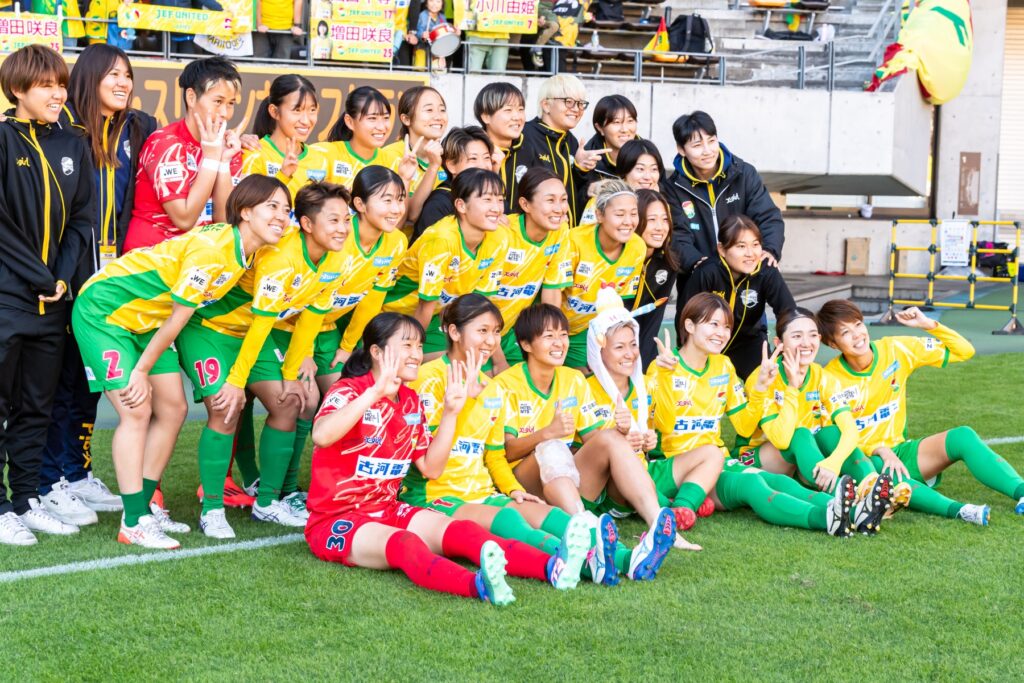
But these victories and trophies on the world stage wouldn’t be possible without the leaders behind the scenes – none more so than Miyuki Kobayashi, former WE League Board Member and current JEF United Ladies Scout and Academy Chief.


Laying the foundations

Kobayashi has led the charge for women’s football in Japan, promoting not only a sport which values success, but one which empowers female footballers across the nation.

“At university, not many girls were playing and we didn’t have an official team. I went to the US and the environment was so different,” Kobayashi explained.

“That opened my eyes – women can play. That’s how I started the women’s soccer league when I came back: to make an environment for girls to play.”

Thus, accessibility and opportunity became driving factors behind Kobayashi’s work, not only for those on the pitch, but for those in the dugout.

“I got involved at the JFA (Japanese Football Association) to promote women’s football. We wanted to create the opportunity for women to be coaches.”

“They are coached by men all the time, so even when the top players leave the football world, they never think to be involved.”

Furthermore, as a former coach of JEF United Ladies Youth and General Manager, Kobayashi was intent on employing as many female coaches as possible. It was not merely a personnel change, but a challenge to widespread social attitudes.

“When I started to employ female coaches, the girls’ parents asked why the coach wasn’t a man. But gradually, we started to make it equal – they didn’t talk about the gender, but about the quality of the coach.”


The mission to empower

In 2011, the same year Japan’s women won the World Cup, the domestic league was yet to become professional. Known as the Nadeshiko League, players would work during the day and train in the evenings.

The transition from an amateur to the current professional league required time, resilience and a change in perspective.

“The sports world in Japan is more traditional – it is dominated by men,” said Kobayashi.

“If you want to make the environment even, or (want) more women to come into the (football) world, you can change the mind of the players.”

Since 2021, the WE League has embodied a sense of growth and positive change for the women’s game. In name and nature, it looks to empower players, coaches and all involved in the industry.

“I was in charge of mission achievement for women’s empowerment. We wanted to educate the players, to inspire girls and women who watch the game.”

However, the drive to empower women in football was not without backlash and challenges.

“Some people don’t like that word: ’empowerment’. It’s too strong for them. Some women really appreciate it, but it’s not easy to change the mind of society through football,” Kobayashi admitted.


Growing and attracting talent

Although WE League clubs are accelerating youth development and expanding pathways across U15, U18 and first team football, Kobayashi acknowledged that the overall product must improve to bring foreign players to Japan and entice homegrown talent to stay.

“Most of the national team players go to Europe or North America. I don’t say it’s a problem, but from a young age, girls who can play in the WE League want to go abroad,” Kobayashi outlined.

Indeed, when looking at the starting XI in last month’s AFC Women’s Asian Cup final, only one player – Hana Takahashi – plays in the WE League.

But the key to attracting domestic and international players to the WE League, is aligning financial investment and industry attitudes.

“The reason why women’s football has developed in European countries is the social thinking – you have to be equal and have the same opportunities as men in football. The Japanese way of thinking, especially in the football world, is not that at all,” Kobayashi continued.

“When I speak to people at Spanish clubs, women’s football is not a charity, but an investment.”

“We have assets. We have good, young players, but we’re exporting them, so we need to import too.”

Indeed, Spain is a perfect example of what can happen when investment becomes intentional, not optional. Back-to-back UEFA Women’s Nations League titles, 90% television viewership increase since 2016, and record-breaking crowd numbers reflect what can happen when the industry aligns in vision and commitment.

Japan has the players to compete against any nation in the world. Purposeful investment, combined with its overall quality of players and style, could transform the WE League into a true, global powerhouse.


The vision for the future

Moving forward, Kobayashi hopes that girls progressing through JEF United’s academies develop confidence and resilience, whether as players or people.

“We want to make the girls – even if they aren’t in JEF United – continue playing football and continue to be leaders,” Kobayashi said.

“Some of them have a dream to be a coach or a leader off the field too, so that’s one of the attributes we want to develop.”

This resilience, reflected by the club’s ‘never give up’ philosophy, is testament to the vision of empowerment championed by Kobayashi across the women’s game.

Even in the face of social obstacles and a lack of financial investment, perseverance and hard work is at the bedrock of women’s football in Japan. It is not just that these values exist, but that they are consistently manifested on and off the pitch, which can show future generations that football is a sport for all – men and women alike.


Final thoughts

There is no limit to what the WE League and the national team can achieve if given the resources it deserves. All the ingredients are there: individual quality, a distinct playing style, football philosophy and ambitions to grow.

By following the example of industry leaders like Kobayashi, women’s football in Japan can hopefully continue to make waves of impact – in the sporting landscape and society as a whole.

Most Popular Topics

Editor Picks

Send this to a friend