


Waverley City Soccer Club boosted by significant funding from the Victorian Government  

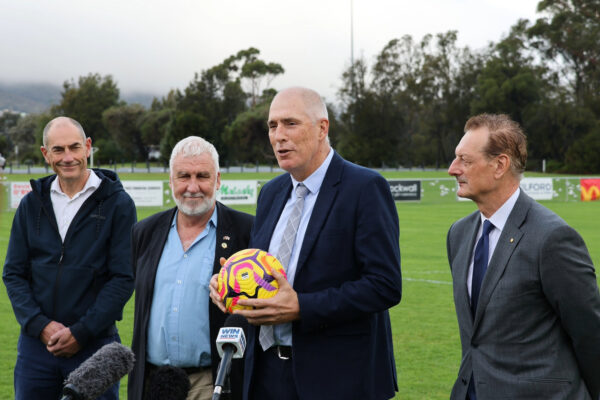
Waverley City Soccer Club have received a $125,000 funding boost in the form of new and improved competition grade lighting, through the Victorian Government’s World Game Facilities Fund.

The installation of the state-of-the-art LED lighting at the club’s home ground at Milpera Reserve in Wantirna coincides with recent upgrades currently in progress at the facility, which includes the implementation of a new playing surface, irrigation system, fencing and goals.

Club president Kevin Tan explained to Soccerscene that the range of upgrades are extremely beneficial for the club.

“For us specifically, it’s fantastic that we now have the ability to train and play night games sporadically in the same location,” he said.

“Before this, we had to move our training sessions to a different ground and play games here.

“Being able to train at the ground you play may seem like a small thing but for us it saves us so much money. There are also other benefits such as having the juniors and seniors training together, so the juniors and seniors now see each other and interact – which is great for building a culture in the club.”

The club was formed in 2007 on the back of a group of mates who were looking to play games of football together on the weekends.

Since then, the club has expanded significantly with 172 members, fielding four senior men’s teams, two senior women’s teams and six junior teams.

The local community have played a huge role in the progress of the club and according to Tan, the new upgrades are for all to enjoy.

“In regards to our affiliation with the area, we want be more visible in the community; we can hold events and things like that to get to know our neighbours a bit more,” he said.

“The wider community can obviously use it, importantly it’s for them as well.

“Some of the early feedback we’ve received from members around the community is that they love the ability to walk around Milpera at night now.

“Previously there was no lights at all, so if they want to go for a walk at night in the area while we train, they can, and have, which is really good.”

Lisa Cooper, Mayor and Councillor of Knox City Council, spoke about the funding for the lighting upgrades: “There are so many new teams, and every team needs a suitable space to train and play. The Victorian Government’s World Game Facilities Fund is helping us keep up with growth in the sport locally.

“Training and match standard lighting enables more teams to train and play in the evening but it can be expensive, and the grants are helping us complete the upgrades more quickly than Council could find the budget for on our own.

“The LED lighting is energy-efficient and focuses the light on the pitch so it doesn’t spill into surrounding backyards,” Cooper concluded.

The funding boost has also been complemented by goodwill agreements with the local council, who have cancelled ground hire costs for Waverley City Soccer Club this season.

“Our council has been good with us; they’ve waived fees this season for ground fees,” Tan said.

“We’ve obviously had some financial struggles in the last year with Covid like a lot of clubs, so being able to save money while you can, is amazing for us.

“It is something that has allowed us to stabilise the club.”

In the near future, further upgrades are set for Milpera Reserve, including the introduction of portable change-rooms which will give the club the scope to eventually expand the number of boys’ and girls’ teams.

“It’s part of a 3-year plan which had been previously confirmed, but COVID has messed up the timeline a bit,” Tan said.

“Previously we had a really good chat with our former councillor Jackson Taylor and he was really big on improving our area’s sporting clubs (he eventually became a member of parliament for Bayswater) and really helped a lot with getting our grants sorted for us.

“The lights were meant to be done in the last year, but nothing really got done in 2020 because of the pandemic. I’m now not actually sure of what the rest of the timeline is, but I do believe they (portable change-rooms) are guaranteed for some time in the future, which is definitely exciting for us.”


Previous ArticleNext Article

Football NSW Expands Flexible Football Program as Women’s Participation Surges

Football NSW has expanded its Flexible Football Initiatives program into six additional associations in 2026, building on a successful pilot year that demonstrated measurable demand for shorter, more accessible formats among women and girls across the state.

The program, a key pillar of the NSW Football Legacy Program funded by the NSW Office of Sport, offers casual tournaments and abbreviated competitions designed to fit around the schedules of women who may not be able to commit to the structure of a traditional 90-minute outdoor winter season. The participation data supports the premise: women currently make up 33 percent of summer football participants compared to 26 percent in outdoor winter football, representing a gap that points directly to the role format flexibility plays in driving female engagement with the game.

First piloted in 2025 in partnership with Football Canterbury, Northern Suburbs Football Association, Macarthur Football Association and Hills Football, the program has now expanded to ten associations across NSW following strong results in its inaugural year.

“Flexible Football gives women more ways to get involved, whether through shorter games or casual competitions,” said Football NSW Female Football Coordinator Emma Griffin. “It’s about making football easier to access and helping more women enjoy playing.”

The structural logic is straightforward. Barriers to participation in women’s sport are rarely about interest, but rather are about time, cost, geography and the degree to which formal competition structures accommodate the realities of women’s lives. A program that removes the requirement to commit to a full winter season lowers the threshold at the point where many women disengage.

The initiative sits within a broader national picture of sustained growth in women’s football, with participation numbers at record levels following the 2023 FIFA Women’s World Cup and the 2026 AFC Women’s Asian Cup currently underway in Australia.

Northern NSW Football Calls in SAPA as Participation Surge Sparks Big Plans

Northern NSW Football has commissioned Sports Advisory Partners Australia to lead the development of its 2027 to 2029 Strategic Plan, a process that will shape the direction of one of Australia’s most significant regional football markets at a moment when the game nationally is navigating unprecedented growth and structural complexity.

The engagement, announced this week, will see SAPA conduct extensive consultation across NNSWF’s registered participants, member zones, standing committees, board of directors and executive leadership before delivering a final plan scheduled for release in September. The firm brings to the project a track record that spans Football Australia, the A-Leagues, AFL, Rugby Australia, Golf Australia and the Oceania Football Confederation.

NNSWF CEO Peter Haynes said the organisation intended to be deliberate and ambitious about what the next plan would ask of the sport in the region.

“This plan will do more than that,” Haynes said. “It will play a critical role in shaping the future of football in our region. We are going to be bold, ambitious and take this opportunity to really push our sport forward to reach its potential.”


Building on a period of significant growth

NNSWF’s current 2024 to 2026 Strategic Plan has already delivered measurable outcomes across participation, competition strength and community engagement, and has done so against a national backdrop that has made the job of growing football both easier and more demanding simultaneously.

The 2023 FIFA Women’s World Cup and the recent AFC Women’s Asian Cup in Australia have driven participation surges that are being felt at the regional level as acutely as anywhere. Northern NSW, which covers a vast and diverse geographic footprint from the Hunter Valley to the Queensland border, has seen women’s and girls’ football registrations climb sharply, reflecting a trend Haynes flagged publicly during Football Australia’s recent push for a $343 million NSW grassroots infrastructure fund, in which he noted that participation across the region was at record levels and still rising.

That growth creates a specific strategic challenge. Momentum is relatively easy to generate in the wake of a major tournament. Sustaining it across a three-year planning horizon, through the inevitable post-event cooling of public attention, against ongoing pressure on club volunteers and community facilities, and in competition with other codes for government funding and ground access, requires a more deliberately constructed framework than goodwill alone can provide.

The 2027 to 2029 plan will need to answer questions that the current plan did not have to confront at the same scale: how to absorb participation growth without degrading the quality of the experience for existing players, how to build the referee and coaching pipelines that expanding competitions demand, and how to make the case for infrastructure investment in regional communities where football’s political leverage is real but not unlimited.


The Regional Dimension

Regional football in Australia occupies a structurally distinct position within the national game. It sits outside the metropolitan NPL systems that tend to attract most of the administrative attention and commercial investment, and serves communities where football is often the largest club-based sport and where the absence of adequate pathways has historically meant talented players relocating or disengaging entirely.

NNSWF’s decision to invest in a professionally developed strategic plan, rather than producing one internally, signals an awareness that the next phase of growth requires external rigour and benchmarking against what is working elsewhere. SAPA’s familiarity with the organisation, cited by Haynes as a factor in the appointment, also suggests a desire for continuity of thinking rather than a wholesale strategic reset.

SAPA Executive Director Sam Chadwick said the firm was focused on producing something actionable rather than aspirational.

“Our goal is to deliver a clear and actionable strategy that will guide continued growth and long-term success for the game,” Chadwick said. “Northern NSW Football has built a strong platform through its 2024 to 2026 Strategic Plan and we are delighted to support the next phase of its journey.”

Community at its Centre

NNSWF Chairman Mike Parsons emphasised that the process would be driven by community voice rather than imposed from above, a commitment that carries practical as well as symbolic weight in a region where the diversity of football communities, from coastal clubs to inland associations, means that a single strategic framework must accommodate significantly different local realities.

“This will be a strategy for the entire football community and it is vital that we hear from as many voices as possible,” Parsons said. “Through genuine consultation and collaboration we will ensure the next strategic plan reflects the needs and aspirations of our community while positioning our game for continued success.”

Consultation opportunities will roll out across the coming months. The 2027 to 2029 Strategic Plan is scheduled for release in September.

Most Popular Topics

Editor Picks

Send this to a friend